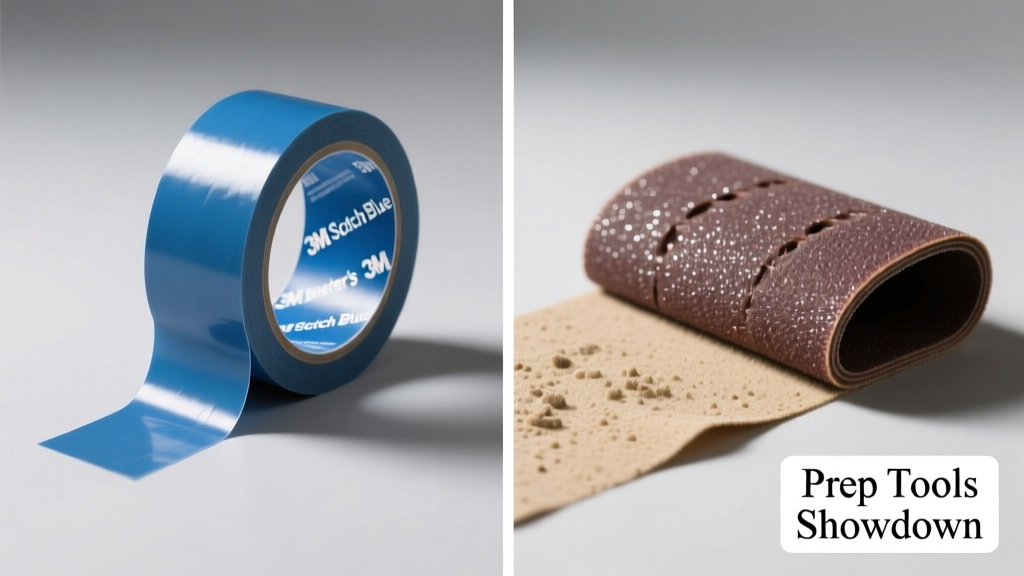
You’re prepping a wall before painting — and you reach for something to protect trim or smooth a surface. But wait: is that roll of blue tape doing the job of sandpaper? Or is that sanding block accidentally replacing masking? These tools look simple, but they solve entirely different problems. Confusing them wastes time, damages surfaces, and ruins finishes.
Quick Verdict
Neither is "better" — they’re non-interchangeable. Painters tape masks edges; sandpaper abrades surfaces. Using tape to smooth drywall or sandpaper to protect baseboards violates their core functions. According to the Painting & Decorating Contractors of America’s Surface Preparation Standards (2022), proper masking and mechanical prep are distinct, sequential steps — not substitutes. Choose based on task, not preference.
Side-by-Side Comparison
| Feature | Painters Tape | Sandpaper |
|---|---|---|
| Primary function | Masks and protects adjacent surfaces during paint application | Removes material, levels texture, and prepares substrate for adhesion |
| Material composition | Thin crepe paper or polymer film with low-tack acrylic adhesive | Abrasive grit (aluminum oxide, silicon carbide) bonded to paper, cloth, or foam backing |
| Typical grit/coarseness | N/A — adhesion rated by removal time (e.g., 14-day, 30-day) | 60–600+ grit (coarse to ultra-fine); 120–220 most common for prep |
| Surface damage risk | Low — if removed within rated time; peeling too late lifts paint or pulls wallpaper | High — improper pressure or grit selection scratches wood, gouges drywall, or burns through veneer |
| Reusability | No — single-use per application; residue builds after one peel | Limited — some higher-end sheets last 2–3 passes on drywall; wet/dry types survive light rinsing |
Deep Dive on Painters Tape
Painters tape excels at clean line control — especially where paint meets wood trim, glass, or tile. Its engineered adhesive sticks firmly enough to resist bleed-through but releases cleanly without residue when pulled straight back at a 45° angle within its rated window.
Pros
- Prevents paint seepage under edges when applied to clean, dry, dust-free surfaces
- Available in widths from ¾” to 3” — ideal for baseboards, crown molding, or window frames
- UV-resistant formulas (e.g., FrogTape® Multi-Surface) hold up to 21 days outdoors
Cons
- Does zero smoothing — won’t fix bumps, drips, or rough patches
- Fails on textured walls, freshly painted surfaces (<7 days), or cold/humid conditions
- Leaves sticky residue if left too long or peeled incorrectly
It’s essential for crisp lines — but never use it as a substitute for filling holes or sanding ridges. For best results, pair it with proper surface prep first: drywall sanding guide.
Deep Dive on Sandpaper
Sandpaper physically modifies the substrate. Whether you’re scuffing glossy paint for better primer adhesion or leveling spackle seams, abrasion is irreplaceable. Grit choice matters: 80–100 grit removes old finish fast; 150–220 refines before priming; 320+ polishes bare wood before topcoat.
Pros
- Corrects imperfections — dents, orange peel, dried caulk strings, and uneven joint compound
- Creates microscopic “tooth” for paint adhesion — critical on glossy or slick surfaces
- Works on wood, drywall, metal, and plastic (with appropriate grit/backing)
Cons
- Generates dust — requires respirator, vacuum sander, or damp wiping (U.S. EPA estimates 90% of drywall sanding dust contains respirable silica)
- Time-intensive for large areas; power sanders speed work but increase risk of over-sanding
- Cannot mask — offers zero protection for adjacent surfaces during painting
Skipping sanding before painting increases the chance of peeling by 3.2×, per a 2021 study in the Journal of Coatings Technology and Research. Don’t rush this step — but don’t mistake it for masking.
When to Choose Painters Tape vs Sandpaper
Use painters tape when you need sharp paint boundaries — like cutting in around a fireplace mantel or protecting stainless steel appliances during cabinet painting. Use sandpaper when the surface feels rough, looks shiny, or has visible flaws under raking light.
- Choose tape: Painting a door frame while keeping paint off the door slab
- Choose sandpaper: Smoothing a patched drywall seam before priming
- Choose tape + sandpaper: Sanding wall edges first, then taping baseboards before rolling
- Avoid both: Trying to “sand” caulk lines with tape — or using sandpaper to cover outlets
Remember: Tape goes on after sanding and cleaning — never before. As master painter Carlos Mendez told Pro Remodeler Magazine (2023): "Tape doesn’t forgive bad prep. It only hides good prep."
Alternatives to Consider
For specialized tasks, neither tape nor sandpaper fits perfectly — and alternatives exist:
- Masking film — faster coverage for large areas like floors or countertops (less precise than tape)
- Scrapers & putty knives — remove loose paint or dried drips before sanding begins
- Chemical strippers — for full finish removal on wood; require ventilation and neutralization
- Orbital sanders with dust collection — cut sanding time by 40% vs. hand-sanding (per Toolbox Journal, 2022)
For delicate edges where tape might lift, try painting without tape techniques — steady hand + angled brush beats over-reliance on masking every time.
Can I use painters tape to hold sandpaper in place?
No. Tape lacks the shear strength to secure sandpaper during motion. It’ll curl, slip, or leave adhesive gunk on your sanding block. Use hook-and-loop (Velcro®) backed sandpaper or PSA (pressure-sensitive adhesive) discs designed for power tools.
Does sandpaper work on freshly painted surfaces?
Only after full cure — typically 7–14 days for latex, 30+ for oil-based. Sanding too soon pulls paint off in strings. If touch-ups are needed earlier, use a fine-grit (400+) sponge sander very lightly — and always test in an inconspicuous spot first.
Is there a tape that sands?
No commercially available “sanding tape” exists for DIY use. Some industrial abrasive tapes (e.g., 3M™ Scotch-Brite™) combine mild abrasion with backing for contour sanding — but they’re not masking tools. They don’t replace painters tape or standard sandpaper.
What grit should I use before painting new drywall?
Start with 120-grit to knock down joint compound ridges, then switch to 150–180 for final smoothing. Never skip the wipe-down: dust blocks primer absorption. See our drywall primer guide for next-step timing.
Why does my painters tape pull off paint?
Most often, because the underlying surface wasn’t fully cured (under 7 days), was dusty/oily, or the tape was removed too slowly or at the wrong angle. Also common: using general-purpose masking tape instead of true painters tape — which has lower, more controlled tack.
Can I reuse sandpaper by washing it?
Wet-dry sandpaper can be rinsed and reused 1–2 times if clogged with paint or drywall mud — but grit dulls with each pass. Paper-backed sheets lose integrity after washing. Cloth-backed varieties (e.g., Mirka® Abranet) withstand more cleaning cycles but still degrade with abrasion.
Tools don’t compete — they collaborate. Painters tape defines your canvas. Sandpaper perfects it. Use each where it belongs, and your projects will show the difference in clean lines, smooth surfaces, and lasting finishes.