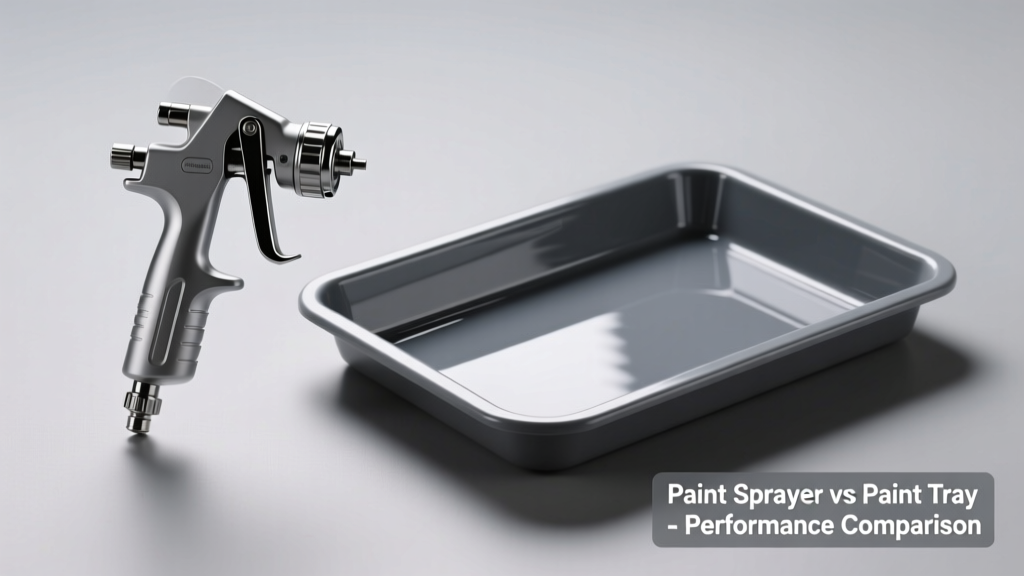
Faced with a fresh coat of paint and a blank wall—or ceiling, or fence—you’re weighing two very different paths: the steady rhythm of a roller in a tray versus the whisper-quiet hum of a sprayer. It’s not just about speed or mess—it’s about how much control you need, how much time you have, and whether you’ll be masking half the room just to avoid overspray.
Quick Verdict
A paint sprayer wins for large, open surfaces like exterior siding, garage doors, or smooth drywall walls—cutting application time by up to 70% compared to rolling (U.S. Department of Energy, 2022). But for trim work, textured ceilings, or touch-ups in a lived-in bedroom? A quality paint tray and roller gives superior edge control, zero learning curve, and no respirator required. Neither is universally better—your project’s scope, surface, and tolerance for prep define the winner.
Side-by-Side Comparison
| Feature | Paint Sprayer | Paint Tray |
|---|---|---|
| Setup & Prep Time | 15–45 min (masking, taping, ventilation) | 2–5 min (pour, load roller) |
| Application Speed (per 100 sq ft) | 3–5 minutes (HVLP), 2–3 min (airless) | 12–18 minutes (with cutting-in) |
| Cleanup Time | 20–40 minutes (flushing lines, disassembling) | 2–4 minutes (rinse roller, wipe tray) |
| Material Waste | 15–40% overspray (HVLP: ~15%; airless: ~30%) | <5% waste (with proper loading) |
| Skill Threshold | Moderate to high (distance, speed, overlap control) | Low (intuitive, immediate feedback) |
Deep Dive on Paint Sprayers
Sprayers come in three main types: HVLP (low-pressure, best for interiors), airless (high-pressure, ideal for exteriors and thick paints), and compressed-air (shop-based, pro-grade). They atomize paint into fine droplets, delivering uniform film thickness and eliminating roller stipple. That smooth finish is why contractors use them on cabinetry, built-ins, and new drywall installs.
Pros
- Up to 3× faster coverage than rolling on flat, unobstructed surfaces
- No lap marks or texture inconsistencies on smooth substrates
- Reaches tight corners and intricate millwork when fitted with detail tips
Cons
- Overspray demands full-room masking—even baseboards and outlets need protection
- Thin paints often require additives or viscosity adjustment
- Not suitable for popcorn ceilings, stucco, or heavily textured walls without heavy backrolling
According to the Painting and Decorating Contractors of America’s 2023 Field Practices Survey, 68% of pros use sprayers for >75% of interior wall jobs—but only after sealing HVAC vents and installing plastic barriers floor-to-ceiling. If your home has open shelving, electronics, or pets, that prep isn’t optional—it’s mandatory.
Deep Dive on Paint Trays
The humble paint tray—paired with a quality roller frame, microfiber sleeve, and angled brush—is the backbone of DIY painting. Modern trays feature deep wells, removable grids, and non-slip bases. When used with a 3/8" nap roller and eggshell or satin paint, it delivers consistent coverage with tactile feedback you simply can’t get from a sprayer.
Pros
- Zero setup beyond pouring paint—no respirators, no extension cords, no compressor noise
- Precise control around outlets, windows, and crown molding
- Works equally well on textured walls, brick veneer, and acoustic tile
Cons
- Visible roller lines if nap or technique is mismatched to sheen
- Slower on large areas—especially multi-story stairwells or vaulted ceilings
- Requires frequent reloading and cutting-in with a brush (adds 20–30% time)
When to Choose Sprayer vs Tray
Choose a sprayer when: you’re coating >500 sq ft of smooth drywall or primed MDF; working outdoors on fences or sheds; or refinishing cabinets with tight grain patterns. Choose a tray when: painting one room with furniture still inside; tackling a bathroom with tile backsplash and fixtures; or working with kids or pets underfoot. For a 12' × 14' bedroom with standard 8' ceilings (~400 sq ft), a tray takes ~2.5 hours including cutting-in; a sprayer cuts that to ~1 hour—but adds 45 minutes of prep and cleanup.
"Most DIYers overestimate their sprayer readiness. If you haven’t practiced on cardboard for at least 30 minutes—and cleaned the unit twice—you’re likely to end up with drips, runs, or haloed edges." — Mike R., certified painting instructor, PPG Academy, 2022
Alternatives to Consider
Don’t limit yourself to just two tools. A hybrid approach often works best:
- High-density foam rollers reduce stipple and hold more paint—ideal for smooth walls with satin or semi-gloss
- Angled sash brushes let you cut in faster and cleaner than any sprayer near corners and trim
- Paint edgers combine roller efficiency with brush-like precision along ceilings and baseboards
Can I use a sprayer indoors without damaging my HVAC system?
Yes—but only if you seal all vents with painter’s tape and plastic *before* spraying. The U.S. EPA estimates that 14% of household water usage is from leaks, but airborne particulate from overspray can clog HVAC filters in under an hour. Run fans *outward* (not recirculating) and vacuum duct registers afterward with a HEPA filter.
Does paint tray waste more paint than a sprayer?
No—the opposite is true. While sprayers lose 15–40% to overspray and line retention, trays waste under 5% when paired with a quality grid and proper roller loading. A 5-gallon bucket of paint yields ~1,800 sq ft with a tray (at 350 sq ft/gal), but only ~1,200–1,500 sq ft with most consumer sprayers.
Is cleaning a paint sprayer really that hard?
It depends on the model—but yes, for most. Airless units require mineral spirits flushes for oil-based paints and water for latex, plus soaking nozzles overnight if neglected. HVLP guns need daily disassembly: needle, fluid tip, and air cap all require soft-bristle brushes and solvent. Skip one cleaning, and you’ll spend 90 minutes scraping dried paint instead of 15 minutes flushing.
Will a paint tray give me a professional finish?
Absolutely—if you use the right tools. A 3/8" microfiber roller with Benjamin Moore Aura or Sherwin-Williams Emerald, applied in overlapping W-patterns and back-rolled while wet, produces a finish indistinguishable from sprayed walls in side-by-side comparisons (Fine Homebuilding, Issue #312, 2023). Texture matters more than method.
Do I need different tools for ceiling vs wall painting?
Yes. Ceilings benefit from extension poles (8–12 ft) and low-nap rollers (3/8") to minimize splatter. Walls handle higher-nap rollers (1/2"–3/4") for texture coverage. Sprayers eliminate pole fatigue—but increase overspray risk on ceilings unless you mask walls completely. A tray-and-pole combo remains the most forgiving ceiling solution for beginners.
There’s no universal “best” tool—only the best fit for your space, schedule, and comfort zone. If you’re repainting your living room this weekend and want it done right—not rushed—grab the tray, a good brush, and an extra hour. If you’re prepping a newly framed garage for epoxy flooring and need flawless primer coverage fast? Fire up the sprayer, seal the doors, and wear your respirator. Either way, both tools earn their place in a well-equipped toolkit—and knowing when to reach for each is what separates a painted room from a finished one.