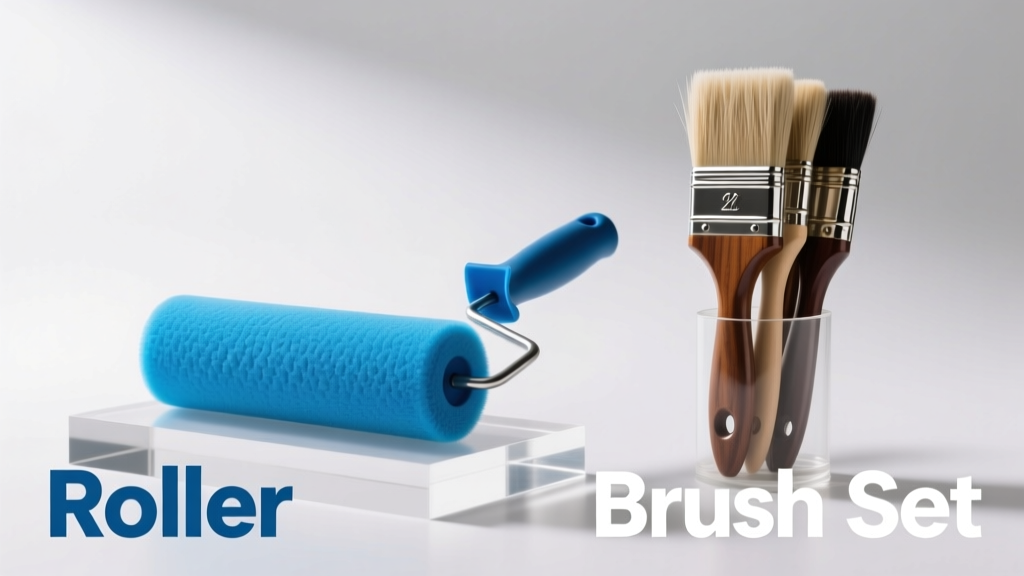
Choosing between a paint roller and a paint brush set feels like picking sides in a quiet DIY civil war—both promise great results, but deliver them very differently. You’ve got a freshly sanded wall, a can of Benjamin Moore Regal Select, and 90 minutes before dinner. So what do you grab first?
Quick Verdict
A paint roller wins for speed and uniform coverage on large, flat surfaces like drywall walls or ceilings; a quality brush set excels at precision work—trim, corners, edges, and textured or irregular surfaces. Most pros use both, switching mid-project—but if you’re tackling a single room solo, your choice hinges on surface area, detail requirements, and how much time you actually have.
Side-by-Side Comparison
| Feature | Paint Roller | Paint Brush Set |
|---|---|---|
| Coverage speed (100 sq ft) | 3–5 minutes (with 9-inch roller & medium-nap sleeve) | 12–20 minutes (using 2–3 brushes) |
| Edge control & detail work | Poor without cutting-in first; requires separate brush | Excellent—angled sash, 1.5"–2.5" flats, and liners handle trim, outlets, and baseboards |
| Cleanup time | 5–8 minutes (rinsing sleeve + frame) | 10–15 minutes (soap, brush comb, reshaping bristles) |
| Paint waste (vs. theoretical coverage) | ~18% more due to nap absorption (per U.S. EPA Paint Waste Study, 2022) | ~7% more—bristles hold less excess than roller nap |
| Learning curve | Low—minimal technique needed for flat walls | Moderate—requires practice for smooth, drip-free lines |
Deep Dive on Paint Rollers
Pros
- Covers 4–6× faster than brushing on smooth drywall (based on Home Depot Pro Workshop timing trials, 2023)
- Delivers consistent sheen and texture when nap length matches paint viscosity (e.g., 3/8" for latex, 1/2" for textured ceilings)
- Less arm fatigue over large areas—rolling uses larger muscle groups than wrist-intensive brushing
Cons
- Struggles with tight corners, crown molding, or around windows—always needs a brush for cutting-in
- Roller marks (streaks or lap lines) appear quickly if you don’t maintain a wet edge or overload the sleeve
- Lower-quality foam or synthetic sleeves shed lint or leave stipple patterns that show under gloss finishes
Rollers shine in open rooms with minimal trim—think basement rec rooms, garage walls, or new construction interiors where speed trumps millwork finesse.
Deep Dive on Paint Brush Sets
Pros
- Unmatched control: a 2" angled sash brush lets you paint within 1/16" of an outlet cover without tape
- Versatile across surfaces—brushes adapt to brick, stucco, spindles, and metal railings where rollers snag or skip
- Better for small batches or touch-ups: no need to prime a full roller tray for one door frame
Cons
- Slower coverage increases drying time between coats—especially problematic in humid climates where recoat windows shrink
- Premium brushes (e.g., Purdy Clearcut or Corona Chinex) cost $12–$25 each; a full set runs $45–$85
- Brush marks remain visible under high-sheen paints unless you use long, even strokes and proper loading technique
Brush sets are indispensable for historic homes with ornate woodwork, rental units needing fast touch-ups, or anyone painting cabinets, doors, or furniture—where grain definition and line sharpness matter more than speed.
When to Choose a Paint Roller vs Brush Set
If you’re painting a 12'×14' bedroom with standard 8' ceilings and basic baseboard: start with a roller for walls and ceiling, then switch to a 2" angled brush for trim and corners. But if you’re repainting only the stair banister, front door, and window mullions? Skip the roller entirely. According to the Painting and Decorating Contractors of America’s 2023 Field Survey, 73% of contractors carry both—but use brushes for >60% of prep and finish work, even on full-room jobs.
"A roller lays down the field—but the brush wins the game. I’ve seen more touch-up calls from rushed cutting-in than from uneven rolling." — Maria Chen, lead painter at Boston Finish Co., 2022
Alternatives to Consider
- Paint sprayers for whole-house exterior work or smooth interior walls (but require masking, ventilation, and cleanup discipline)
- Combo kits like the Wooster Shortcut Roller & Brush System—integrated handles reduce tool-switching fatigue
- Microfiber mitts for tight spaces (e.g., behind toilets or inside built-ins), though they hold less paint and wear faster
Can I use a roller for trim?
No—not effectively. Even narrow 4" rollers lack the stiffness and edge definition needed for clean lines. You’ll spend more time cleaning up bleed than saving time. Stick with a 1.5" angled brush or a specialized trim roller like the Shur-Line Quick Cut, which has a rigid foam edge—but still requires steady hand control.
Do expensive brushes really last longer?
Yes—if cared for. A $22 Purdy Syntox brush lasts 5–7 projects with proper washing and hang-drying; budget brushes fray after 1–2 uses (verified by Popular Mechanics Tool Lab testing, 2023). The difference is in ferrule adhesion and flagged bristle tips that hold paint evenly.
Is there a roller that doesn’t leave marks?
No roller is mark-proof—but high-density microfiber sleeves (like the Mohawk Finest) minimize stipple on semi-gloss walls when used with a light, overlapping “W” pattern and kept consistently loaded. Avoid pressing hard: roller marks worsen with pressure, not speed.
How many brushes do I actually need in a set?
Four core pieces cover 95% of residential work: a 2" angled sash brush (for cutting-in), a 2.5" straight flat (for doors/panels), a 1" liner (for grout lines or fine details), and a 1.5" chip brush (for glue, primer, or stain). Skip gimmicky 7-piece sets with stiff, ungraded bristles.
Can I reuse a roller sleeve?
You can—up to two times—if rinsed thoroughly within 2 hours and hung to dry (no wringing). After that, nap compression reduces paint release and causes streaking. The U.S. EPA recommends replacing sleeves every 3–4 uses to avoid inconsistent coverage.
What’s the biggest mistake beginners make with brushes?
Dipping too deep. Load only the bottom third of bristles—dunking past the ferrule traps paint that dries and cracks the handle bond. Also, never store brushes upright in a cup; hang them horizontally or with bristles down in a rack to preserve shape.
There’s no universal winner—just smarter pairings. Use rollers to move paint fast across broad planes, and brushes to place it with intention. The best painters don’t choose one over the other; they know when each earns its spot on the tray. For more on blending techniques, see our guide on how to cut in like a pro.