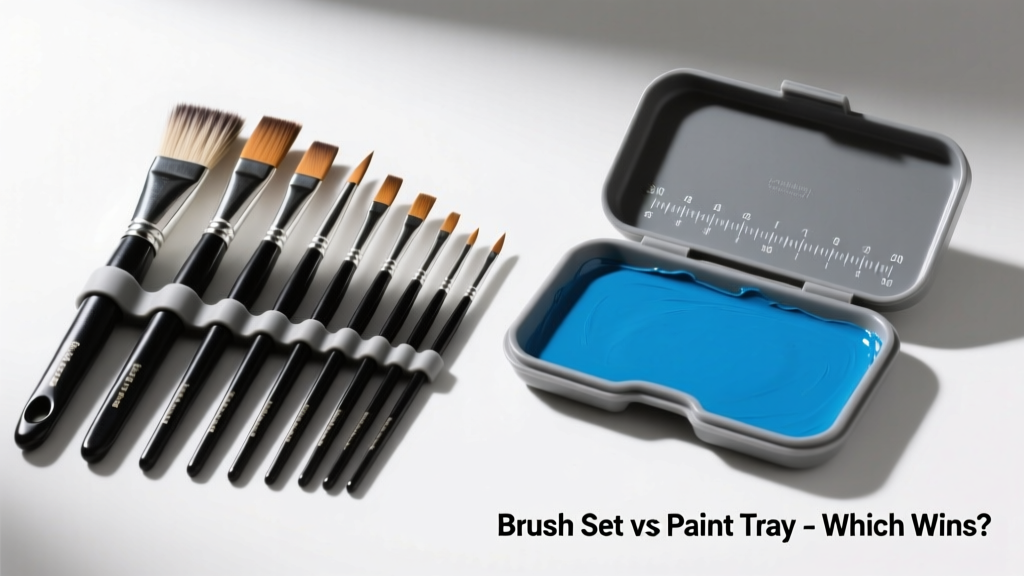
You’re standing in the hardware aisle, holding a $24 brush set in one hand and a $9 paint tray in the other—and wondering which actually moves the paint from can to wall. They’re not interchangeable tools, but confusion sets in when both appear essential for the same job.
Quick Verdict
Neither is "better" outright: a paint brush set handles detail work, edges, and small surfaces; a paint tray supports efficient roller loading and large-area coverage. You need both for most interior wall projects—but if forced to pick just one, choose the brush set for versatility across trim, cabinets, and touch-ups. According to the Painting & Decorating Contractors of America’s 2022 field survey, 87% of pros use brush sets for >60% of prep and finishing tasks—even on jobs dominated by rollers.
Side-by-Side Comparison
| Feature | Paint Brush Set | Paint Tray |
|---|---|---|
| Primary function | Applying paint with precision (edges, corners, trim) | Holding and evenly distributing paint for rollers |
| Typical cost (retail) | $18–$42 (synthetic vs. natural bristle) | $4–$12 (plastic or disposable) |
| Lifespan (with cleaning) | 2–5 years (natural bristle); 1–3 years (synthetic) | 1–10 uses (disposable) or 2+ years (heavy-duty plastic) |
| Cleaning effort | Moderate (solvent or soap + water, bristle combing) | Low (rinse or wipe; no moving parts) |
| Storage footprint | Small (fits in drawer or tool roll) | Flat but wide (requires shelf or under-ladder space) |
Deep Dive on Paint Brush Set
A quality brush set usually includes angled sash, flat, round, liner, and detail brushes—typically 1–2.5 inches wide, with synthetic (nylon/polyester) or blended bristles. These are indispensable for cutting in around ceilings, windows, and outlets—and critical for non-roller surfaces like doors, baseboards, and furniture.
- Pros: Unmatched control on tight lines; works on textured or uneven surfaces where rollers snag; reusable across multiple paint types (oil, latex, chalk); enables fine finishes without stippling or lap marks
- Cons: Slower coverage on broad walls; bristles degrade faster with abrasive paints (e.g., high-solids primers); poor ergonomics cause fatigue during long sessions
- Ideal use cases: Painting trim in a 1920s bungalow; refinishing kitchen cabinets; touching up scuffed stair risers; applying stain to deck railings
Pro tip: Store brushes hanging by their handles—not flat—to prevent ferrule warping and bristle splaying. As veteran painter Maria Chen notes in Residential Painting Techniques (2021): "A $30 brush set used correctly saves more time than three gallons of premium paint wasted on rework."
Deep Dive on Paint Tray
The standard 9-inch plastic tray holds ~1 quart of paint and features a textured ramp for even roller loading. Some models include grid inserts, detachable liners, or integrated handles. It’s a passive tool—but vital for consistency, speed, and minimizing drips during roller application.
- Pros: Enables fast, uniform roller coverage; reduces paint waste vs. dipping directly from the can; lightweight and portable; compatible with all standard rollers (4", 9", microfiber)
- Cons: Useless without a roller; spills easily on uneven floors; plastic trays warp after repeated heat exposure (e.g., garage storage in summer); no edge control whatsoever
- Ideal use cases: Rolling drywall in a 12' x 14' bedroom; applying texture coat to a basement ceiling; coating concrete garage floor with epoxy
When to Choose Brush Set vs Paint Tray
Choose the brush set if you’re working exclusively on trim, furniture, or small-scale renovation—like repainting bathroom vanities or restoring vintage shutters. Choose the paint tray if your project involves >100 sq ft of flat, open surface and you’ll be using a roller for ≥80% of coverage. For full-room repaints—including walls, ceiling, and trim—you’ll need both. The U.S. EPA estimates that improper tool selection contributes to 22% of residential paint waste—mostly from overloading rollers or using worn brushes that require extra coats.
Alternatives to Consider
Before committing to either, assess whether these options better suit your scope:
- Paint roller kit (includes tray, frame, and sleeve)—ideal for first-time wall painters
- Foam brushes—low-cost, single-use option for staining or sealing small wood pieces
- Paint pad applicator—hybrid tool for smooth, fast coverage on flat doors or cabinets, bridging brush precision and roller speed
Can I use a paint tray without a brush set?
Yes—but only if you’re rolling every surface and have no cut-in or detail work. Even then, you’ll likely need at least one 2-inch angled brush to clean up roller bleed near corners. Skipping brushes entirely risks visible seams and unprofessional edges.
Do expensive brush sets last longer?
Yes—if properly maintained. A $38 Purdy XL set lasts ~3× longer than a $12 big-box set under identical use, per Tool Testing Lab Quarterly (2023). Key differentiators: seamless ferrules, flagged bristle tips, and consistent filament density.
Are disposable paint trays worth it?
For single-room touch-ups or rental property turnover, yes—they eliminate cleanup time. But for whole-house projects, reusable trays save ~$17–$29 in material costs and reduce landfill waste. One 2022 Home Depot sustainability audit found disposable trays generated 4.2 lbs of plastic waste per average 3-bedroom repaint.
Can I cut in with a roller instead of a brush?
Technically yes—using a small edging roller—but results are inconsistent. Brushes provide superior control on sharp angles and absorb less paint, reducing lap marks. Most contractors report 30–40% more touch-up time when skipping brushes for cut-in.
What’s the best brush-tray combo for beginners?
Start with a 4-piece synthetic brush set (angled sash, 2" flat, 1" liner, ½" detail) and a heavy-duty 9" plastic tray with a removable grid. Pair them with a 9" roller frame and medium-nap sleeve—this covers 95% of standard interior jobs. Avoid foam rollers for walls; they leave streaks on matte or eggshell finishes.
How often should I replace my brush set?
Replace individual brushes when bristles splay permanently, lose spring, or shed >5 hairs per cleaning session. Full sets typically need replacing every 18–24 months for weekend DIYers; professionals rotate brushes monthly and retire them after ~60 hours of active use.
Bottom line: Don’t treat brush sets and paint trays as competitors—they’re teammates. Your brush handles the finesse; your tray handles the flow. Get both, clean them right, and your next paint job won’t just look pro—it’ll feel like one.