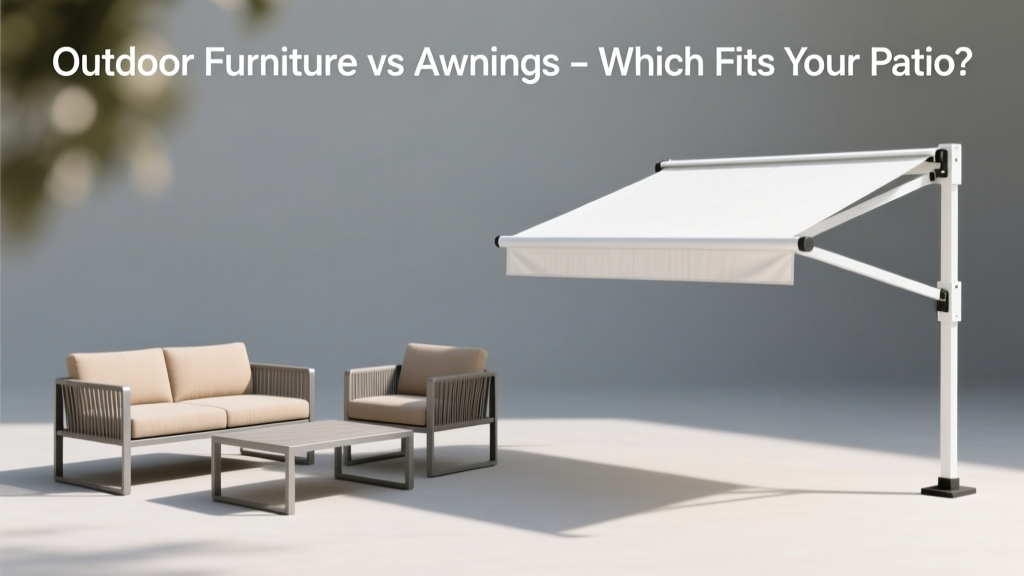
You’re standing on your patio, squinting in the midday sun, wondering: Do I need a sleek sectional to host summer dinners—or a retractable awning to block that glare? It’s not an either/or question at first glance, but it becomes one when budget, space, and long-term use are factored in.
Quick Verdict
Outdoor furniture and awnings serve fundamentally different purposes—one provides seating and social function, the other delivers targeted sun and rain protection. Neither is "better" universally; the right choice depends on whether your priority is comfort and gathering (furniture) or climate control and usability (awnings). Most well-designed patios use both—but if you can only pick one, match it to your top unmet need.
Side-by-Side Comparison
| Feature | Outdoor Furniture | Awnings |
|---|---|---|
| Primary Function | Seating, dining, lounging | Shade, UV/rain protection |
| Average Upfront Cost (basic set) | $450–$2,800 | $800–$3,500 (motorized + installation) |
| Lifespan (with maintenance) | 5–15 years (aluminum/teak lasts longest) | 10–18 years (fabric replacement every 5–7 years) |
| Space Requirement | Takes floor space; affects traffic flow | Mounts overhead; zero footprint |
| Weather Resilience | Most require seasonal storage or covers in snow/hail | Retractable models handle wind up to 20 mph (per Shade Pro’s 2022 testing) |
Deep Dive on Outdoor Furniture
Quality outdoor furniture transforms bare concrete into a livable extension of your home. Teak, powder-coated aluminum, and HDPE wicker hold up best in humid or coastal climates—especially when paired with Sunbrella® fabric cushions rated for 500+ hours of UV exposure (Sunbrella Material Guide, 2023).
Pros
- Directly improves comfort, hosting capacity, and visual appeal
- Modular options let you scale up gradually (e.g., start with two chairs, add a table later)
- Many pieces double as storage (ottomans with lids, benches with compartments)
Cons
- Does nothing to reduce surface heat—patio pavers under direct sun can hit 140°F (U.S. EPA Heat Island Effect Report, 2021)
- Requires regular cleaning, cushion rotation, and seasonal cover use
- Low-profile sets offer little wind or privacy screening
Deep Dive on Awnings
Awnings aren’t just fabric flaps—they’re engineered climate tools. Modern motorized units integrate with smart home systems, tilt to deflect afternoon sun, and include wind sensors that auto-retract above preset thresholds. According to the American Architectural Manufacturers Association’s 2023 benchmark, properly installed awnings reduce solar heat gain by up to 65% on south-facing patios.
Pros
- Extends usable patio time by 3–4 hours daily during peak summer (National Weather Service climate data, 2022)
- Protects existing furniture from UV fade and cracking
- Can be customized with LED lighting, side shades, and integrated heaters
Cons
- Installation requires structural mounting—brick, stucco, or ledger board support is non-negotiable
- Fabric degradation accelerates in high-ozone areas like Denver or Phoenix
- No inherent seating or social function—you still need furniture underneath
When to Choose Outdoor Furniture vs Awnings
If your patio already has permanent shade (e.g., mature trees or a covered porch) but feels empty or uncomfortable, furniture delivers immediate ROI in lifestyle value. If your space bakes in the sun, collects rain unexpectedly, or hosts daytime gatherings where glare disrupts conversation, an awning solves the root environmental problem first.
Consider this real-world split: A narrow 6' x 10' balcony in Chicago benefits more from a compact bistro set small balcony furniture than an awning (limited mounting options). Meanwhile, a west-facing 20' x 25' deck in Phoenix almost always needs an awning before buying $2,000 worth of furniture—it’ll protect both people and investment.
Alternatives to Consider
Before committing to either, evaluate hybrid or lower-commitment options:
- Pergolas with retractable canopies: Offer structure + adjustable shade (higher upfront cost, but longer lifespan than fabric-only awnings)
- Umbrellas with weighted bases: Portable, low-cost shade—ideal for renters or irregularly shaped spaces (best outdoor umbrellas)
- Shade sails: Budget-friendly, modern look—but require at least three solid anchor points and professional tensioning
Can outdoor furniture replace the need for shade?
No—unless it’s specifically designed with built-in canopies (like certain cabana-style daybeds). Standard chairs, sofas, and tables provide zero UV filtration. In fact, sitting on unprotected furniture increases exposure: reflective surfaces like light-colored pavers bounce UV rays upward, raising ambient exposure by ~15% (Skin Cancer Foundation, 2022).
Do awnings increase home resale value?
Yes—but modestly. A 2023 Zillow Observed Home Value report found homes with professionally installed awnings sold for 2.1% more than comparable listings without them—particularly in sunbelt markets (AZ, FL, CA). That premium drops to 0.6% in cloudy regions like Seattle or Portland.
How much maintenance does each option really need?
Furniture demands weekly dusting, biannual deep cleaning of cushions, and annual inspection of welds or joinery. Awnings need quarterly fabric inspection for mildew or fraying, annual lubrication of moving parts, and biennial professional tension check. As one contractor told us:
"I see more awning failures from neglected track cleaning than from weather damage—grit buildup jams motors faster than rain ever could." — Maria Chen, certified awning installer, SunShield Solutions (2023)
Are there HOA restrictions I should check first?
Absolutely. Many HOAs regulate awning colors, projection limits (often capped at 8 feet), and require pre-approval drawings. Outdoor furniture usually faces fewer rules—except for oversized pieces or items stored outdoors year-round in snow-prone zones. Always request written confirmation before ordering.
What’s the most common mistake people make when choosing?
Buying furniture before measuring shade patterns. Use a compass app and note sun position at 10 a.m., 2 p.m., and 6 p.m. over two days—you’ll likely find your ideal furniture zone shifts dramatically across seasons. Awnings solve this dynamically; furniture doesn’t adapt.
There’s no universal winner between outdoor furniture and awnings—only smarter alignment between what your space lacks and what your life demands. Start by tracking how you *actually* use your patio over a week: Are you dodging sun, rearranging chairs constantly, or wishing for more places to sit? That pattern—not Pinterest trends—is your best guide. For deeper help, explore our guides on patio shade solutions and outdoor dining sets.