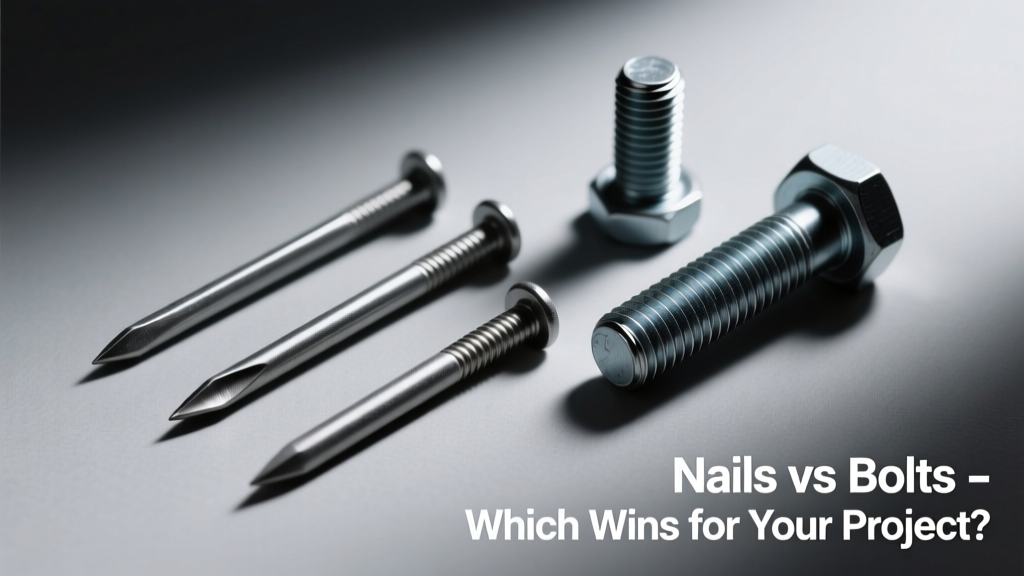
Choosing between nails and bolts feels like picking between a sprinter and a weightlifter—both get the job done, but in wildly different ways. You’re standing in the hardware aisle, holding a 2x4 and a load-bearing shelf bracket, wondering: ‘Do I nail it or bolt it?’ The answer isn’t universal—it depends on load type, material, access, and whether you’ll ever need to take it apart.
Quick Verdict
Bolts win for high-strength, adjustable, or disassemblable connections—especially in structural framing, machinery mounts, or outdoor decks exposed to wind uplift. Nails excel in speed, shear resistance, and wood-to-wood applications like wall sheathing or subflooring where flexibility and vibration damping matter. Neither is ‘better’ overall—but using the wrong one can compromise safety or longevity.
Side-by-Side Comparison
| Feature | Nails | Bolts |
|---|---|---|
| Tensile strength (per 3" fastener in SPF lumber) | ~150–250 lbs | ~800–1,400 lbs (with washer & nut) |
| Shear strength (per 3" fastener) | ~300–450 lbs | ~500–900 lbs |
| Installation speed (avg. per fastener) | 1–2 seconds (hammer or nail gun) | 15–45 seconds (drill, washer, nut, torque) |
| Removability | Damages surrounding material; often impractical | Full reusability with minimal substrate damage |
| Cost per fastener (retail, 2024) | $0.02–$0.07 (common 16d) | $0.18–$0.65 (¼"–⅜" carriage bolt + nut/washer) |
| Vibration resistance | Moderate (flexes slightly under cyclic load) | High (when properly torqued and locked) |
Deep Dive on Nails
Nails rely on friction and lateral grip—especially in wood—to resist pull-out and shear. Their slight ductility allows them to absorb small movements without snapping, making them ideal for applications where thermal expansion, moisture swelling, or footfall vibration occurs.
Pros
- Extremely fast to install—critical for large-scale framing or roofing
- Lower material cost per unit; bulk boxes cost under $10 for 5,000
- Superior shear resistance in wood-to-wood joints (e.g., stud-to-plate connections)
- Less likely to split dry, dense hardwoods when angled or pre-drilled
Cons
- Poor tensile strength—pull-out resistance drops sharply in damp or rotten wood
- Almost impossible to remove cleanly; repeated extraction splinters framing
- No clamping force—can’t draw components tightly together like a bolt does
- Not suitable for metal-to-wood or concrete anchoring without specialized variants
According to the American Wood Council’s 2023 National Design Specification, nails derive up to 70% of their holding power from the wood’s density and grain orientation—not just diameter or length. That means a 10d common nail in southern yellow pine holds nearly twice as much as in spruce-pine-fir under identical conditions.
Deep Dive on Bolts
Bolts function as tension-based fasteners: they clamp two or more materials together using threaded engagement and compressive force. This makes them indispensable where alignment, load transfer, or serviceability matters.
Pros
- High, predictable tensile and shear capacity—especially with grade 5 or grade 8 steel
- Fully reversible: loosen, adjust, or replace without damaging substrates
- Works across dissimilar materials (e.g., steel bracket to concrete with anchor bolt)
- Clamping action prevents slippage in dynamic joints—critical for deck ledger boards
Cons
- Requires precise hole alignment and drilling—slower setup, higher labor cost
- Can loosen over time without lock washers, threadlocker, or proper torque
- More expensive per connection—even basic ½" x 4" lag bolts run $1.20+ each
- Risk of wood splitting if pilot holes are undersized or too close to edges
“A properly torqued ½" A325 structural bolt in a double-shear wood connection delivers over 3,200 lbs of allowable load—more than 12 times a standard 16d nail in the same configuration.” — American Institute of Steel Construction, Manual of Steel Construction, 15th Ed. (2022)
When to Choose Nails vs Bolts
Match the fastener to the physics of the load—not just tradition or convenience:
- Use nails for wall sheathing, roof decking, joist hangers (where specified), and non-structural trim where speed and shear resistance outweigh tensile needs.
- Use bolts for ledger board attachments, post-to-beam connections, swing-set anchors, and any joint subjected to uplift, cantilevered loads, or inspection requirements (e.g., IRC Table R602.3(1) mandates bolts for deck ledgers).
- Never substitute nails for bolts in engineered connections—like hurricane ties rated only for specific bolt sizes—or where local building codes require mechanical anchorage (e.g., seismic retrofitting).
Alternatives to Consider
Sometimes neither nails nor bolts hit the sweet spot. These options bridge the gap:
- Deck screws: Higher pull-out resistance than nails, faster than bolts, but limited reuse and lower shear than structural bolts.
- Lag screws: Threaded like bolts but installed like screws—good for wood-to-wood where drilling a nut side isn’t possible.
- Concrete anchor systems (e.g., wedge anchors, sleeve anchors): Required when fastening to masonry or poured concrete—neither nails nor standard bolts work safely there.
- Structural adhesive + mechanical fastener hybrids: Increasingly used in timber framing and I-joist flange connections per APA E30 recommendations.
Can I use nails instead of bolts for my deck ledger?
No. The International Residential Code (IRC R507.2.1) explicitly prohibits nailing ledger boards to rim joists. Bolts (or approved lag screws with specific spacing and edge distance) are required because wind uplift creates tensile forces nails cannot resist. A 2021 study by the Forest Products Laboratory found that nailed ledger connections failed at an average of 680 lbs uplift—well below minimum design loads of 1,200+ lbs.
Are ring-shank nails stronger than smooth shank?
Yes—in pull-out resistance. Ring-shank nails increase withdrawal strength by 30–50% compared to smooth shank of the same size, according to ASTM D1761 testing. But they offer no advantage in shear, and their installation requires more force—making them harder to drive with hand hammers.
Do bolts always need washers?
Yes—for structural applications. Washers distribute clamping force, prevent embedment into soft wood, and reduce the risk of nut loosening. The 2023 ANSI/AISC 360 standard requires hardened steel washers for all A325 and A490 structural bolts in wood connections.
Can I mix nails and bolts in one assembly?
Only if engineered and detailed as such. Combining fastener types changes load distribution unpredictably. For example, adding bolts to a nail-connected truss heel may overstress the bolts while underutilizing the nails—creating a false sense of security. Always follow the connector manufacturer’s installation instructions (e.g., Simpson Strong-Tie’s C-C double-shear clip specs).
What’s the best bolt for outdoor cedar decking?
Stainless steel carriage bolts (ASTM A193 B8M) or hot-dipped galvanized lag screws (ASTM A153 Class C). Avoid zinc-plated or plain steel—they corrode rapidly in cedar’s acidic tannins and wet environments. The U.S. Department of Agriculture’s Wood Handbook (2023) confirms stainless steel fasteners retain >95% of original tensile strength after 15 years of coastal exposure.
Is there a nail equivalent to a structural bolt?
No. Structural bolts meet ASTM F3125 standards with certified tensile yield and proof load testing. Even specialty nails like TimberLOK or Heli-Coil nails are not rated for the same tension or cyclic loading. If your project calls for a bolt, substituting a nail—even a larger one—is a code violation and liability risk.
Fasteners aren’t just hardware—they’re load paths. Choosing nails or bolts isn’t about preference; it’s about honoring how force travels through your build. When in doubt, consult the connector manufacturer’s load tables or a structural engineer—especially for anything bearing weight, resisting wind, or protecting people. And remember: the cheapest fastener isn’t the one with the lowest sticker price—it’s the one that keeps working, season after season.