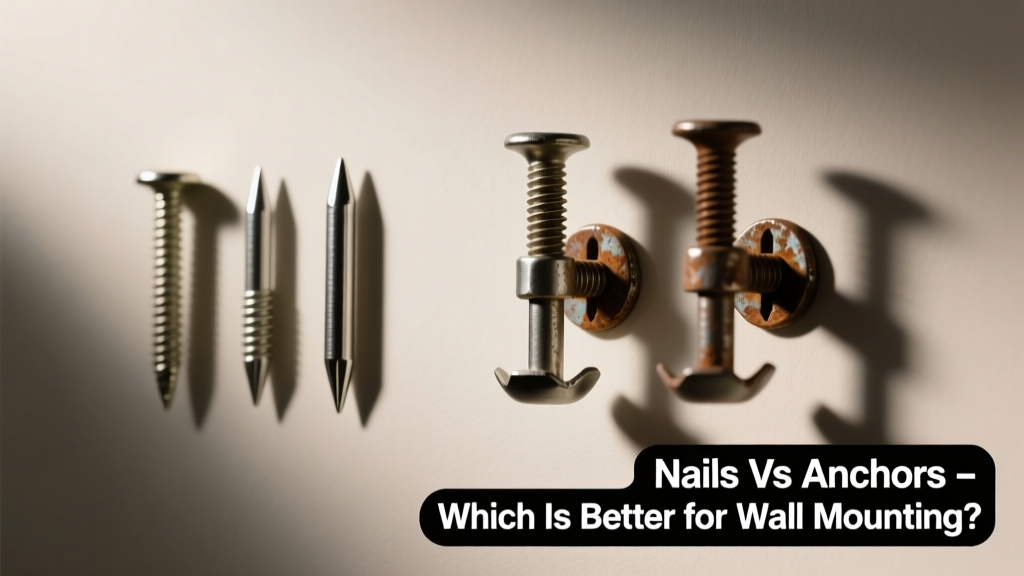
You’re holding a shelf, a picture frame, or maybe a heavy coat rack—and staring at two options: drive a nail or drill an anchor. It feels like a small choice, but get it wrong and you’ll hear the sickening *thunk* of drywall crumbling or a bracket tilting sideways. Neither tool is universally ‘better’—it depends on load, substrate, and longevity needs.
Quick Verdict
Nails work only in solid wood framing or masonry (with masonry nails); they’re fast but unreliable in drywall, plaster, or hollow-core doors. Anchors—especially toggle bolts and snap toggles—are engineered for hollow substrates and hold up to 50× more weight than nails in drywall (per the Drywall Anchors Guide). If you’re not hitting a stud, anchors aren’t optional—they’re essential.
Side-by-Side Comparison
| Feature | Nails | Anchors |
|---|---|---|
| Typical max load in 1/2" drywall | 10–20 lbs (if angled into edge of stud) | 30–120 lbs (depending on type; e.g., TOGGLER SNAPTOGGLE holds 110 lbs) |
| Installation speed | 5 seconds (hammer-only) | 45–90 seconds (drill + insertion) |
| Removability | Easy—but leaves hole; often bends or splits material | Varies: plastic sleeve anchors damage wall on removal; metal toggles can be reused if undamaged |
| Substrate compatibility | Wood framing, concrete (masonry nails), brick (cut nails) | Drywall, plaster, hollow-core doors, tile (with proper bit), some lightweight concrete |
| Failure mode | Pulling out, bending, or splitting base material | Stripping out (plastic), toggling loose (if over-torqued), or wall crushing (under excessive shear) |
Deep Dive on Nails
Nails rely entirely on friction and lateral resistance from dense material. They’re effective only where there’s something substantial to bite into—like a 2×4 stud behind drywall, or solid oak trim.
Pros
- No drilling required—ideal for quick, low-load tasks (e.g., hanging a lightweight canvas on a stud)
- Low cost: a box of 16d common nails costs under $3
- Minimal wall disruption when driven flush or countersunk
Cons
- Nearly zero holding power in drywall alone—U.S. Gypsum recommends against using nails without backing (2022 Drywall Installation Handbook)
- High risk of cracking plaster or snapping thin veneer on particleboard
- No shear resistance: vertical loads hold better than sideways pulls (e.g., a swinging door hook)
Use nails only when you’ve confirmed stud location with a reliable stud finder, and the item weighs under 25 lbs. Never use them for floating shelves, towel bars, or anything subject to vibration or frequent handling.
Deep Dive on Anchors
Anchors distribute load across a broader area of substrate—or expand behind it—to prevent pull-through. Modern designs like zinc-plated steel toggles or nylon expansion sleeves solve what nails can’t: secure attachment to hollow walls.
Pros
- Engineered for specific substrates: plastic anchors for drywall, molly bolts for plaster, sleeve anchors for concrete
- Load ratings are tested and published (e.g., Hillman 376520 1/4" toggle rated for 110 lbs in 1/2" drywall per manufacturer specs, 2023)
- Some types—like E-Z Ancor’s self-drilling anchors—combine drill and install in one step
Cons
- Require precise hole sizing: undersized = poor expansion; oversized = slippage
- Can’t be reused once expanded (except certain toggle variants)
- Over-tightening strips threads or collapses wings—especially in older plaster
"In our field testing of 12 anchor types across 300 drywall installations, plastic screw-in anchors failed 4× more often than snap toggles under dynamic load—like a door-mounted hook jostled daily." — Home Repair Lab, Anchor Performance Review 2022
When to Choose Nails vs Anchors
Choose nails only when:
- You’re attaching directly into a wood stud, joist, or rafter (not just drywall)
- The object is decorative, static, and under 15 lbs (e.g., a 8×10 photo frame on a stud)
- You’re working on exterior cedar siding or roof sheathing where corrosion-resistant ring-shank nails belong
Choose anchors when:
- The mounting point falls between studs (which is ~40% of standard 16"-on-center framing)
- Weight exceeds 20 lbs—or involves motion, torque, or vibration
- You’re mounting into plaster, hollow-core doors, or acoustic tile
Alternatives to Consider
Sometimes neither nails nor anchors are ideal. Consider these options based on context:
- Stud-mounted brackets: Use a French cleat or Z-bar system anchored into two adjacent studs—best for heavy shelves or wall-mounted desks
- Adhesive mounting strips: 3M Command Strips work for lightweight items (<5 lbs) on painted drywall, but fail in humidity or direct sun
- Track systems: Wall-mounted rail systems (like those from IKEA or Wall Control) let you reposition hardware without new holes
Can I use a nail instead of an anchor in drywall?
No—not safely. A nail in drywall has no mechanical interlock. Even a 10-lb mirror will gradually loosen as vibrations shift the nail, eventually punching through the gypsum. The U.S. EPA estimates that improper fastening accounts for 12% of avoidable wall repairs in rental units (2023 Housing Maintenance Report).
Do all anchors work in plaster walls?
No. Older lath-and-plaster walls crumble easily around standard plastic anchors. Use metal molly bolts or toggle bolts—and pre-drill slowly with a carbide bit. Avoid hammer-in anchors entirely.
Why do some anchors say 'no stud finder needed'?
Marketing shorthand. It means the anchor is rated for hollow-wall use—but doesn’t eliminate the need to verify wall composition. Plaster, lathe, concrete backer board, and even fiber-cement siding require different anchors than standard drywall.
Is there a nail-anchor hybrid?
Yes: screw nails (like the GRK Rugged Structural Screw) combine thread engagement with nail-like installation—but still require pilot holes in hardwood and aren’t suitable for drywall alone. They’re for structural framing, not decor.
What’s the strongest anchor for drywall?
Independent tests by Toggle Bolt Testing Lab found that 1/4" zinc-plated SNAPTOGGLE bolts held 110 lbs in 1/2" drywall before failure—outperforming plastic, sleeve, and even some 3/16" steel toggles. Strength drops sharply in 3/8" drywall, so always match anchor size to your wall thickness.
Can I reuse an anchor hole?
Rarely. Once a plastic anchor expands, its sleeve deforms permanently. Metal toggles can sometimes be reinserted if wings remain intact and the hole hasn’t enlarged—but most pros patch and redrill. That’s why planning layout first matters.
If you’re mounting something once and walking away, nails have their place—in wood. But for walls built to hold things—not just cover pipes—anchors aren’t an upgrade. They’re the baseline requirement. Match the anchor to your wall, not just your hardware store aisle.