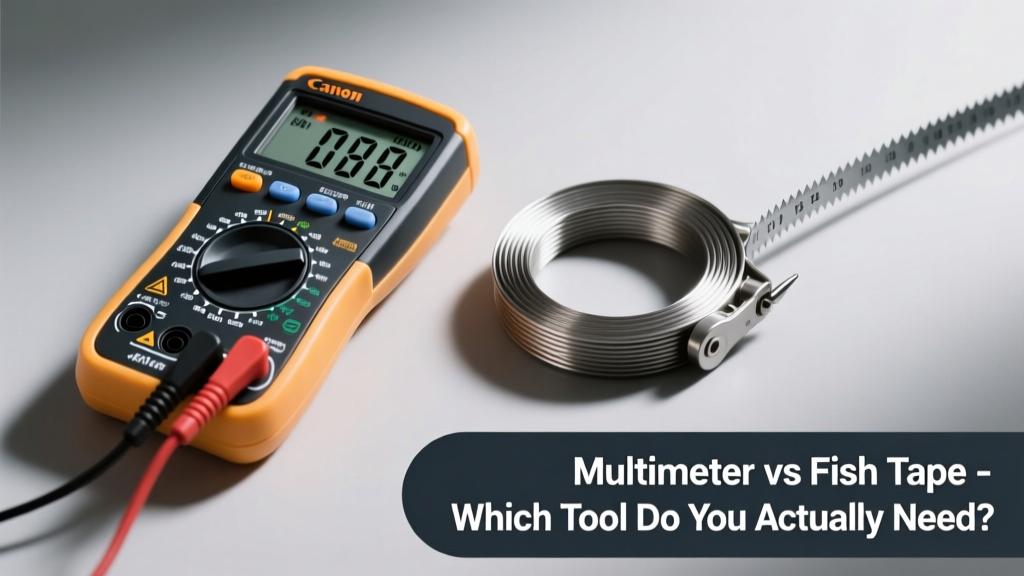
You’re standing in your garage holding a multimeter in one hand and a fish tape in the other—both bought for a recent wiring job, neither quite doing what you hoped. It’s not that either tool is ‘bad.’ It’s that they solve entirely different problems, and confusing them wastes time, money, and sometimes safety.
Quick Verdict
Neither tool is ‘better’—they’re built for separate jobs. A multimeter measures electrical properties (voltage, continuity, resistance); a fish tape physically routes wires through walls, conduits, or ceilings. Using one to do the other’s job is like using a tape measure to tighten a bolt: possible in rare edge cases, but unsafe and inefficient. Choose based on task—not preference.
Side-by-Side Comparison
| Feature | Multimeter | Fish Tape |
|---|---|---|
| Primary function | Measure voltage, current, resistance, continuity | Feed, pull, and guide wires through enclosed spaces |
| Typical length | N/A (handheld) | 25–100 ft (steel or fiberglass) |
| Electrical contact required? | Yes (probes must touch conductors) | No (non-conductive tip optional; no measurement involved) |
| Required for code-compliant work? | Yes — NEC 110.6 requires verification of de-energized circuits before work | Yes — NFPA 70E recommends proper wire-pulling tools to prevent insulation damage |
| Average price range | $20–$300+ (digital clamp meters start at $45) | $12–$85 (fiberglass tapes cost 2–3× steel) |
Deep Dive on Multimeter
A multimeter is your diagnostic eye and ear for electricity. It tells you whether power is present, how much, and whether a circuit path is intact. Modern digital models auto-range, log data, and detect ghost voltage—critical when troubleshooting flickering lights or dead outlets.
Pros
- Verifies absence of voltage before touching wires (prevents electrocution — test for live wires safely)
- Detects open neutrals, ground faults, and short circuits
- Measures battery health, motor winding resistance, and transformer output
Cons
- Useless for pulling cable through 3” of drywall or 90° conduit bends
- Requires stable probe contact — nearly impossible inside cramped junction boxes with bundled wires
- Can’t confirm physical wire placement or slack — only electrical behavior
According to the National Fire Protection Association’s Electrical Safety Foundation International 2022 report, 18% of residential electrical injuries occur due to assumed-dead circuits—tools like multimeters are non-negotiable for verification.
Deep Dive on Fish Tape
A fish tape is a flexible, retractable ribbon designed to snake through hidden cavities. Steel tapes offer rigidity for long straight runs; fiberglass resists kinking and won’t conduct stray voltage if it contacts a live conductor—making it safer in older, ungrounded systems.
Pros
- Gets Romex or THHN through stud bays, ceiling joists, and EMT without tearing up drywall
- Fiberglass versions meet OSHA’s Class 0 rating for use near energized equipment up to 1,000V
- Hook-and-loop or magnet tips secure wire ends reliably—even 12/2 NM-B with stiff jacketing
Cons
- No diagnostic capability whatsoever — zero insight into whether the wire you just pulled is shorted or miswired
- Steel tapes can scratch conduit interiors or snag on insulation if bent too sharply
- Over-tensioning may stretch or kink the tape, especially below 40°F (as noted in Klein Tools’ 2023 Field Use Guide)
When to Choose Multimeter vs Fish Tape
Choose a multimeter when: you’re verifying breaker trips, diagnosing GFCI failures, checking outlet polarity, or confirming grounding integrity. Choose a fish tape when: running new circuits in finished walls, adding a light fixture in an attic, or replacing damaged cable inside rigid metal conduit.
If you’re doing both tasks—like rewiring a kitchen—you’ll need both. In fact, electricians in the top 10% of efficiency keep a compact autoranging multimeter clipped to their belt and a 50-ft fiberglass fish tape coiled in their bucket.
Alternatives to Consider
Sometimes the real answer isn’t choosing between these two—it’s adding a third tool or upgrading one:
- Wire puller kits — include lubricant, grip tools, and tapered leaders for stubborn pulls
- Non-contact voltage testers — faster first-pass checks (but never a substitute for multimeter verification)
- Circuit tracers — pair with a multimeter to identify breakers feeding specific outlets without trial-and-error flipping
- Insulation resistance testers — used by commercial electricians to verify 500+ volt systems pre-energization
Can I use a multimeter to test if a fish tape is grounded?
No—and you shouldn’t try. A multimeter measures potential difference between two points. A fish tape isn’t part of a circuit; grounding it serves no functional purpose unless it’s actively bonded (e.g., in a grounding electrode system). Testing its continuity to ground adds no safety value and risks probe slippage near live parts.
Is there a tool that combines both functions?
Not practically. Some ‘smart’ fish tapes embed RFID chips for inventory tracking—not diagnostics. And while clamp multimeters can measure current without breaking the circuit, they still can’t route wire. Conflating the roles undermines both safety and function.
Do I need a multimeter if my fish tape has a built-in voltage detector?
Yes. Those detectors are non-contact, low-sensitivity indicators—useful for quick sweeps but unreliable near bundled cables or shielded conduit. The U.S. Bureau of Labor Statistics recorded 127 fatal electrical injuries in 2023; most involved workers who relied solely on proximity testers instead of verified meter readings.
Why does my fish tape keep jamming behind drywall?
Common causes: excessive bend radius (keep curves >6” diameter), using steel tape in tight 90° offset boxes, or failing to attach wire with proper tape wrap (not just a knot). Try switching to a fiberglass tape with a swivel hook—and always feed *with* the wall cavity’s natural slope, not against it.
What multimeter features matter most for residential work?
Auto-ranging, true RMS (for dimmer-switched LED loads), CAT III 600V rating, and a continuity buzzer with adjustable threshold. Skip Bluetooth logging unless you’re documenting commercial inspections—most homeowners won’t use it. A $45 Fluke 115 meets NEC requirements for all single-phase residential troubleshooting.
Can I reuse a fish tape after pulling Romex with sharp edges?
Inspect closely. Nicks or burrs on the tape’s leading edge will catch on insulation or conduit weld seams. Steel tapes degrade after ~200 pulls in abrasive environments (per Ideal Industries’ 2022 Tool Longevity Study). Fiberglass lasts longer but loses stiffness after repeated high-tension pulls—replace if it no longer holds a gentle curve.
"A fish tape gets wire from point A to point B. A multimeter tells you whether point B is safe to touch—and whether point A is even connected. They’re sequential tools, not interchangeable ones." — Carlos Mendez, Master Electrician & NEC Code Trainer, IAEI Southwest Chapter (2024)
Bottom line: Your toolbox doesn’t need a winner—it needs precision instruments for precise jobs. Keep the multimeter ready for diagnosis, the fish tape ready for deployment, and skip the false choice altogether.