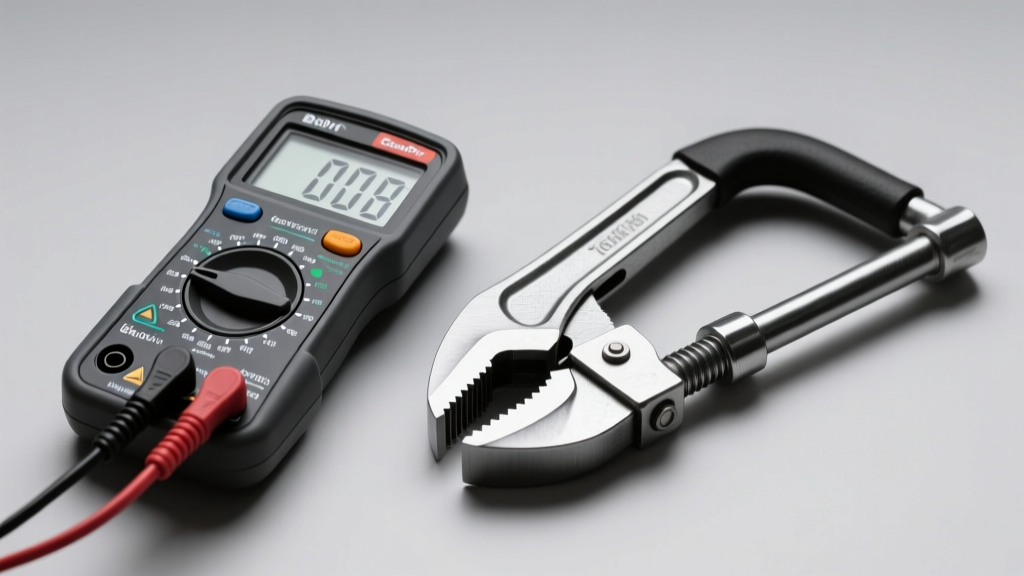
You’re standing in the hardware aisle, holding a digital multimeter in one hand and a hand conduit bender in the other—and wondering why they’re even on the same shelf. They serve entirely different functions, yet both appear in electrician toolkits and DIY garage inventories. Confusion isn’t surprising: neither is a ‘general-purpose’ tool, but both are mission-critical in their niches.
Quick Verdict
Neither tool is ‘better’—they solve fundamentally different problems. A multimeter measures electrical properties (voltage, current, resistance); a conduit bender shapes metal or PVC tubing to route wiring around corners and obstacles. Buying one instead of the other because it looks more ‘technical’ or ‘heavy-duty’ is like choosing a wrench over a thermometer to diagnose an overheating circuit. Your job dictates the tool—not preference.
Side-by-Side Comparison
| Feature | Multimeter | Conduit Bender |
|---|---|---|
| Primary function | Measures voltage, current, continuity, resistance, capacitance | Bends rigid or EMT conduit to precise angles (e.g., 90°, offset, saddle) |
| Typical price range (new) | $15–$300+ (Fluke 87V: $329) | $25–$120 (Greenlee 555: $89) |
| Required skill level | Beginner-friendly with basic safety training | Intermediate; requires practice for consistent bend accuracy |
| Electrical hazard risk | High if misused on live circuits without CAT rating awareness | Low (mechanical only; no electrical contact) |
| Storage footprint | Small (fits in tool pouch) | Bulky (12–18" long; needs dedicated rack or wall mount) |
Deep Dive on Multimeter
A multimeter is your diagnostic eyes and ears for any electrical system. Modern auto-ranging models like the Klein Tools MM400 deliver millivolt resolution and non-contact voltage detection—critical when verifying de-energized circuits before work begins.
- Pros: Versatile across residential, commercial, and automotive applications; detects open neutrals, ground faults, and load imbalances; many include data logging and Bluetooth (e.g., Brymen BM869s)
- Cons: Useless for physical installation tasks; fragile displays and probes wear out; low-cost units (<$20) often lack true RMS or CAT III/IV ratings
- Ideal use cases: Troubleshooting a tripped GFCI, validating outlet polarity, checking battery health in solar setups, or confirming motor winding continuity
According to the National Fire Protection Association’s 2023 Electrical Safety Foundation Report, 12% of residential electrical fires involved undetected open neutrals—issues a quality multimeter catches before energizing a panel.
Deep Dive on Conduit Bender
A conduit bender physically reshapes steel or aluminum EMT (electrical metallic tubing) or rigid PVC to navigate joists, beams, and walls while maintaining wire-pull integrity. Unlike pipe benders, conduit benders account for ‘take-up’—the amount of conduit consumed during bending—so measurements stay accurate.
- Pros: Enables clean, code-compliant runs (NEC 344.24 mandates max 360° of total bend between pull points); eliminates need for couplings and fittings in tight spaces; durable cast-aluminum models last decades
- Cons: Requires memorization of multipliers (e.g., 2.5× for 22.5° offsets); inaccurate bends cause wire damage or failed inspections; not usable for liquid-tight or flexible conduit
- Ideal use cases: Running circuits through basement ceiling cavities, installing outdoor service entrances, or retrofitting old buildings with minimal wall disruption
When to Choose Multimeter vs Conduit Bender
Choose a multimeter when your priority is verification, diagnosis, or validation—especially before and after work. Choose a conduit bender when you’re physically routing conductors and need to change direction without violating NEC fill or bend-radius rules.
- You’re replacing a faulty breaker and need to confirm zero voltage on the bus bar → multimeter
- You’re feeding a subpanel around two load-bearing studs → conduit bender
- You’re inspecting a tenant’s outlet that’s reading 92V instead of 120V → multimeter
- You’re running EMT from a meter base to a garage panel along a brick foundation → conduit bender
- You’re teaching apprentices how to verify grounding electrode resistance → multimeter
Alternatives to Consider
Neither tool replaces the other—but depending on scope, alternatives may reduce need for both:
- Wire strippers with built-in continuity testers offer limited diagnostics but won’t replace full multimeter functionality
- Conduit bending apps (e.g., Bend-Tech Pro) help calculate offsets and saddles—but still require a physical bender to execute
- For light residential retrofits, pre-bent conduit elbows (e.g., 90° EMT sweeps) eliminate bending—but add cost and limit adaptability on-site
Can I use a multimeter to test if my conduit bender is calibrated?
No. Calibration of a conduit bender relies on mechanical alignment and die geometry—not electrical properties. Some pros use a laser level and protractor to verify bend angle accuracy, but that’s unrelated to multimeter function.
Do I need both tools for a home renovation project?
It depends on scope. If you’re only replacing outlets and switches, a multimeter is essential—and a conduit bender unnecessary unless you’re adding new circuits with surface-mounted EMT. According to the U.S. Census Bureau’s 2022 Construction Spending Survey, 68% of single-family remodels involved no new conduit runs—just device replacement and panel upgrades.
Is a cheap $10 multimeter safe for household use?
Risky. UL-listed budget meters often omit input protection and CAT ratings. A surge from a nearby lightning strike or panel fault can send >6,000V through the leads—enough to vaporize cheap internals and injure the user. Stick with CAT III 600V-rated models like the Extech EX330.
Why do some conduit benders have degree markings while others don’t?
Markings (e.g., Greenlee’s ‘Degree-O-Meter’) help beginners visualize bend angles without external tools. Professional-grade benders like the Ideal 46000 rely on take-up marks and experience—because experienced electricians know a 10″ stub-up with a 22.5° bend consumes exactly 2.5″ of conduit length.
Can I borrow or rent either tool instead of buying?
Yes—for short-term jobs. Tool rental platforms like Home Depot’s Tool Rental or Sunbelt Rentals offer Fluke multimeters ($12/day) and Greenlee benders ($18/day). But if you’ll use either more than ~5 days/year, ownership pays off in convenience and calibration consistency.
Does OSHA require either tool for licensed electricians?
OSHA 1910.333 mandates verification of de-energized circuits before work—making a properly rated multimeter effectively required. Conduit benders aren’t mandated, but NEC compliance (which OSHA enforces via 1910.303) makes them necessary for any EMT installation involving bends.
"A bender doesn’t lie—but a multimeter tells the truth only if you read it right. One prevents physical failure; the other prevents human error." — Carlos M., master electrician and NJIB instructor since 2007
If your work involves measuring electricity, you need a multimeter. If it involves shaping pathways for that electricity, you need a conduit bender. Neither substitutes for the other—and trying to force one into the other’s role wastes time, money, and sometimes, safety. Match the tool to the task—not the toolbox aesthetic.