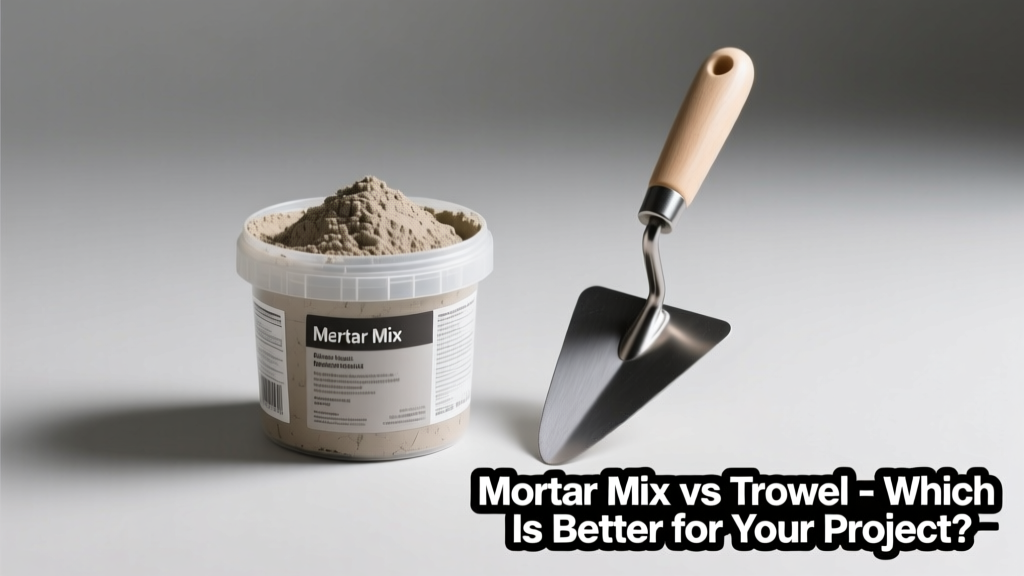
You’re standing in the hardware aisle, holding a bag of gray powder and staring at a stainless-steel trowel—and suddenly realize you don’t actually know which one solves your problem. That’s because mortar mix and trowel aren’t alternatives; they’re teammates. Confusing them is like asking whether a hammer or nails is ‘better’ for building a shelf.
Quick Verdict
Mortar mix and trowel serve entirely different functions: mortar is the adhesive material, while a trowel is the tool used to apply, shape, and smooth it. Neither replaces the other. Choosing one over the other isn’t possible—you need both for most masonry tasks. What matters is selecting the right mortar formulation (e.g., Type N, S, or M) and the correct trowel profile (pointing, margin, or brick) for your job.
Side-by-Side Comparison
| Feature | Mortar Mix | Trowel |
|---|---|---|
| Nature | Pre-mixed or dry blend of cement, lime, sand, and additives | Hand tool with a flat, tapered blade (typically steel or magnesium) |
| Primary Function | Bonds masonry units (brick, block, stone) | Spreads, shapes, levels, and finishes mortar joints |
| Shelf Life | 6–12 months unopened (per Sakrete Technical Data Sheet, 2022) | Indefinite with proper cleaning and storage |
| Cost Range (typical) | $5–$12 per 80-lb bag | $8–$45 depending on size, material, and brand |
| Requires Skill? | Yes—mixing ratios, water content, and curing affect bond strength | Yes—edge control, pressure, and angle impact joint consistency |
Deep Dive on Mortar Mix
Mortar mix is a structural component—not just filler. Its composition determines compressive strength, flexibility, and weather resistance. Type N (750 psi) suits above-grade exterior walls and interior load-bearing applications. Type S (1,800 psi) handles below-grade foundations and retaining walls. Type M (2,500 psi) is for heavy-load masonry like driveways or stone veneer anchors.
- Pros: Provides adhesion, accommodates thermal movement, contributes to wall stability and moisture management
- Cons: Sensitive to mixing errors—too much water reduces strength by up to 40% (per ASTM C270 testing protocols); requires proper curing time (3–7 days minimum)
- Ideal use cases: Laying concrete block for a garden wall, repairing cracked brickwork on a chimney, installing cultured stone veneer
Deep Dive on Trowel
A trowel is a precision instrument—not just a scraper. Blade geometry dictates function: a 4″ pointing trowel fits tight joints on tile grout lines; an 11″ brick trowel delivers consistent 3/8″ mortar beds; a flexible margin trowel excels at smoothing thin-set on backsplashes. Magnesium blades resist rust and offer lighter weight; stainless steel holds a sharper edge longer.
- Pros: Enables control over mortar thickness, joint compression, and surface finish; reusable across dozens of projects
- Cons: Poorly maintained trowels warp or corrode—causing inconsistent bedding and weak joints; cheap stamped-steel versions bend under pressure
- Ideal use cases: Laying pavers on a patio, repointing historic brick façades, applying mortar for a DIY fireplace surround
When to Choose Mortar Mix vs Trowel
You never choose one *instead* of the other—but you do prioritize based on project phase. If you’re prepping for a weekend brick path, buy mortar mix first (check local climate for freeze-thaw requirements), then select a trowel that matches your unit size. If you’re replacing a damaged trowel mid-project, confirm blade width aligns with your block height—e.g., a 12″ trowel pairs best with standard 8″ concrete blocks.
"A trowel doesn’t hold mortar together—it reveals whether the mortar was mixed and applied correctly." — Masonry instructor Elena Ruiz, North Carolina State University Construction Program, 2021
Alternatives to Consider
For small repairs, premixed mortar in tubes (like Quikrete Mortar Repair, 2023 formulation) eliminates measuring and mixing—but costs 3× more per volume and lacks structural capacity for load-bearing work. For large-scale laying, consider a mortar board or mechanical mixer instead of hand-mixing. And if joint finishing is your bottleneck, a jointer tool or concave brick jointer adds speed and consistency beyond what a standard trowel achieves.
Can I use a putty knife instead of a trowel?
No—putty knives lack rigidity and edge control. They compress mortar unevenly and rarely maintain straight lines in vertical joints. A 4″ pointing trowel starts at $10 and lasts decades; a putty knife risks voids and delamination.
Does mortar mix expire?
Yes. Dry mortar loses plasticity and bonding power after 6–12 months if exposed to humidity—even in sealed bags. The U.S. Department of Housing and Urban Development recommends discarding any bag with visible clumping or discoloration before mixing.
What trowel size works for tile installation?
For wall tile up to 8″ × 8″, a 3/16″ V-notched trowel applies even thin-set. Floor tile 12″ × 12″ or larger needs a 1/4″ × 1/4″ square-notched trowel. Notch depth directly controls adhesive thickness—and undersized notches cause poor coverage and hollow tiles.
Is polymer-modified mortar worth the extra cost?
For exterior applications or areas with freeze-thaw cycles, yes. Polymer additives increase bond strength by 25% and reduce water absorption by 30%, according to the Tile Council of North America’s 2022 Performance Report. But for interior dry-area brickwork, standard Type N performs identically at half the price.
Can I reuse leftover mortar mix?
Only if unused and kept dry. Once water contacts the mix, hydration begins—and re-wetting cured mortar creates weak, non-adhesive paste. Discard any mixed mortar after 2.5 hours (per OSHA guidelines on material handling).
Do I need different trowels for indoor vs outdoor work?
Not strictly—but outdoor work benefits from heavier-duty stainless steel trowels that resist corrosion from rain and de-icing salts. Indoor tile work often uses lightweight magnesium for fatigue reduction during long sessions. See our guide on best trowels for tile installation for side-by-side durability tests.
If your project involves bonding, leveling, or finishing masonry, you’ll use both mortar mix and trowel—just not in the same way. Start with the right mortar type for your substrate and exposure, then match it with a trowel that gives you control over placement and finish. For more on pairing materials and tools, explore our mortar types guide or how to repoint brick tutorial.