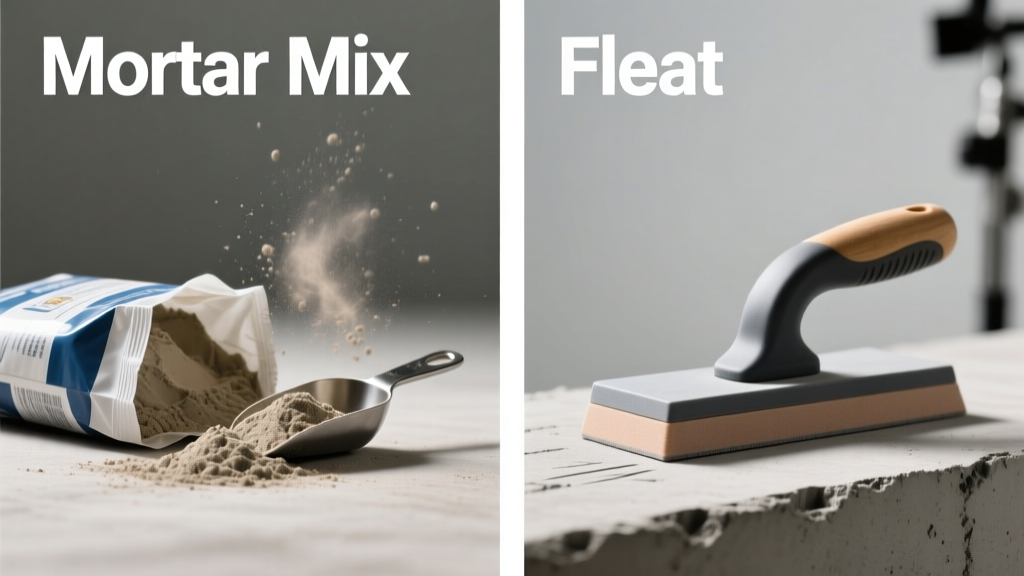
You’re standing in the hardware aisle, holding a bag of mortar mix in one hand and a stainless-steel float in the other—both labeled ‘essential’ on adjacent displays. But they’re not interchangeable. One’s a material; the other’s a tool. Confusing them can mean cracked grout lines, uneven surfaces, or wasted hours reworking a wall.
Quick Verdict
Mortar mix and float serve entirely different roles: mortar is the binding compound (cement, sand, lime), while a float is a hand tool used to smooth, compact, or finish surfaces—including mortar, stucco, or concrete. Asking 'which is better' is like comparing nails to a hammer—you need both for most masonry tasks. The real question is when and how to use each correctly.
Side-by-Side Comparison
| Feature | Mortar Mix | Float |
|---|---|---|
| Category | Construction material (pre-blended dry compound) | Hand tool (typically aluminum, magnesium, or wood) |
| Primary Function | Bonds masonry units (brick, block, tile) and fills joints | Levels, compacts, and finishes wet materials like mortar, stucco, or concrete |
| Typical Cost (U.S.) | $8–$15 per 60–80 lb bag | $12–$45 depending on size, material, and brand |
| Lifespan | Shelf life: 6–12 months unopened; unusable once mixed and dried | 10+ years with proper cleaning and storage |
| Key Variants | Type N, S, M, and pre-mixed thin-set; polymer-modified options | Wood float (for initial screeding), magnesium float (for denser finishing), rubber float (for textured stucco) |
Deep Dive on Mortar Mix
Mortar mix is a formulated blend—usually Portland cement, hydrated lime, and fine sand—with additives that control set time, water retention, and bond strength. Type N (750 psi) suits general above-grade applications like brick veneer or garden walls. Type S (1,800 psi) handles load-bearing walls or below-grade work like foundation piers.
- Pros: Predictable strength and consistency; meets ASTM C270 standards; available in ready-mix and pre-blended thin-set variants for tile
- Cons: Requires precise water ratios—too much weakens compressive strength; unused mixed mortar hardens in 2–3 hours; sensitive to temperature extremes during curing
- Ideal use cases: Laying concrete block for a garage wall; installing ceramic floor tile over a plywood subfloor; repairing historic brickwork where lime-based mortar is specified
According to the Mason Contractors Association of America’s 2022 Field Guide, improper mortar mixing accounts for nearly 37% of field-reported bond failures in residential masonry projects.
Deep Dive on Float
A float isn’t just for smoothing—it’s a precision instrument that controls surface density, moisture migration, and texture. Magnesium floats create tight, closed surfaces ideal for interior plaster or concrete countertops. Wood floats leave a slightly porous, breathable finish preferred for exterior stucco. Rubber floats add grip and are standard for exposing aggregate in decorative concrete.
- Pros: Reusable across dozens of projects; improves mortar adhesion by compacting the surface layer; helps prevent efflorescence by controlling bleed water
- Cons: Requires technique—over-floating causes laitance (weak, dusty surface); too-aggressive pressure on fresh mortar can displace bedding and weaken joint integrity
- Ideal use cases: Finishing a poured concrete patio slab; burnishing a lime plaster wall; texturing a fiber-reinforced stucco coat; leveling thin-set before setting large-format porcelain tiles
When to Choose Mortar Mix vs Float
You don’t choose one over the other—you sequence them. Mortar mix goes down first. Then you use a float to manipulate its surface. But timing matters: start floating mortar within 20 minutes of placement (before initial set), using light, overlapping strokes. Delay too long, and the surface skins over; rush it, and you’ll draw up water and weaken the matrix.
- Installing a stone veneer fireplace surround? Use Type S mortar mix, then a 16" magnesium float to press stones into place and skim excess from joints.
- Repairing a crumbling mortar joint on a 1920s brick chimney? Lime-based mortar mix is mandatory—and a soft wood float prevents damaging historic units.
- Laying 24" x 48" porcelain tiles on a heated floor? Polymer-modified thin-set mortar mix is required, followed by a notched trowel—not a float—for consistent coverage.
Alternatives to Consider
If your goal is faster installation or specialized performance, consider these complementary options:
- Thin-set mortar: Cement-based adhesive with latex or polymer additives—better for tile on concrete or backer board than traditional mortar
- Grout: Non-structural filler for tile joints; never substitutes for mortar in structural bonding
- Self-leveling underlayment: Used beneath tile or flooring—not a mortar replacement, but often paired with it for flat substrates
- Power trowel: For large concrete slabs where hand-floating becomes impractical or inconsistent
Can I use a float on dry mortar mix?
No—dry mortar mix is inert powder. A float only works on freshly mixed, plastic (workable) mortar or concrete. Trying to float dry material does nothing and risks scratching your tool’s face.
Does mortar type affect which float I should use?
Yes. Stiff, high-strength Type M mortar responds best to firm magnesium floats. Softer lime-rich mortars demand gentler wood or resin floats to avoid displacing the mix. Overly aggressive tooling can squeeze out lime paste, weakening the bond.
Why does my floated surface look blotchy?
Blotching usually means inconsistent pressure or timing. Floating too early brings up water and cement paste; too late creates drag marks and missed areas. Let the surface dull slightly (a sheen-to-matte transition) before starting—typically 15–25 minutes after placement, depending on humidity and temperature.
Is there a float that works for both mortar and stucco?
Yes—magnesium floats handle both, but use separate tools if possible. Stucco often contains coarse aggregates that scratch float faces. Dedicated stucco floats have thicker blades and reinforced edges; mortar floats prioritize smoothness over durability.
Do I need a float for small tile jobs?
Not for the tile itself—but you’ll need one for the substrate. If you’re installing tile over a self-leveling compound or a skim-coated wall, floating ensures a uniform, pore-free base. Skipping it increases the risk of hollow spots and lippage.
Can I substitute a trowel for a float?
A margin trowel shapes and moves mortar; a float finishes and densifies it. They’re complementary—not interchangeable. Using only a trowel leaves a weaker, more porous surface prone to dusting and poor adhesion.
"The float doesn’t just make things look smooth—it locks in strength. Proper floating increases surface compressive strength by up to 22% compared to un-floated mortar, per the Portland Cement Association's 2021 Surface Finishing Bulletin."
Bottom line: Mortar mix builds the structure; the float perfects its skin. Neither replaces the other—and mistaking their roles is how otherwise solid projects develop hairline cracks, spalling, or delamination. Match the mortar to your load and exposure, then match the float to your material and finish goal. When in doubt, test both on a scrap board first—your wrist (and wall) will thank you.