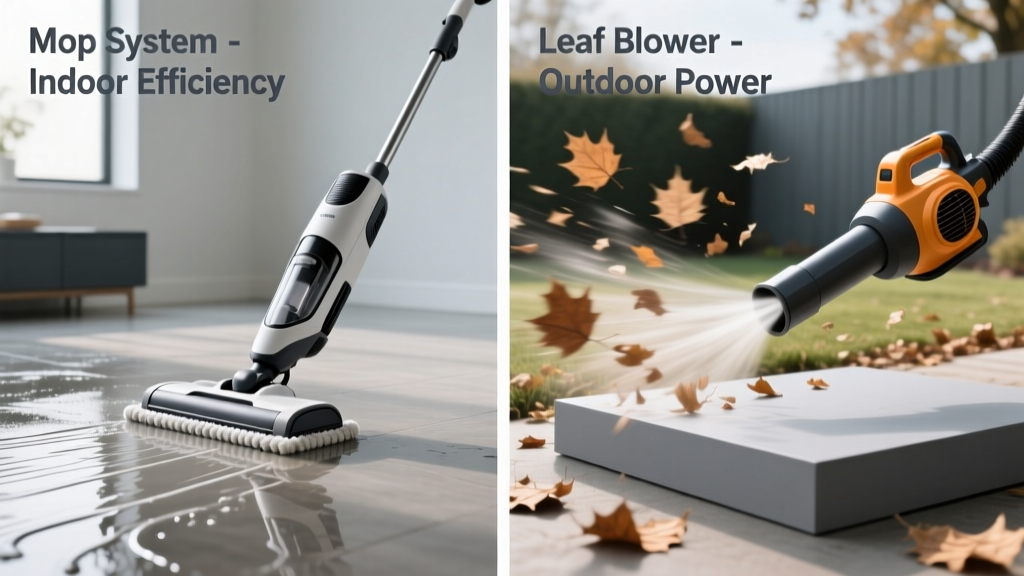
You’re standing in your garage holding a microfiber mop handle in one hand and a gas-powered leaf blower in the other — and it hits you: these tools look nothing alike, yet both promise to 'clean.' But comparing a mop system to a leaf blower isn’t apples-to-oranges; it’s apples-to-leaf-blower — and that confusion is exactly why people overbuy, underuse, or misuse either tool.
Quick Verdict
Neither is universally 'better' — they solve entirely different problems. A mop system excels at removing soil, grime, and bacteria from hard indoor floors. A leaf blower moves dry, lightweight debris (leaves, pine needles, grass clippings) across outdoor surfaces. Using one for the other’s job leads to frustration, damage, or safety hazards — like blowing dust into your kitchen vents or mopping gravel off your driveway.
Side-by-Side Comparison
| Feature | Mop System | Leaf Blower |
|---|---|---|
| Primary Use Case | Indoor hard-surface cleaning (tile, vinyl, hardwood) | Outdoor debris clearance (driveways, patios, gutters) |
| Power Source | Battery, manual, or plug-in (typically 5–100W) | Gas, battery, or corded (300–3,000W equivalent) |
| Noise Level | Under 60 dB (quiet enough for apartments) | 65–115 dB (gas models exceed OSHA’s 85 dB 8-hour exposure limit) |
| Water Usage | Yes — 0.1–0.5 gallons per 100 sq ft (steam mops use more) | No — dry operation only |
| Average Cost | $15–$250 (spin mops to robotic mops) | $40–$700 (corded to commercial-grade gas) |
Deep Dive on Mop Systems
Mop systems range from string mops to spray-and-vac units like the iRobot Braava Jet and steam cleaners like the Bissell PowerFresh. Their strength lies in soil removal via moisture, friction, and chemistry — not airflow.
Pros
- Removes sticky spills, grease, and biofilm that air can’t dislodge
- Sanitizes when paired with EPA-approved disinfectants or steam (≥212°F for ≥3 minutes kills 99.9% of household bacteria, per CDC 2022 guidelines)
- Low physical strain — especially spin and robotic models
Cons
- Ineffective on loose, dry debris like sawdust or pet hair without pre-vacuuming
- Overwetting can warp hardwood or lift vinyl seams
- Microfiber pads require frequent washing — neglecting this spreads bacteria instead of removing it
Deep Dive on Leaf Blowers
Leaf blowers move air at speeds up to 250 mph (ECHO PB-770, 2023 model). They’re engineered for volume displacement — not precision cleaning. The U.S. EPA estimates that gas-powered blowers emit as much pollution in 30 minutes as driving a 2023 Toyota Camry 3,900 miles.
Pros
- Covers 2,000+ sq ft in under 10 minutes — far faster than raking or sweeping
- Reaches tight spots: under decks, around downspouts, between pavers
- Many newer battery models (e.g., Greenworks 80V) meet CARB emissions standards and operate at ~68 dB
Cons
- Blows allergens, mold spores, and pesticide residue into the air — a known asthma trigger (American Lung Association, 2021)
- Can scatter litter, displace mulch, or erode topsoil on slopes
- Useless indoors: creates airborne dust clouds and risks electrocution near outlets or wet floors
When to Choose a Mop System vs Leaf Blower
Choose a mop system if you’re tackling dried coffee rings on kitchen tile, foot traffic film on entryway stone, or post-renovation dust on hardwood. Choose a leaf blower if you’re clearing 3 inches of wet maple leaves off a 40-foot concrete driveway before rain arrives — or evacuating pine needles from a rooftop gutter.
"A leaf blower doesn’t clean — it relocates. A mop cleans — but only where water and contact are safe and effective." — Dr. Lena Cho, indoor environmental health specialist, University of Illinois Extension (2023)
Alternatives to Consider
Before buying either, ask: Is there a better-fit tool? For indoor messes, a hard-floor vacuum with soft roller brush removes dry debris *and* captures fine dust — no water needed. For light outdoor cleanup, a stiff-bristle push broom works quietly and zero-emission on small patios. And for stubborn outdoor gunk (moss, algae), a pressure washer (≤2,000 PSI) outperforms both tools.
Can I use a leaf blower to dry a wet floor?
No. Leaf blowers force unfiltered air — carrying dust, mold, and volatile organic compounds — directly onto damp surfaces. This spreads contaminants and increases slip risk. Use fans rated for indoor use (like Lasko 20-inch box fans) or absorbent microfiber cloths instead.
Will a steam mop kill weeds in my patio cracks?
Steam mops deliver brief, low-volume heat — insufficient for root-zone weed control. Handheld steamers (e.g., Dupray Neat) reach higher temps and longer dwell times, but even those require multiple passes and don’t prevent regrowth. A targeted herbicide or flame weeder remains more effective.
Do robotic mops work on textured tile?
Yes — but performance varies. Models like the Ecovacs Deebot X1 Omni navigate 10mm height changes and adjust pressure for grout lines. Avoid basic vibrating mops on heavily textured or porous stone; they leave streaks and miss crevices.
Are battery leaf blowers strong enough for oak leaves?
Most 60V+ models (e.g., EGO Power+ LB6502) generate 650 CFM and 170 MPH — sufficient for dry oak leaves. But wet, matted leaves demand gas or high-end corded units (≥700 CFM). Always clear in layers: start with top dry layer, then revisit after sun dries lower strata.
Can I mop over sealed concrete outdoors?
Only if the sealer is solvent-based and fully cured (≥30 days). Water-based sealers degrade with repeated wet cleaning. Better: use a leaf blower + dry sweep combo, or dilute pH-neutral cleaner (like Simple Green) with a stiff brush — never a steam mop, which can blister the coating.
Is there a hybrid tool that does both?
No true hybrid exists — and for good reason. Combining high-velocity air and controlled water delivery creates engineering conflicts: corrosion, motor shorting, and inconsistent pressure. Some 'wet/dry vacs' accept blower attachments, but they lack the CFM or nozzle design for leaf management, and their mopping accessories are shallow-damp only — not true cleaning.
If your goal is cleanliness, match the tool to the contaminant type, location, and surface sensitivity — not convenience or brand loyalty. A $20 flat mop beats a $400 leaf blower every time on linoleum. And no mop, no matter how advanced, belongs within 20 feet of a wet deck.