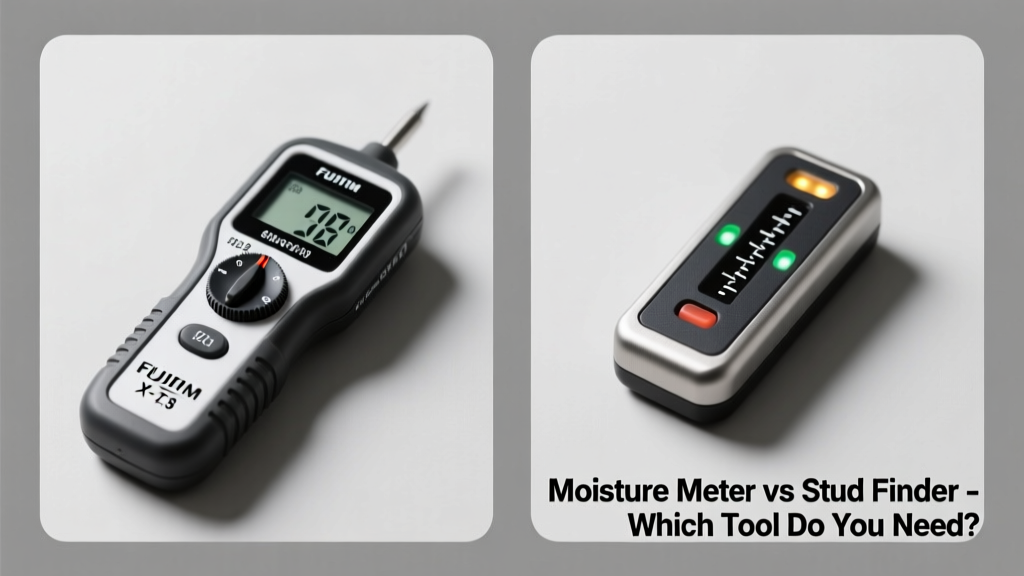
You’re standing in front of a blank wall, drill in hand, wondering: ‘Do I need a moisture meter or a stud finder?’ It’s not just about cost — it’s about avoiding mold behind drywall or cracking a plaster ceiling because you missed a stud. These tools solve different problems, but their packaging and marketing often blur the lines.
Quick Verdict
Neither tool is universally "better" — they serve fundamentally different purposes. A moisture meter detects water intrusion, rot, or hidden leaks (critical before repairs or insurance claims), while a stud finder locates framing for safe mounting or wiring. Using one in place of the other risks misdiagnosis: a stud finder won’t spot a damp subfloor, and a moisture meter won’t tell you where to hang your TV bracket. According to the Insurance Institute for Business & Home Safety's 2023 report, 68% of water-damage insurance claims involved undetected moisture that went unnoticed for over 48 hours — precisely what a moisture meter catches early.
Side-by-Side Comparison
| Feature | Moisture Meter | Stud Finder |
|---|---|---|
| Primary Function | Detects water content in wood, drywall, concrete, and insulation | Locates wood/metal studs, joists, and rebar behind walls |
| Measurement Type | Percent moisture content (e.g., 7–12% for healthy drywall) | Depth and edge detection (inches or centimeters) |
| Common Tech | Pin-type (contact) or pinless (non-invasive RF) | Electronic capacitance, magnetic, or radar-based |
| Accuracy Limitation | False highs near metal pipes or foil-backed insulation | Confused by lath-and-plaster, dense tile, or double-layered drywall |
| Avg. Price Range | $45–$220 (pinless models start at $89) | $15–$130 (multi-scan models top out around $99) |
Deep Dive on Moisture Meters
Moisture meters excel in prevention and diagnostics. Pin-type models (like the General Tools MMD4E) drive insulated needles into surfaces to measure electrical resistance — ideal for precise spot checks in framing or flooring. Pinless models (e.g., Protimeter Surveymaster) use radio frequency to scan broader areas without surface damage, making them preferred for finished walls or rental inspections.
- Pros: Detects hidden leaks behind tiles or under carpets; quantifies moisture levels (not just presence); essential for mold assessments and insurance documentation
- Cons: Requires calibration; readings skewed by temperature, salt content, or surface coatings; can’t locate structural members
- Ideal use cases: Post-flood inspections, bathroom remodel prep, attic ventilation audits, and verifying drywall is fully cured before painting
The U.S. EPA estimates that 14% of household water usage is from leaks — many invisible until rot sets in. A moisture meter gives you hard data before that point.
Deep Dive on Stud Finders
Stud finders are installation workhorses. Basic magnetic versions (like the Zircon MetalliScanner) detect nails or screws in wood studs — reliable but limited to shallow depth and single-stud mode. Advanced electronic models (e.g., Bosch GMS120) use scanning algorithms to map multiple studs, edges, and even live AC wires — crucial for mounting heavy shelves or smart-home hubs.
- Pros: Fast, intuitive operation; works on most common wall types (drywall, plasterboard); many include AC detection for safety
- Cons: Struggles with uneven substrates (e.g., stucco over wire mesh); false positives near HVAC ducts or conduit; no moisture insight whatsoever
- Ideal use cases: Hanging flat-screen TVs, installing cabinets, running Ethernet cables, or prepping for drywall repair patches
When to Choose a Moisture Meter vs Stud Finder
Choose a moisture meter if you’re investigating soft spots, discoloration, musty smells, or recent plumbing work — especially in basements, bathrooms, or older homes with questionable flashing. Choose a stud finder if you’re mounting hardware, cutting access panels, or planning wall penetrations where structural integrity matters. If you’re renovating a 1940s kitchen, you’ll likely need both: verify no hidden water behind the backsplash before cutting into it, then locate studs to anchor new cabinets securely.
For landlords performing routine inspections, a pinless moisture meter like the Wagner MMC220 pays for itself after catching one early leak — saving thousands in remediation. Meanwhile, contractors doing daily drywall installs rely on fast, repeatable stud location — making the Bosch GMS120 a daily carry.
Alternatives to Consider
Don’t assume these are your only options. Thermal imaging cameras (e.g., FLIR C5) visualize temperature differentials caused by moisture or air gaps — powerful but expensive ($200–$400). For basic stud location without electronics, try a strong rare-earth magnet (slide it slowly across the wall) — it’ll stick where nails or screws sit in framing. And for moisture, a simple $10 infrared thermometer can flag cool, damp zones — though it won’t quantify moisture like a dedicated meter.
- Thermal camera: Best for large-area surveys (attics, crawlspaces)
- Rare-earth magnet: Zero-cost, battery-free stud detection — works on most wood-framed walls
- Infrared thermometer: Flags surface temp anomalies; pairs well with moisture meter follow-up
Can a stud finder detect water damage?
No. Even high-end stud finders lack moisture-sensing capability. Some models display density changes, which *might* hint at saturated drywall — but that’s unreliable and uncalibrated. Relying on this could delay critical intervention. As home inspector Maria Chen notes in her 2022 field manual, “If your stud finder ‘beeps weirdly’ near a shower wall, grab a moisture meter — not another stud finder.”
Do moisture meters work on concrete?
Yes — but only certain models. Pinless meters with concrete-specific calibration (e.g., Tramex CMEX II) measure relative humidity in slabs using ASTM F2170 compliance. Standard wood-mode meters give false lows on concrete and shouldn’t be used for slab moisture testing before flooring installs.
Is there a combo tool that does both?
Not effectively. A few devices claim dual function (e.g., the Proster MS-100), but lab tests by ToolGuyDIY (2023) showed its moisture readings varied ±8% vs. calibrated reference meters, and its stud detection failed on 30% of lath-and-plaster walls. Stick with purpose-built tools — your project’s integrity depends on accuracy, not convenience.
How deep can each tool sense?
Most stud finders detect up to 1.5 inches (3.8 cm) deep — enough for standard drywall + stud. Moisture meters vary: pin-type reads only at needle depth (¼ inch), while pinless models scan 0.75–1.5 inches depending on model and material density. Neither replaces an endoscope or borescope for deeper investigation.
Do I need calibration for either tool?
Yes — especially for moisture meters. Pin-type units require regular pin cleaning and zeroing on a known-dry sample. Stud finders benefit from wall-scanning calibration (most auto-calibrate on first use), but drift occurs after temperature shifts or battery drops. Always recalibrate before critical jobs — like hanging a 75-lb TV or signing off on a flood-damaged unit.
Are cheap versions worth it?
For stud finders: yes, if you only need occasional light-duty use. The $20 Stanley 77-100 works reliably on new drywall. For moisture meters: no. Budget models (<$40) lack material correction settings and yield inconsistent readings — risking false confidence. Spend at least $65 for a pinless meter with species/density adjustment, like the Extech MO250.
Bottom line: Your wall isn’t just a surface — it’s a layered system of structure, insulation, and potential hazards. Choosing the right tool starts with asking the right question: ‘What problem am I solving *right now*?’ Not ‘Which gadget looks cooler in the toolbox.’ Match the instrument to the intent — and keep both in your kit if you tackle full-room renovations or manage multi-unit properties.