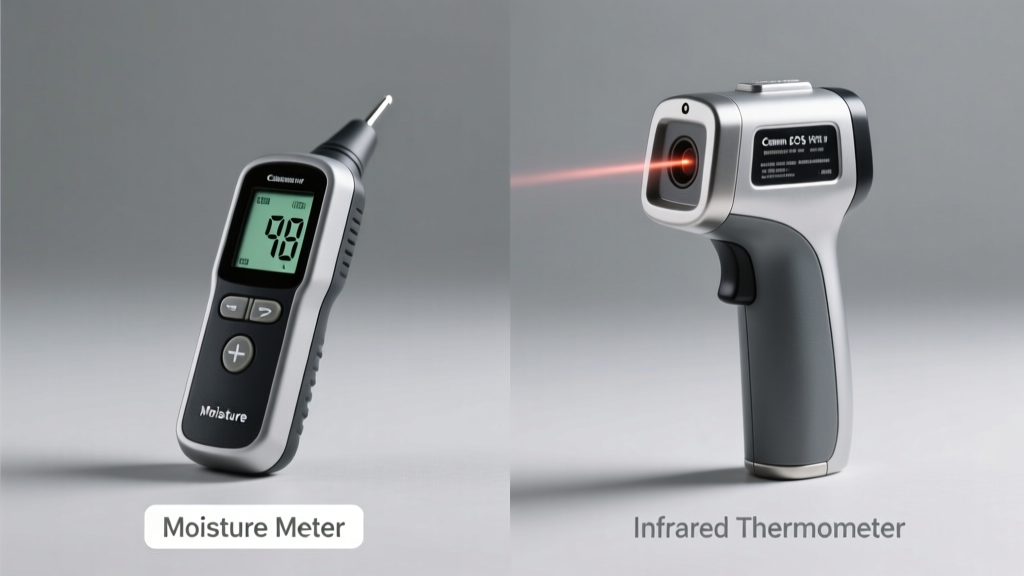
You’re standing in a water-damaged basement, holding two tools: one that beeps when it touches drywall, another that flashes a temperature reading from across the room. Both claim to help diagnose problems — but they measure entirely different things. Confusion is understandable. Neither is ‘better’ universally — it depends on what you’re actually trying to find.
Quick Verdict
A moisture meter detects water content inside materials like wood, drywall, or concrete — often down to 0.1% accuracy — while an infrared thermometer measures surface temperature only, with no insight into internal moisture. They’re complementary, not interchangeable. If you suspect hidden water damage behind walls or under flooring, a moisture meter is essential. If you’re scanning for cold spots indicating insulation gaps or HVAC leaks, reach for the infrared thermometer.
Side-by-Side Comparison
| Feature | Moisture Meter | Infrared Thermometer |
|---|---|---|
| Measures | Internal moisture content (%, WME, or relative scale) | Surface temperature only (°F/°C) |
| Method | Pin-type (electrical resistance) or pinless (capacitance) | Infrared radiation detection (non-contact) |
| Accuracy dependency | Material calibration (e.g., species setting for wood) | Emissivity setting, distance-to-spot ratio, ambient conditions |
| Typical price range (new) | $35–$350+ | $25–$200+ |
| Common use cases | Water damage restoration, flooring installation, fire restoration | HVAC diagnostics, electrical panel scanning, energy audits |
Deep Dive on Moisture Meters
Moisture meters come in two main types: pin-type and pinless. Pin-type models drive insulated probes into material to measure electrical resistance — highly accurate for wood (±0.5% per the Wagner Meters 2022 calibration report), but leave small punctures. Pinless meters use electromagnetic wave reflection and are ideal for finished surfaces like tile or painted drywall, though readings can be skewed by metal backing or uneven density.
Pros
- Direct quantification of moisture — critical for mold prevention thresholds (e.g., >16% in framing lumber signals risk per IICRC S520 standards)
- Can map moisture gradients across a wall or subfloor
- Some models log data or pair with apps for reporting (e.g., Protimeter Surveymaster)
Cons
- Pin-type requires surface penetration — not suitable for delicate finishes or post-remediation verification
- Calibration drift over time; needs periodic verification against known samples
- Cannot detect moisture behind vapor barriers or dense materials like ceramic tile without subsurface access
Deep Dive on Infrared Thermometers
Infrared thermometers detect thermal radiation emitted from surfaces and convert it to temperature values. They excel at spotting anomalies — like a 10°F cooler patch on a ceiling that suggests condensation behind drywall or a missing insulation batt. But crucially, they do not measure moisture. A cold spot may indicate moisture, air leakage, or simply thermal bridging — confirmation requires follow-up with a moisture meter or borescope.
According to the U.S. Department of Energy’s 2023 Home Energy Score Technical Guide, 78% of unaddressed thermal bypasses in retrofits were first identified using infrared scanning — yet only 32% were confirmed as moisture-related after physical inspection.
"Infrared is a screening tool — never a diagnostic endpoint. Always verify temperature anomalies with direct measurement or visual inspection." — Dr. Sarah Lin, Building Science Consultant, Building Science Corporation (2022)
Pros
- No contact needed — safe for live electrical panels or hard-to-reach areas
- Instant readings (under 1 second) across large areas
- Helps prioritize investigation zones before drilling or cutting
Cons
- Cannot distinguish between moisture, drafts, or poor insulation
- Shiny or reflective surfaces (e.g., aluminum ductwork) yield inaccurate readings unless treated with matte tape
- Does not work through glass or most plastics
When to Choose a Moisture Meter vs Infrared Thermometer
Choose a moisture meter when:
- You’re verifying dryness after water extraction (e.g., confirming subfloor reads ≤12% before reinstalling hardwood)
- You’re inspecting a suspected leak behind tile in a bathroom shower niche
- You’re assessing fire-damaged framing for hidden moisture pockets
Choose an infrared thermometer when:
- You’re performing a home energy audit and need to locate insulation voids in exterior walls
- You’re troubleshooting HVAC duct leaks by scanning for temperature differentials along seams
- You’re checking breaker panels for hotspots during routine maintenance
Alternatives to Consider
Neither tool replaces visual inspection or experience — but pairing them with other instruments sharpens your assessment. A thermal imaging camera gives context-rich heat maps (though still no moisture data). A flexible borescope lets you visually confirm suspected issues behind walls. For comprehensive building diagnostics, many pros carry both a moisture meter and IR thermometer — then use a digital hygrometer to monitor ambient RH and correlate findings.
Can an infrared thermometer detect mold?
No. Mold growth requires moisture, warmth, and organic material — but infrared only sees temperature. A cool, damp area may support mold, but so might a warm, humid attic with poor ventilation. Use an infrared tool to find suspicious thermal patterns, then confirm with a moisture meter and visual inspection.
Do moisture meters work on concrete?
Yes — but only specialized models calibrated for concrete (e.g., Wagner’s MMC series). Standard wood meters read inaccurately on slabs. ASTM F2659-22 specifies that concrete moisture testing should use either relative humidity probes (in drilled holes) or calcium chloride tests for flooring prep — surface meters alone aren’t sufficient for slab certification.
Is there a hybrid tool that does both?
Not reliably. Some IR thermometers include basic non-contact moisture estimation (e.g., “wet/dry” icons), but these lack calibration and are prone to false positives. The Fluke 62 Max+ adds IP54 rating and ruggedness, but still measures only temperature. True dual-function devices remain rare and unverified by independent labs like UL or NIST.
How often should I calibrate each tool?
Moisture meters should be zero-checked daily using a calibration block (e.g., Delmhorst’s Calibrator Block) and full calibration every 6–12 months depending on usage intensity. Infrared thermometers require less frequent calibration — typically annually — but should be verified before critical jobs using a blackbody source or ice-water slurry (32°F/0°C reference).
Will either tool help me find a hidden pipe leak?
An infrared thermometer may reveal a cool trail along a stud bay if water is actively leaking and evaporating — but only if the leak is active and near the surface. A moisture meter will detect residual saturation in drywall or subfloor after the leak stops. Neither finds buried copper or PEX pipes directly; for that, you’d need a pipe locator or acoustic listening device.
If your job involves water damage, flooring, or restoration work, start with a quality moisture meter — it’s the only tool that answers the question, “Is this dry enough?” If you’re focused on energy efficiency, HVAC, or electrical safety, an infrared thermometer delivers faster, safer insights. And if your work spans both domains? Many contractors keep both in their truck — not because one replaces the other, but because they answer fundamentally different questions.