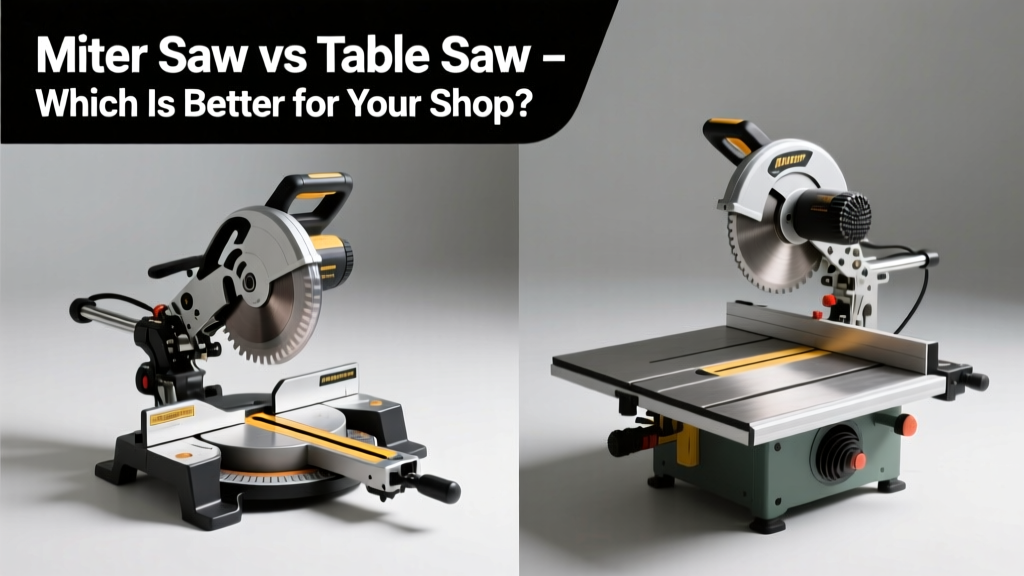
Choosing between a miter saw and a table saw is one of the first big decisions woodworkers face—and it’s not just about price or space. It’s about how you cut, what you build, and where precision meets practicality. Both tools excel, but in fundamentally different ways.
Quick Verdict
A miter saw delivers unmatched speed and accuracy for crosscuts, angles, and trim work—especially in framing, crown molding, and deck builds. A table saw dominates rip cuts, sheet goods, repeatable joinery, and larger-scale cabinet or furniture work. Neither replaces the other; they complement each other. If you can only own one, your most common cut type—not your budget—should decide.
Side-by-Side Comparison
| Feature | Miter Saw | Table Saw |
|---|---|---|
| Cutting motion | Blade lowers vertically onto stationary workpiece | Workpiece pushed horizontally across stationary blade |
| Best cut type | Crosscuts, miters, bevels, compound angles | Rip cuts, long straight cuts, dadoes, rabbets |
| Max rip capacity (standard) | N/A (no rip function) | 24–36 inches (with extension fence) |
| Typical blade size | 10″ or 12″ | 10″ (contractor), 10″–12″ (cabinet) |
| Floor space required | 2–3 sq ft (portable); up to 5 sq ft (sliding) | 8–12 sq ft (including safety zone) |
| Setup time per cut | Seconds (preset angles, stops, fences) | Minutes (fence alignment, zero-clearance insert, blade height) |
Deep Dive on Miter Saw
Miter saws shine when repetition, angle consistency, and clean end grain matter. A high-end 12″ sliding compound miter saw—like the DeWalt DWS780—can cut a 2×14 at 90° and a 2×10 at 45°, with detents every 1°–2° and laser guides that hold ±1/64″ accuracy over 24″ (per Wood Magazine’s 2023 tool test).
Pros
- Extremely fast setup for repeated angled cuts (e.g., 8 identical crown pieces)
- Minimal tear-out on end grain due to downward cutting action
- Compact footprint—fits in garages, job sites, and small workshops
- Integrated stops for common angles (45°, 22.5°, etc.) reduce measuring errors
Cons
- No true rip capability—cannot cut along the length of a board
- Limited capacity for wide or thick stock without flipping or repositioning
- Less stable for very small parts (<2″ wide) unless using a stop block or clamp
- Blade changes take longer than on most table saws due to guard mechanisms
Deep Dive on Table Saw
The table saw remains the undisputed centerpiece of most serious woodshops. Its ability to make precise, repeatable, long cuts gives it unmatched versatility. According to the U.S. Department of Labor’s 2022 OSHA woodworking report, over 73% of shop-related amputations involved improper use of table saws—but 92% of those incidents occurred on models lacking modern riving knives or flesh-detecting brakes like SawStop’s.
Pros
- Superior control for rip cuts, especially on sheet goods (plywood, MDF)
- Excellent for joinery: dados, grooves, tenons (with jigs or dado stacks)
- High repeatability with fence, miter gauge, or crosscut sled
- Better dust collection integration (especially cabinet saws)
Cons
- Requires more floor space and permanent setup
- Steeper learning curve for safe, accurate operation
- Poor for intricate angled cuts on narrow stock without custom jigs
- End-grain crosscuts often need a crosscut sled to match miter saw quality
When to Choose Miter Saw vs Table Saw
If you’re building picture frames, installing baseboard or crown molding, or doing residential framing—your first power saw should be a miter saw. But if you’re making cabinets, bookshelves from sheet goods, or any project requiring consistent rip widths or joinery, start with a table saw. The best table saws under $500 now include integrated riving knives and improved blade guards, narrowing the safety gap significantly.
"A miter saw answers 'How do I cut this piece to length at an angle?' A table saw answers 'How do I turn this 4×8 sheet into 12 usable parts?' They solve different problems—and trying to force one to do the other’s job wastes time, material, and safety margin." — Mike Dresdner, Finishing Techniques, 2021
Alternatives to Consider
Neither tool handles every cut perfectly. For hybrid flexibility, consider:
- Track saws: Excellent for breaking down sheet goods with portability and precision—ideal for contractors or small-space builders
- Band saws: Best for curves, resawing, and irregular shapes—not for straight-line accuracy
- Sliding compound miter saw + table saw combo kits: Some brands (like Bosch and Festool) offer modular stands and accessories that improve workflow synergy
Can a miter saw replace a table saw?
No. While some sliding miter saws claim “rip-like” capacity, they lack fence rigidity, blade stability, and feed control needed for safe, accurate rips. Attempting long rips risks kickback and inconsistent width—especially on hardwoods over 1″ thick.
Is a table saw safer than a miter saw?
Not inherently—but risk profiles differ. Table saws cause more severe injuries (fingers, hands), while miter saws more often cause minor lacerations or pinch injuries. Per the CPSC’s 2023 injury database, table saw incidents account for 32% of all power tool ER visits involving hand injuries, versus 7% for miter saws.
Do I need both for cabinetmaking?
Yes—practically speaking. You’ll use the table saw for panel ripping, dadoes, and edge jointing; the miter saw for door stiles, face frames, and finish trim. Even shops with CNC routers keep both for quick prototyping and cleanup cuts.
What’s the minimum budget for a reliable starter model?
A capable 10″ contractor table saw starts around $450 (e.g., Delta 36-725T2). A solid 10″ dual-bevel miter saw begins at $280 (e.g., Metabo HPT C10FCG). Avoid sub-$200 models—they often skip critical safety features and drift out of calibration within months.
Can I use a table saw for crown molding?
You can—but it’s slower and riskier without a dedicated crown-cutting jig or tall fence. A miter saw with a crown stop delivers faster, safer, and more repeatable results for standard profiles. Save the table saw for coping joints or scribing irregular walls.
Which tool holds value better over time?
Table saws retain ~65–75% resale value after 5 years (based on Machinery Pete’s 2024 Used Tool Market Report), while miter saws average 50–60%. Cabinet saws and premium sliding miter saws (e.g., Festool Kapex) hold value best due to serviceability and precision longevity.
Ultimately, the question isn’t which tool is “better”—it’s which one solves your next three projects most safely and efficiently. Start with the tool that matches your dominant cut type, then add the other as your work evolves. And if you’re still unsure, try renting both for a weekend project: cut identical 1×6 boards at 45°, then rip them to width—you’ll feel the difference in seconds.