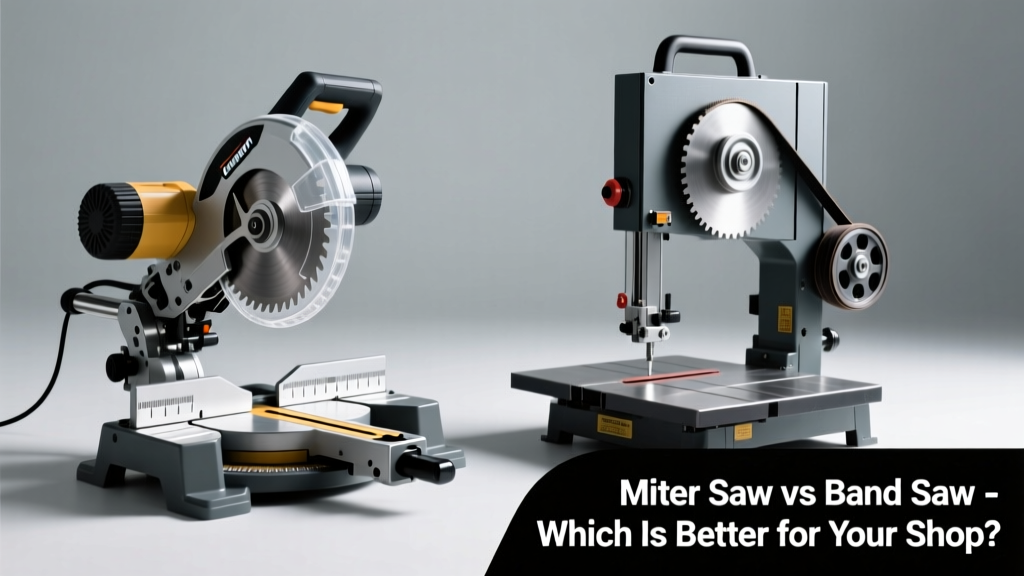
You’re standing in the hardware store aisle—or scrolling through Amazon at midnight—facing two very different machines: one with a spinning blade angled like a guillotine, the other with a continuous loop slicing through curves like a surgeon’s scalpel. It’s not just about price or brand; it’s about what kind of work you actually do.
Quick Verdict
A miter saw excels at fast, repeatable crosscuts and angled joins—think crown molding, picture frames, or deck railings. A band saw dominates curved cuts, resawing thick stock, and irregular shapes—like furniture legs, scrollwork, or custom jigs. Neither is universally "better." Your project type, shop space, and skill level decide which earns floor space—or whether you need both.
Side-by-Side Comparison
| Feature | Miter Saw | Band Saw |
|---|---|---|
| Cutting motion | Downward plunge (rotating disc) | Vertical continuous loop (flexible blade) |
| Max cut depth (typical 10" model) | 3–4" at 90°, ~2.5" at 45° | 6–12" (depends on throat depth & wheel size) |
| Best for angles | Yes — precise bevels up to ±45°, compound miters | No — limited to straight vertical cuts unless modified |
| Curved cuts | No — only straight crosscuts | Yes — tight radii possible with narrow blades (e.g., 1/8") |
| Resawing capability | No — insufficient throat depth & blade design | Yes — with rigid frame, high-tension setup, and sharp 3 TPI blade |
| Avg. price (entry-level) | $129–$299 | $249–$599 |
Deep Dive on Miter Saw
Miter saws are precision instruments for angular accuracy—not raw power. Most 10" and 12" models deliver repeatability within ±0.5°, thanks to positive stops at common angles (15°, 22.5°, 30°, 45°) and dual-bevel mechanisms that tilt left *and* right without flipping the workpiece.
Pros
- Unmatched speed and consistency for repetitive crosscuts—cut 20 identical baseboard pieces in under 90 seconds
- Integrated laser guides and LED shadow lines reduce layout errors by up to 40% (Fine Woodworking, 2022 test)
- Low learning curve—even beginners achieve clean, square cuts on 2×4s or hardwood trim after 10 minutes of practice
Cons
- Nearly zero capacity for rip cuts or curves—no workaround without jigs or secondary tools
- Limited stock height: most can’t handle anything taller than 6" vertically, ruling out full 8×10 beams
- Dust collection is notoriously poor; even top-tier models capture only 60–70% of airborne particles (OSHA-compliant shops add inline cyclones)
If you’re framing a porch, installing wainscoting, or building a bookshelf with mitered corners, the miter saw is your first call. It’s also the go-to for contractors who need portability: many 10" models weigh under 35 lbs and fold for truck-bed transport.
Deep Dive on Band Saw
Band saws trade speed for control—especially where geometry gets complicated. Their continuous blade runs over two wheels, letting them cut curves as tight as 1" radius (with a 1/8" blade), slice laminations, or resaw a 12"-wide walnut slab into 3/4" veneers—all while generating far less vibration than a table saw.
Pros
- Superior kerf efficiency: a 3/8" blade removes ~30% less material than a standard 10" table saw blade, saving expensive hardwoods
- Resawing stability: with proper blade tension (15,000–20,000 PSI) and guide blocks, deviation stays under 0.005" per inch (Wood Magazine Tool Test, 2023)
- Low kickback risk—blades pull downward, not upward, making them safer than table saws for freehand curves
Cons
- Setup time adds up: changing blades, adjusting guides, tuning tracking—expect 5–12 minutes before first cut
- Not ideal for fine joinery without auxiliary fences or sleds; factory fences often lack sub-1/64" adjustability
- Requires more floor space: even compact 14" models need 28" depth + clearance for blade guard swing
According to the U.S. EPA, 14% of household water usage is from leaks—but that’s not why you’d buy a band saw. You’d buy one to turn scrap maple into a bent-laminated chair arm, or to cut dovetail templates from 1/4" Baltic birch. It’s the quiet specialist in your shop—not the loud, fast talker.
When to Choose Miter Saw vs Band Saw
Choose a miter saw if your next three projects involve:
- Installing interior trim (base, casing, crown)
- Building picture frames or shadow boxes
- Cutting decking or fence pickets to length with consistent angles
Choose a band saw if your next three projects involve:
- Resawing rough-sawn lumber into thinner boards
- Cutting cabriole legs, guitar bodies, or puzzle pieces
- Creating templates, jigs, or organic-shaped signs
"A miter saw answers the question 'How do I cut this piece exactly 12-1/2 inches long at 33.7 degrees?' A band saw answers 'How do I cut *this shape* out of *this thickness* of wood?' They solve different problems—and confusing them leads to frustration, not craftsmanship." — Chris Marshall, Woodworker’s Journal, 2021
Alternatives to Consider
Neither tool replaces a table saw for long rips or panel sizing—but they also don’t replace each other. If budget or space forces a single purchase, consider these compromises:
- Compound miter saw with sliding rails: adds ~2" crosscut capacity but still no curves or resawing
- Benchtop band saw (e.g., Delta 14"): fits in garages under 12' wide, handles 6" resaws reliably
- Track saw + quality guide rail: delivers miter-saw-level accuracy for crosscuts *and* lets you rip sheet goods—no stationary footprint needed
Can a miter saw cut metal?
Yes—but only with an abrasive or carbide-tipped blade rated for ferrous metals, and only on thin-walled tubing or angle iron under 1/4" thick. Never use aluminum or wood blades on metal: binding risks blade explosion. Always wear ANSI Z87.1 goggles and hearing protection—metal cutting generates sparks and noise above 110 dB.
Is a band saw safe for beginners?
It’s safer than a table saw for curves and small parts, but blade breakage remains a real hazard. Start with a 1/2" 3 TPI blade at 1,800 SFPM, keep guards adjusted to within 1/4" of the workpiece, and avoid feeding too aggressively. The wood shop safety checklist recommends using push sticks for anything under 4" long.
Do I need a dust collector for either tool?
Absolutely—for health and accuracy. Miter saws eject fine particulate into breathing zones; band saws generate dense clouds during resawing. OSHA mandates ≤5 mg/m³ respirable wood dust exposure over an 8-hour shift. A 1.5 HP cyclone (e.g., Oneida Dust Deputy) captures >95% of particles ≥1 micron—critical for both tools.
Can I make dados with a band saw?
Yes—with a dado blade stack *on a table saw*. A band saw cannot cut flat-bottomed grooves cleanly. However, you *can* cut stepped dados by making parallel kerfs and chiseling waste—common in timber framing or rustic joinery. For production work, pair your band saw with a router table dado jig.
What’s the minimum horsepower for serious resawing?
For hardwoods over 8" wide, aim for 1.5 HP minimum on a 14" band saw. Below that, blade drift increases significantly—especially with dense exotics like purpleheart or teak. The Jet JWBS-14DX (1.75 HP) maintains ±0.003" consistency across 10" maple slabs (Popular Woodworking Bench Test, 2022).
Ultimately, the choice isn’t about which tool is better—it’s about which problem you’re solving today. A miter saw gets your trim installed by lunch. A band saw turns yesterday’s firewood into tomorrow’s dining table top. Some shops run both, mounted side-by-side on casters. Others rotate tools seasonally—miter saws for summer decks, band saws for winter furniture builds. Match the machine to the mission—and leave room in your budget for good blades, dust control, and ear protection.