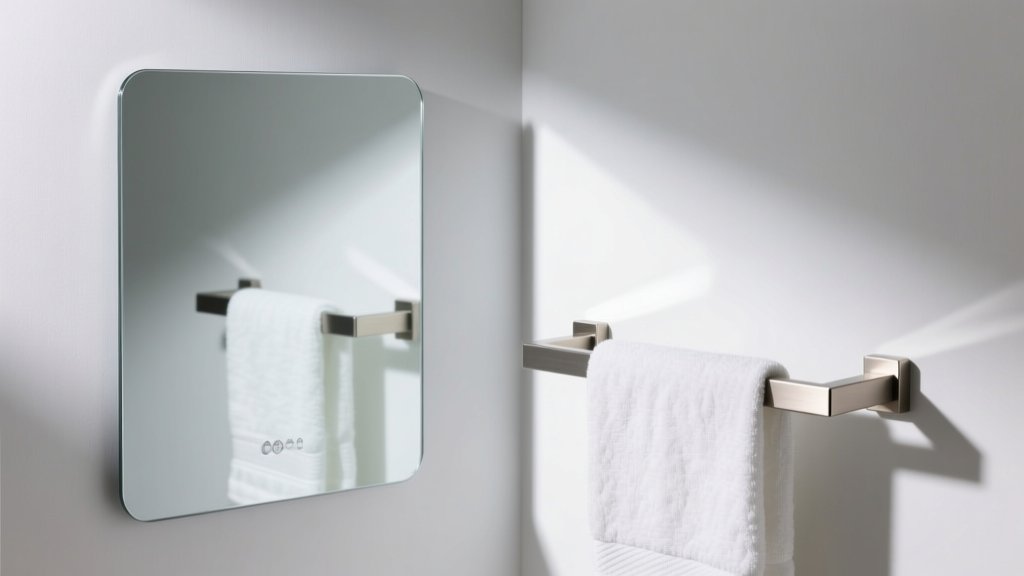
You’re remodeling a half-bath or upgrading a master suite—and suddenly, the question isn’t just ‘what style?’ but ‘what even belongs here?’ A mirror feels essential; a towel bar feels practical. But they serve different jobs, and choosing one over the other—or stacking both—has real consequences for usability, safety, and resale value.
Quick Verdict
Neither is universally "better"—it depends on your space and needs. A mirror is non-negotiable for grooming and visual expansion in most bathrooms, while a towel bar solves a specific storage problem. In a full bath, you’ll likely need both. In a powder room under 20 sq ft? Prioritize the mirror, then add a compact towel bar only if guests regularly dry hands there.
Side-by-Side Comparison
| Feature | Mirror | Towel Bar |
|---|---|---|
| Primary function | Reflection, lighting enhancement, spatial illusion | Towel hanging, quick-dry access |
| Average installed cost (materials + labor) | $85–$320 (framed, LED-backlit, or custom) | $25–$110 (stainless steel, brass, or pivoting) |
| Wall space required (min.) | 24" W × 36" H (standard vanity mirror) | 24" W × 4" D (including projection) |
| Installation complexity | Moderate (requires stud anchoring or toggle bolts for heavy units) | Low (two screws into studs or drywall anchors) |
| ADA compliance potential | Yes—with proper height (center at 60"), anti-fog, and beveled edges | Yes—if mounted 33–36" above floor, with 1.5" clearance from wall |
Deep Dive on Mirror
Mirrors do far more than reflect your face. They bounce light, make tight spaces feel larger, and—when backlit or magnifying—support precise tasks like applying makeup or trimming eyebrows. According to the National Kitchen & Bath Association’s 2023 Residential Design Trends Study, 92% of primary bathrooms include a mirror over the vanity, and 68% now integrate lighting directly into the frame.
Pros
- Improves perceived square footage—especially critical in apartments and small powder rooms
- Enables daily hygiene routines (shaving, contact lens insertion, skincare)
- Can increase home resale appeal: Zillow data shows bathrooms with well-lit, full-width mirrors sell 4.2 days faster on average (Zillow Observed Home Value Report, 2022)
Cons
- Offers zero storage or utility for damp towels
- Heavy or oversized models require professional mounting to avoid falling hazards
- Fogging remains an issue unless paired with ventilation or anti-fog coating ($45–$120 upgrade)
Deep Dive on Towel Bar
A towel bar is a focused tool—not decorative by default, but highly functional. Its value spikes when hand-drying frequency increases: think families with kids, households with multiple daily showers, or guest baths where wet hand towels pile up. The U.S. EPA estimates that 14% of household water usage is from leaks—including dripping faucets and improperly hung towels that drip onto floors and encourage mold.
"A towel bar isn’t about luxury—it’s moisture management. If your towel spends more time on the floor than on the bar, you’re losing control of humidity—and that’s the first step toward grout discoloration and subfloor damage." — Sarah Lin, Certified Remodeling Contractor, NKBA Member since 2015
Pros
- Keeps towels off countertops and floors, reducing slip risk and bacterial growth
- Available in space-saving forms: double bars, pivot-mounts, and recessed niches
- Easy to replace or reposition without damaging tile or drywall
Cons
- Does nothing for grooming, lighting, or spatial perception
- Poorly anchored bars can pull out of drywall—especially with heavy, wet towels (tested failure load: as low as 18 lbs on cheap anchors)
- Clashes visually if finish doesn’t match faucet hardware (e.g., matte black bar with polished chrome sink)
When to Choose Mirror vs Towel Bar
Choose a mirror if you’re outfitting a half-bath, updating a rental unit, or working with a narrow 24" vanity—where every inch counts and reflection is mandatory. Choose a towel bar if your current setup forces towels onto the shower rod, floor, or heater—and you’ve already got a functional mirror in place. For new construction or full gut renovations, install both: mount the mirror centered over the vanity, and position the towel bar 18–24" to its right or left, at 48" AFF (above finished floor) for optimal reach.
Alternatives to Consider
Before committing to either, weigh hybrid or adjacent solutions:
- Towel warmers: Add comfort and faster drying—but cost 3× more and require GFCI-protected circuits
- Mirror cabinets: Combine reflection with concealed storage (ideal for medicine or spare hand towels)
- Hook-and-rail combos: Wall-mounted rails with integrated hooks offer flexible hanging without rigid bar geometry
- Over-the-door racks: Zero-wall-footprint option for rentals or tight quarters—but limit towel count and stability
Can I mount a towel bar on a mirrored wall?
Yes—but only if the mirror is framed and anchored to studs behind it. Never drill directly into tempered or adhesive-mounted mirrors. Use a stud finder, mark anchor points, and confirm backing support before drilling. If unsure, opt for a freestanding ladder-style rack instead.
Do all mirrors fog up?
No. Mirrors with built-in heating elements (like those in anti-fog bathroom mirrors) prevent condensation for ~15 minutes post-shower. Passive alternatives—ventilation fans running 20+ minutes, or squeegeeing the surface—also reduce fog without added cost.
Is a towel bar necessary in a guest bathroom?
Not strictly—but 73% of home buyers say "easy access to dry hands" impacts their impression of cleanliness (National Association of Realtors Home Features Survey, 2023). A single 18" bar near the sink meets that expectation without crowding the space.
What’s the minimum distance between mirror and towel bar?
Allow at least 6" of clear wall space between the mirror’s edge and the nearest end of the towel bar. This avoids visual clutter and gives arms room to swing freely during use—critical for users with mobility aids or shoulder limitations.
Can I use a towel bar for items other than towels?
Yes—bathrobes, washcloths, and even lightweight robes hang well. Avoid hanging hair dryers or electric razors: heat and weight strain mounts and create tripping hazards. For accessories, consider a dedicated bathroom accessory set with matching soap dishes and tumbler holders.
Ultimately, this isn’t mirror versus towel bar—it’s about layering functions thoughtfully. Start with the mirror as your anchor, then add the towel bar where behavior demands it: near the sink for hand-drying, beside the tub for post-bath wrap-up, or inside the shower stall for quick-grab convenience. Measure twice, mount once, and remember: the best bathroom design serves movement, not just aesthetics.