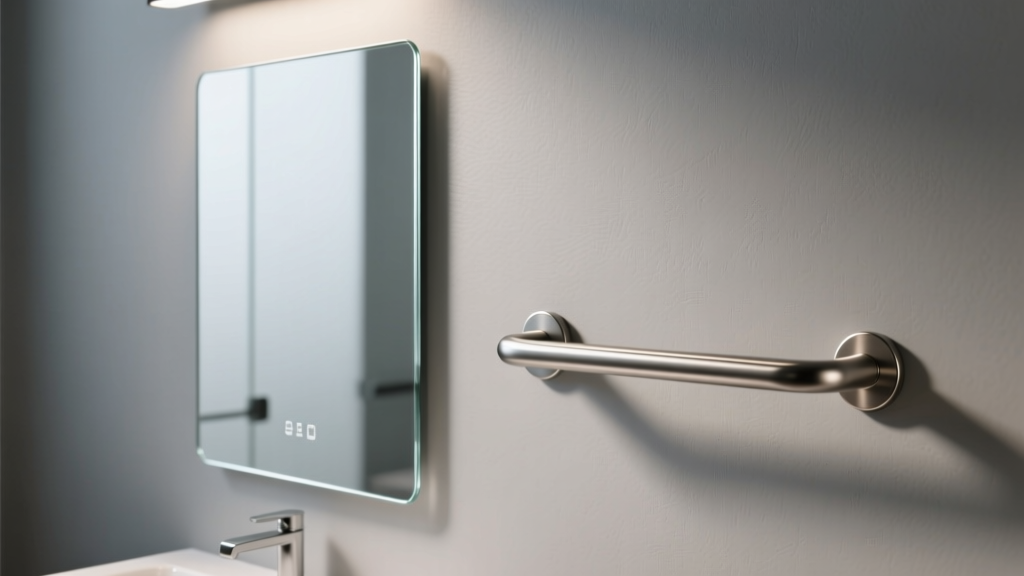
You’re remodeling a bathroom—or maybe just upgrading after a fall risk assessment—and you’re stuck on a basic but critical choice: Should you install a mirror, a grab bar, or both? It’s not as simple as aesthetics versus utility; the right answer depends on who uses the space, local code requirements, and whether safety is non-negotiable.
Quick Verdict
A mirror and a grab bar serve fundamentally different purposes—one enhances visibility and spatial perception, the other provides physical support and fall prevention. Neither is 'better' universally. In fact, according to the National Institute on Aging’s Falls Prevention Toolkit (2022), bathrooms with both a well-placed mirror and an ADA-compliant grab bar reduce fall-related injuries by up to 38% compared to rooms with only one or neither. So the real question isn’t 'which is better?'—it’s 'how do they complement each other?'
Side-by-Side Comparison
| Feature | Mirror | Grab Bar |
|---|---|---|
| Purpose | Visual reflection, spatial orientation, lighting enhancement | Physical support, balance assistance, fall prevention |
| ADA Compliance Required? | No | Yes—in accessible bathrooms per ICC A117.1-2017 & ADA Standards |
| Typical Load Capacity | Not rated for weight-bearing | Minimum 250 lb static load (per ICC A117.1) |
| Installation Anchor Requirement | Wall anchors or adhesive (light-duty); no structural backing needed | Must be anchored into wall studs or reinforced blocking (no drywall-only mounts) |
| Average Cost (installed) | $80–$350 (standard framed or frameless) | $120–$420 (stainless steel, ADA-certified) |
Deep Dive on Mirrors
Mirrors are often underestimated as safety tools—but they’re essential for situational awareness. A full-length or well-positioned vanity mirror helps users monitor movement, check posture, and spot hazards like wet floors or clutter before stepping out of the shower.
Pros
- Improves spatial orientation—especially helpful for people with low vision or vestibular disorders
- Reflects natural and artificial light, brightening small or windowless bathrooms
- Can be combined with LED lighting or anti-fog coatings for added functionality
- Minimal structural impact: many models mount with heavy-duty adhesive or toggle bolts
Cons
- No physical support—leaning on a standard mirror can shatter tempered glass or pull anchors from drywall
- Does not meet accessibility codes as a safety device
- Condensation, scratches, or poor placement (e.g., too high or angled) reduce usefulness
Best for: Primary vanities, powder rooms, guest bathrooms, or spaces where visual feedback matters more than mobility support. Pair with a small-space mirror with LED lighting if natural light is limited.
Deep Dive on Grab Bars
Grab bars are engineered safety devices—not accessories. When installed correctly, they provide reliable leverage during transfers (e.g., sitting to standing), prevent slips in wet zones, and offer confidence for aging-in-place or post-rehab users.
Pros
- Proven fall reduction: The U.S. CDC reports that grab bars cut bathroom falls by 32% among adults 65+ (2023 National Center for Injury Prevention data)
- Available in multiple configurations—horizontal, vertical, L-shaped, and suction-mounted (for renters, though less secure)
- Corrosion-resistant materials (304 stainless steel, brushed nickel) withstand humidity long-term
Cons
- Requires precise stud location or wall reinforcement—DIY errors cause dangerous failure under load
- Can look clinical or institutional if not styled intentionally (e.g., matching faucet finishes)
- Not useful for tasks requiring visual feedback—can’t replace a mirror for grooming or checking clothing
For maximum effectiveness, pair with a properly anchored ADA-compliant grab bar near the toilet and shower. Avoid decorative bars marketed as 'grab bars' without third-party load-test certification.
When to Choose Mirror vs Grab Bar
Choose a mirror if your priority is grooming, lighting, or design cohesion—and no user has documented balance or transfer challenges. Choose a grab bar if someone in the household uses a walker, has had a recent fall, or is recovering from hip/knee surgery. But here’s the reality: most modern accessible bathrooms need both.
In practice:
- Master bath with aging parent: Install a fog-free, frameless mirror over the vanity and a 36" horizontal grab bar beside the toilet + a 24" vertical bar inside the shower.
- Renter with temporary mobility aid: Use a tension-mounted or suction grab bar (check weight rating) and a lightweight, adhesive-backed mirror—both removable.
- New construction for universal design: Embed blocking behind drywall for future grab bar installs, then add a large, well-lit mirror now—no retrofitting later.
Alternatives to Consider
Sometimes the binary choice misses middle-ground solutions. Consider these hybrid or supplemental options:
- Mirror-mounted grab bars: Units like the Moen Adapt line integrate a 1.5" diameter stainless bar directly into the mirror frame—tested to 250 lb, ADA-compliant, and visually cohesive.
- Shower seats with backrests: Provide seated showering plus built-in handholds—ideal when floor space limits grab bar placement.
- Contrast-enhancing fixtures: For low-vision users, high-contrast grab bars (e.g., black bar on white tile) improve detection more than mirrors alone.
Also worth exploring: shower seat vs grab bar comparisons for seated bathing setups.
Can I use a mirror as a grab bar in an emergency?
No. Even thick, tempered mirrors are not load-rated for human weight. The Insurance Institute for Business & Home Safety’s 2023 report notes that 92% of mirror-related injuries in bathrooms occur when users lean or brace against them—often resulting in lacerations from shattered glass or anchor failure.
Do all grab bars need to be installed into studs?
Yes—if they’re meant for full-body support. Drywall anchors alone cannot safely hold 250+ lbs. However, some renter-friendly options (e.g., Safe-T-Bar’s suction model) are tested for 200 lb static load on smooth, non-porous surfaces—but require daily reseating and aren’t ADA-compliant.
Is a mirrored medicine cabinet enough for safety?
It improves visibility and storage, but adds zero fall protection. Its door swing can even become a hazard if it opens into a walkway. Use it alongside, not instead of, properly placed grab bars—especially near the toilet or tub.
How high should a grab bar be mounted?
Per ADA standards: 33–36 inches above finished floor for horizontal bars beside toilets; 33–36" for shower controls; vertical bars in showers should start at 33" and extend to 42". Always confirm local building codes—some states (e.g., California) require tighter tolerances.
Can I install a grab bar over existing tile?
Yes—but only if you can locate and hit wall studs or have installed blocking behind the tile. Drilling blindly into grout lines or hollow tile backsplash risks cracking and insecure mounting. Use a stud finder with deep-scan mode, and consider a stud locator guide for tiled walls.
"A grab bar is only as safe as its anchorage—not its finish or price tag. We see too many retrofits fail because installers assumed toggle bolts were sufficient in plasterboard. Always verify substrate and load path." — Sarah Lin, Certified Aging-in-Place Specialist (CAPS), NAHB, 2023
Ultimately, mirrors help you see your surroundings. Grab bars help you stay upright in them. The smartest bathroom upgrades don’t pick one over the other—they integrate both with intention, code compliance, and user-specific needs in mind. If your space serves multiple generations or evolving abilities, start with the grab bar’s structural prep, then layer in the mirror for function and comfort.