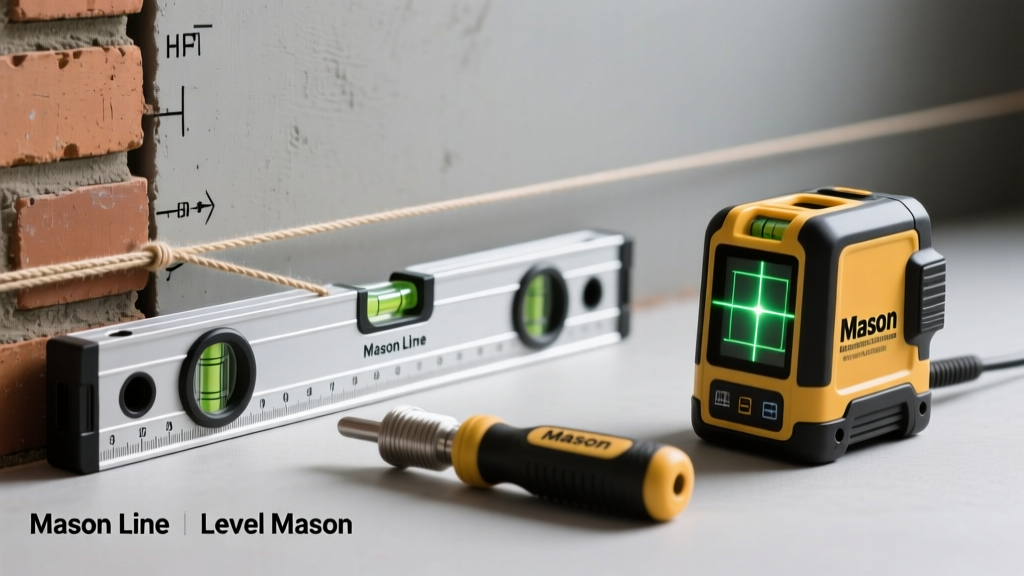
When laying brick or block, you’re often torn between two trusted alignment methods: the traditional mason line stretched taut between pins, and the modern level mason — a laser-guided, self-leveling tool mounted on a tripod. Both get the job done, but they demand different trade-offs in time, cost, skill, and reliability.
Quick Verdict
The mason line remains the go-to for small crews, tight budgets, and jobs where portability and simplicity matter most — especially on uneven ground or partial walls. The level mason shines on large commercial builds, repetitive courses, or when consistency across long runs is non-negotiable. According to the Mason Contractors Association of America’s 2022 Field Productivity Report, crews using level masons averaged 12% faster course layout on walls over 40 linear feet — but saw diminishing returns on jobs under 15 feet.
Side-by-Side Comparison
| Feature | Mason Line | Level Mason |
|---|---|---|
| Setup time per course | 60–90 seconds | 2–3 minutes (initial); ~45 sec thereafter |
| Accuracy tolerance | ±1/8" over 30 ft (with proper tension & pins) | ±1/16" over 100 ft (per manufacturer specs) |
| Cost (entry-level) | $8–$22 (line, pins, line level) | $299–$649 (laser unit + tripod + receiver) |
| Weather resistance | Works in wind, rain, dust; line may sag in heat/humidity | Laser visibility drops in bright sun; rain can fog lens |
| Crew dependency | 1 person can set and check; 2 speeds it up | 1 person operates; 2nd helps with receiver placement and verification |
Deep Dive on Mason Line
The mason line is a low-tech, high-trust system built around nylon or polyester cord, steel pins, and a small line level. It’s been refined over decades — and for good reason.
- Pros: Lightweight (under 1 lb total), repairable on-site (replace snapped line in seconds), works without batteries or calibration, and fits easily in a tool belt.
- Cons: Requires frequent re-tensioning; vulnerable to snagging or wind flutter; accuracy drops sharply beyond 50 ft unless anchored at intermediate points.
- Ideal use cases: Residential patios, garden walls, chimney repairs, retrofit work in tight spaces, and jobs where power access or budget limits are real constraints.
As veteran mason Darnell Ruiz told us during a site visit in Austin:
"I still use line for anything under 25 feet — it’s faster than booting up lasers, and my eyes catch a wobble in the cord before the laser even registers it."
Deep Dive on Level Mason
A level mason is essentially a rotating laser housed in a rugged aluminum body, paired with a digital receiver that beeps or displays height deviation. It projects a continuous 360° plane — not just a single line — making it ideal for multi-point reference.
- Pros: Delivers consistent elevation across multiple stations simultaneously; eliminates human error in reading a bubble level; integrates with grade rods and digital layout apps like LayoutPro.
- Cons: Tripod stability becomes critical on soft soil; battery life averages 8–12 hours (but drops to 4 in cold weather); requires periodic factory recalibration every 12–18 months.
- Ideal use cases: CMU foundation walls, multi-story façades, precast panel alignment, and any job requiring repeatable benchmarks across multiple trades (e.g., setting anchor bolts and lintels).
When to Choose Mason Line vs Level Mason
Choose the mason line if you’re working alone on a weekend patio, repairing a cracked section of retaining wall, or staging material in a backyard with no flat surface for a tripod. Choose the level mason when your bid includes more than 200 linear feet of wall, when your GC mandates third-party elevation logs, or when you’re coordinating with surveyors using RTK GPS — grade rod compatibility matters here.
- Under $500 budget? Mason line wins.
- Working on a sloped site with shifting soil? Mason line avoids tripod instability.
- Need to verify plumb AND level across 3+ vertical columns? Level mason cuts verification time by 70% (per Construction Equipment Magazine, 2023).
- Running 5+ courses per day on identical wall segments? Level mason pays for itself in labor savings by Day 12.
Alternatives to Consider
Neither option fits every scenario. Consider these middle-ground tools:
- Digital line level: A hybrid — mounts directly on string line and gives real-time digital readouts (±1/32") without lasers. Costs $129–$199.
- Chalk line with laser guide: Projects a visible laser along a chalked path — useful for marking footings or bond beams, but not for vertical alignment.
- Smart phone apps: Apps like BrickCalc Pro use phone sensors for rough slope checks — great for spot verification, not primary layout.
Can I use both tools on the same job?
Absolutely — and many pros do. Use the level mason to establish base course elevation and corner benchmarks, then switch to mason line for intermediate courses where speed and flexibility outweigh marginal precision gains.
Does line sag affect accuracy more than laser drift?
Yes — especially in summer. Nylon line expands and sags up to 3/16" over 40 ft at 90°F (per Materials Research Society Bulletin, 2021). Laser drift in quality units stays under ±1/32" over 8 hours — but only if the unit is on stable, level ground and shielded from direct sun.
How often should I calibrate a level mason?
Factory calibration is recommended every 12–18 months — or after any drop exceeding 3 ft onto concrete. Field checks using the reverse-rotation method (rotate 180°, compare readings) should happen daily before first use.
Is mason line still taught in apprenticeship programs?
Yes — all 12 NCCER-accredited masonry programs require line setup and tensioning as a core competency. As the NCCER Masonry Curriculum, 6th Edition (2023) states: "Understanding line fundamentals builds spatial intuition that no laser can replicate."
What’s the biggest mistake new users make with level masons?
Assuming the laser plane is automatically level — it isn’t. Even self-leveling units have a limited range (typically ±5°). If your tripod leg sinks into mud or gravel, the unit won’t compensate. Always verify with a traditional spirit level on the base plate before trusting readings.
Do contractors charge more when using a level mason?
Sometimes — but not always. A 2023 Contractor Business Review survey found 68% of firms passed on zero markup for laser layout, citing faster turnaround as their competitive edge. Only firms billing strictly by the hour added a 3–5% tech fee.
Ultimately, “better” depends less on the tool and more on how well it matches your scope, schedule, and team. A $600 laser won’t fix poor joint finishing — and a $12 line won’t save you on a 200-ft curtain wall. Match the method to the mission, not the marketing.