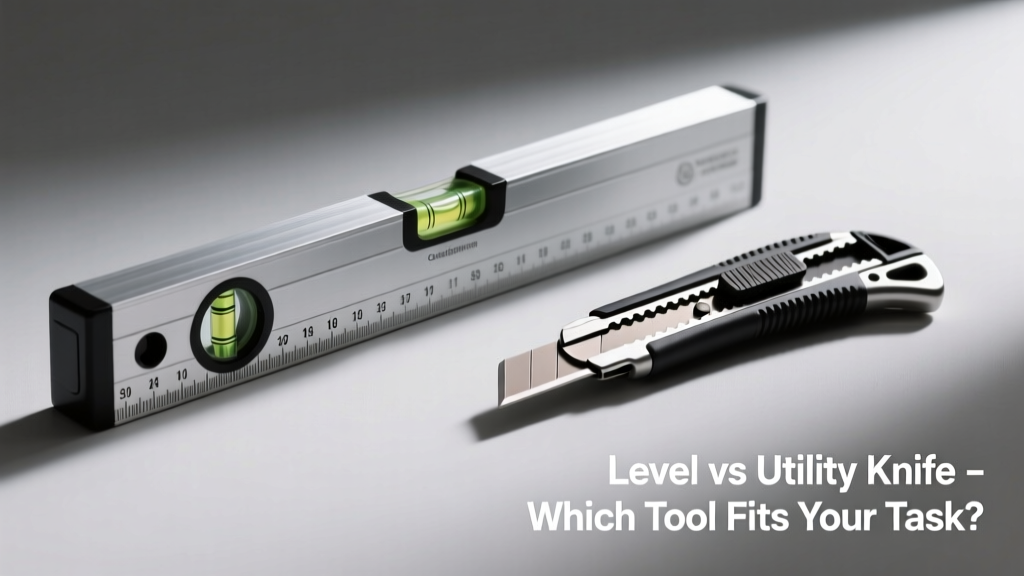
You’re standing on a ladder, tape measure in one hand, trying to hang a shelf—and suddenly you’re second-guessing whether you need a level or a utility knife. They’re both common in toolboxes, but serve wildly different purposes. Confusing them isn’t just inefficient—it can mean crooked shelves, cut fingers, or rework.
Quick Verdict
Neither tool is "better" overall—they solve fundamentally different problems. A level verifies alignment (horizontal, vertical, or plumb); a utility knife cuts, scores, or trims materials like drywall, carpet, or packaging. Using one to do the other’s job leads to poor results or safety risks. Choose based on your immediate task—not habit, convenience, or what’s already in your hand.
Side-by-Side Comparison
| Feature | Level | Utility Knife |
|---|---|---|
| Primary function | Measures and verifies alignment (level, plumb, or pitch) | Cuts, scores, scrapes, or slices materials |
| Core components | Vial(s) of liquid with air bubble, precision-machined body, often magnetic or self-leveling | Retractable or fixed blade, ergonomic handle, replaceable carbon-steel or ceramic blades |
| Typical accuracy | ±0.5 mm/m (0.005°) for standard I-beam levels; ±0.029° for digital models (Bosch 2023 Professional Line) | No inherent accuracy metric—depends entirely on user control and blade sharpness |
| Common materials used on | Walls, framing lumber, tile backer board, countertops, door jambs | Drywall, vinyl flooring, cardboard, insulation, carpet, foam board |
| Safety risk profile | Low—no moving parts or sharp edges | Moderate to high—blades cause ~140,000 ER visits annually in the U.S. (CDC, 2022 National Electronic Injury Surveillance System) |
Deep Dive on Level
Levels exist to eliminate guesswork in alignment. Even small deviations—like 1/8″ over 8 feet—can throw off an entire wall of cabinets or a floor tile layout. Traditional spirit levels use sealed vials filled with alcohol and a bubble; digital levels display precise angles in degrees or percent grade and often include data logging.
Pros of using a level
- Prevents costly rework—e.g., a misaligned ledger board can compromise deck structural integrity
- Enables consistent, repeatable results across multiple installers or days
- Digital models (like the DeWalt DW088K) offer audible alerts and Bluetooth transfer to project plans
Cons of using a level
- Useless for cutting, trimming, or material removal
- Poor-quality levels drift out of calibration—especially after drops or temperature swings
- Larger models (48″+ aluminum) are bulky to carry on a belt or in a compact tool bag
Best for: Framing walls, installing backsplashes, hanging pictures evenly, checking door swing clearance, or verifying HVAC duct pitch.
Deep Dive on Utility Knife
A utility knife is a controlled cutting instrument—not a precision measuring tool. Its value lies in versatility and portability. Most contractors keep at least two: one with a quick-change mechanism for drywall scoring, another with a snap-off blade for long-duration carpet cuts.
"A dull utility blade isn’t just slower—it’s more dangerous. Pressure builds, then slips unexpectedly. Replace blades every 2–3 hours of active cutting, or after hitting staples or nails." — Mike R., master carpenter and OSHA-certified trainer (2023)
Pros of using a utility knife
- Fast, clean scoring of drywall paper before breaking (critical for crisp edges)
- Adjustable depth stops prevent over-cutting into subfloor or joists
- Lightweight, fits in a pocket or pouch—no batteries or calibration needed
Cons of using a utility knife
- No built-in feedback on angle or alignment—cutting straight requires skill or a guide
- Blades wear quickly on abrasive surfaces like concrete backer board or grout lines
- Not rated for structural tasks—never use it to cut load-bearing members or electrical conduit
Best for: Trimming excess drywall tape, cutting insulation batts, opening shipping boxes, scoring laminate flooring, or shaving door edges for hinge clearance.
When to Choose Level vs Utility Knife
Ask yourself: Am I verifying position—or removing material? If the answer is verification, reach for the level—even if the job seems small. Hanging a single floating shelf? A 12″ torpedo level takes 8 seconds and prevents a wobble that’ll bug you for years. If you’re slicing open a pallet of tile or trimming baseboard to fit a gap, the utility knife is the only logical choice.
- Choose a level when: Installing tile spacers, checking sill plate slope, aligning cabinet toe kicks, or verifying stud layout before drywall
- Choose a utility knife when: Cutting fiberglass insulation, scoring drywall for recessed outlets, trimming weatherstripping, or slicing through thick carpet padding
- Never substitute: Using a utility knife to "eyeball" a level line leads to cumulative error—especially over 10+ feet. Likewise, trying to score drywall with a level’s edge risks damaging its vials and voiding calibration.
Alternatives to Consider
Sometimes the right tool isn’t either of these—but something that bridges their functions. Laser levels combine alignment verification with visible reference lines for cutting guides. Combination tools like the Stanley FatMax® Tape Rule + Level integrate a 24″ level with a 25′ tape—handy for rough framing checks. For fine trimming, consider a hook knife for carpet or a drywall rasp for smoothing cut edges—both reduce reliance on utility knife pressure.
- Laser levels offer hands-free alignment over distance, especially useful for ceiling grids or drop ceilings
- Drywall T-squares combine straightedge accuracy with built-in level vials for scoring and cutting
- Speed squares help mark and verify 90° and 45° cuts—often faster than switching between level and knife
Can a utility knife replace a level for small projects?
No. Even for a single picture hook, visual estimation introduces up to 3° of error—enough to make the frame visibly tilted. A $12 magnetic torpedo level eliminates that risk instantly.
Do digital levels eliminate the need for utility knives?
No—they’re complementary. Digital levels may include a built-in stud finder or inclinometer, but they don’t cut anything. You still need a knife to trim drywall around a newly located stud.
Is there a tool that does both jobs?
Not effectively. Some multi-tools include a tiny bubble vial and a retractable blade, but both features are severely compromised—vials lack stability, blades lack rigidity. Stick with purpose-built tools.
How often should I calibrate my level?
Check before each critical use: flip it 180° on the same surface—if the bubble reads differently, it’s out of spec. Aluminum levels can go 6–12 months without recalibration if handled carefully; wood-framed ones may shift seasonally. According to the American Society for Testing and Materials (ASTM E1155-22), field verification should happen daily on commercial sites.
What blade type works best with drywall?
Standard carbon-steel #11 blades work for scoring, but snap-off blades (like Olfa RTY-1) let you expose fresh edges mid-job—critical when cutting dozens of sheets. Ceramic blades last longer on abrasive surfaces but cost 3× more and shatter on impact.
Can I use a level to pry or scrape?
Don’t. Aluminum levels dent easily; vials crack under lateral force. Use a dedicated pry bar or drywall scraper instead—drywall scrapers are designed for this and won’t void your level’s warranty.
Bottom line: Respect the specialization. A level tells you *where* things belong. A utility knife helps you *shape* them to fit. Keep both—but never confuse their roles. When in doubt, ask: "Am I measuring truth—or removing material?" That question alone will steer you right.