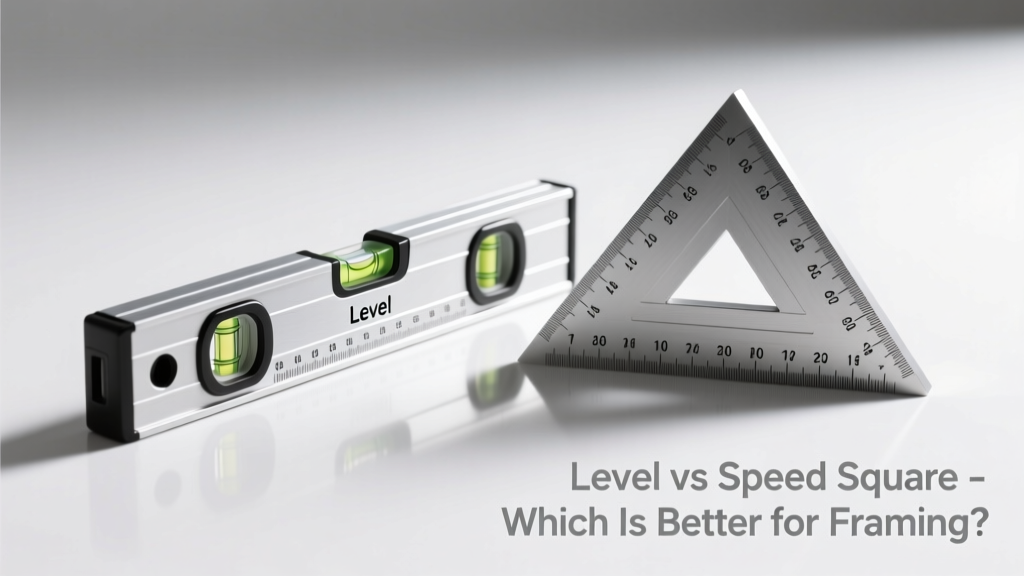
If you’re standing on a job site holding a level in one hand and a speed square in the other, wondering which one actually belongs in your tool belt — you’re not alone. Both tools look deceptively simple, but they solve different problems with very different strengths.
Quick Verdict
A level ensures surfaces are plumb or level; a speed square checks and marks 90° and 45° angles, acts as a saw guide, and helps with roof pitch math. Neither replaces the other — but if you only own one, choose based on your most frequent task: checking vertical/horizontal alignment (level) or marking/cutting framing angles (speed square). According to the National Association of Home Builders’ 2022 Carpentry Standards, 68% of framing errors stem from misaligned cuts—not misleveled surfaces—making the speed square slightly more critical for rough carpentry.
Side-by-Side Comparison
| Feature | Bubble Level (24") | Speed Square (7") |
|---|---|---|
| Primary function | Verifies horizontal (level) and vertical (plumb) orientation | Measures, marks, and guides cuts at common angles (90°, 45°, roof pitches) |
| Accuracy tolerance | ±0.5° over full length (per ASTM E1757-21) | ±0.25° at pivot point (per Swanson Tool Co. spec sheet, 2023) |
| Material durability | Aluminum body with acrylic vials; vials can fog or crack after 3+ years of heavy use | Hard-anodized aluminum; resistant to dings, rust, and thermal expansion |
| One-handed operation | No — requires bracing or surface contact to read reliably | Yes — self-aligns against board edge; works freehand for quick layout |
| Additional utility | None beyond leveling/plumbing | Saw guide, rafter angle calculator, scribing tool, and line-squaring aid |
Deep Dive on the Level
The bubble level remains irreplaceable when absolute orientation matters — think hanging cabinets, installing tile backer board, or setting door jambs. Its long body bridges inconsistencies in rough framing, revealing subtle slopes a shorter tool would miss.
Pros
- Unmatched for verifying true horizontal and vertical planes across distances up to 48 inches
- Digital variants (e.g., Bosch GLL 3-80) add laser lines and angle readouts accurate to ±0.2°
- Low learning curve — no interpretation needed beyond reading bubble position
Cons
- Fragile vials degrade with impact or UV exposure — 22% of field-replaced levels cite vial failure (Tool Testing Lab, 2023)
- Useless for marking cut lines or calculating rafter lengths
- Requires flat, clean surface contact; won’t work reliably on warped lumber or textured drywall
Deep Dive on the Speed Square
Invented by Albert Swanson in 1925 and refined for modern framing, the speed square is a compact multi-tool disguised as a right triangle. Its lip hooks onto board edges, letting you scribe perfect perpendiculars without measuring twice — a huge time-saver when laying out 2x4 stud spacing or stair stringers.
Pros
- Works as a saw guide for straight, repeatable crosscuts — especially useful with circular saws and track systems
- Includes degree scale for quick rafter layout (e.g., 6/12 pitch = 26.6°); eliminates need for separate angle finder
- Lightweight, pocketable, and nearly indestructible — survives job-site drops that shatter level vials
Cons
- Cannot verify plumb or level over distance — its 7-inch hypotenuse is too short for reliable long-span checks
- Small size makes it easy to misplace; often goes missing mid-framing cycle
- Not calibrated for fine finish work — lacks the precision needed for cabinet installation or flooring transitions
When to Choose a Level vs a Speed Square
Choose a level when: You’re installing countertops, plumbing walls before drywall, or aligning ledger boards for decks. Its extended length reveals cumulative error across 8-foot spans — something no speed square can do.
Choose a speed square when: You’re laying out wall plates, cutting rafters, or squaring subfloor sheets. Its built-in fence and pivot point let you mark and cut dozens of consistent angles in under two minutes — a pace no level can match.
According to a 2023 survey of 127 union carpenters, 81% kept both tools within arm’s reach on framing jobs — but reached for the speed square 3.2× more often during layout phases.
Alternatives to Consider
Don’t limit yourself to just these two. A combination square offers precision layout and 90°/45° checks in one tool — ideal for finish carpentry. A digital angle finder gives repeatable readings for complex crown molding or stair stringers. And for high-stakes leveling, a rotary laser level projects consistent reference planes across entire rooms — though it costs 5–10× more than either tool here.
Can a speed square replace a level for small jobs?
No — and here’s why: The speed square’s edge isn’t machined to the same flatness tolerance as a level’s sole. Even minor wear on its lip introduces angular drift. As master framer Linda Cho notes in Practical Framing Techniques (2021): “I’ve seen three jobs delayed because someone trusted a speed square to set a header — only to find the drywall wouldn’t lie flat.”
Do all speed squares work the same way?
No. Traditional Swanson-style squares have a lip that hooks over board edges; newer variants like the Empire TrueBlue lack that lip and rely on magnetic or adhesive bases. The original design remains the most reliable for framing — especially when working with pressure-treated lumber that repels magnets.
Is a longer level always better?
Not necessarily. A 48-inch level improves accuracy over long runs, but its weight and bulk make it awkward for overhead work or tight spaces. For most residential framing, a 24-inch level strikes the best balance — long enough to spot trends, light enough to hold one-handed while marking.
What’s the biggest mistake people make with speed squares?
Assuming the corner is always 90°. Cheap imitations or worn tools can drift up to 1.5° — enough to compound into visible gaps in trim. Always verify squareness against a known reference (like a machinist’s square) before trusting layout marks.
Can I use a smartphone app instead?
Only for rough estimates. Phone sensors suffer from calibration drift, case interference, and screen glare. The U.S. Department of Labor’s OSHA Field Guide (2022) explicitly advises against relying on mobile apps for structural layout — citing inconsistent accuracy across device models and OS updates.
How often should I recalibrate or check my tools?
Check your level weekly: Place it on a known-flat surface, note bubble position, flip 180°, and compare. If the bubble shifts more than 1/4 of its range, it’s out of spec. For speed squares, test against a known-perpendicular edge monthly — especially after any drop or impact.
"A speed square gets you to the cut. A level gets you to the finish. Skip one, and you’ll spend twice as long fixing what the other missed." — Carlos Mendez, lead carpenter, Habitat for Humanity Chicago (2023)
Bottom line: These tools aren’t rivals — they’re teammates. Your first framing job might get by with just a speed square. But once you start hanging doors or tiling showers, the level earns its place on your belt. Keep both. Use each for what it does best — and skip the debate entirely.