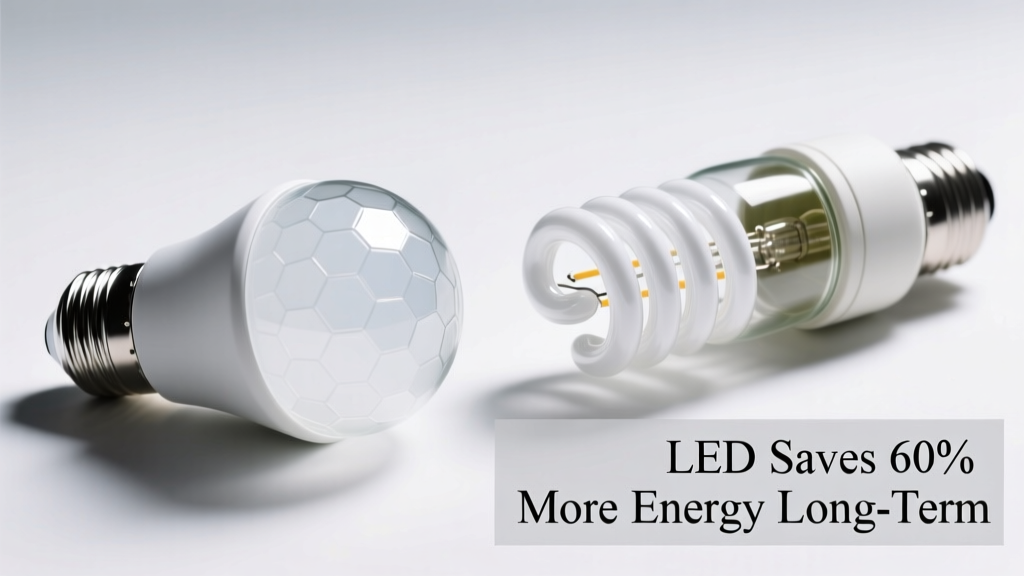
Choosing between LED and CFL bulbs feels like picking between two reliable but very different tools — one’s been around for decades, the other dominates new fixtures. You’ve probably replaced a burnt-out bulb only to stare at the packaging, wondering if that slightly higher upfront price for LED is worth skipping CFL’s familiar spiral shape.
Quick Verdict
For nearly all residential uses today, LED bulbs are the better choice: they last 2–3× longer than CFLs, use 25–30% less energy for the same brightness, contain no mercury, and reach full brightness instantly. CFLs still hold narrow advantages in ultra-low-cost replacements or specific dimming-compatible fixtures — but those cases are shrinking fast.
Side-by-Side Comparison
| Feature | LED Bulb | CFL Bulb |
|---|---|---|
| Average lifespan | 15,000–25,000 hours | 8,000–10,000 hours |
| Energy use (for 800 lumens) | 8–10 watts | 13–15 watts |
| Time to full brightness | Instant | 30–90 seconds |
| Mercury content | None | 3–5 mg per bulb |
| Cold-temperature performance | Works down to –20°F (–29°C) | Output drops below 50°F (10°C); may not start below 20°F (–7°C) |
| Dimmability | Only with "dimmable" label + compatible dimmer | Few models dim; often flicker or buzz |
Deep Dive on LED Bulbs
LEDs dominate modern lighting for good reason — and it’s not just marketing. Their solid-state design means no fragile filaments or gas-filled tubes. That translates directly to reliability in high-vibration areas like garage door openers or ceiling fans.
Pros
- Up to 90% more efficient than incandescents, and ~30% better than CFLs (U.S. DOE, 2022)
- No warm-up time — ideal for motion-sensor closets or stairwells
- Directional light output reduces wasted lumens in recessed or track lighting
- Wide color temperature range (2700K–5000K) with consistent CRI >80 on most mid-tier models
Cons
- Premium models with high CRI (90+) or smart features cost $3–$8 each — still under $1/bulb for basic ones
- Heat-sensitive: poor ventilation in enclosed fixtures can cut lifespan by up to 40% (Lighting Research Center, 2021)
- Early-generation LEDs had blue-heavy spectra; newer ones match warm-white CFLs closely
Deep Dive on CFL Bulbs
CFLs were the first real alternative to incandescents — and they helped shift consumer expectations about efficiency. But their technology plateaued while LED costs dropped 85% between 2010 and 2020 (International Energy Agency, 2021).
Pros
- Still cheaper upfront: $1.25–$2.50 per bulb at big-box stores
- Good diffuse light for table lamps or bare-bulb pendants where soft spread matters
- Proven track record in stable, indoor, room-temperature environments
Cons
- Contains mercury — requires special cleanup if broken and hazardous disposal
- Lifespan plummets with frequent on/off cycling (e.g., bathroom with occupancy sensor)
- Performance degrades noticeably after 6,000 hours — color shifts warmer, output drops ~20%
When to Choose LED vs CFL
Go LED if you’re replacing bulbs in: outdoor fixtures (especially cold climates), ceiling fans, dimmable living rooms, or anywhere used more than 2 hours/day. The payback period is under 1 year in high-use spots — our LED cost calculator shows typical households save $55–$75/year switching 20 bulbs.
Consider CFL only if you’re stocking spares for an older fixture with non-dimmable, non-enclosed sockets — and you’ll replace them within 3 years anyway. Even then, check whether your local hardware store still stocks them: Home Depot phased out CFLs in 2023, and Lowe’s followed in early 2024.
Alternatives to Consider
Don’t default to either if your needs fall outside standard A19 use. For example:
- Smart LED bulbs add scheduling, color tuning, and voice control — useful in bedrooms or home offices
- Halogen incandescents (now rare) still work in oven lights or certain track systems where heat tolerance matters
- Linear LED tubes (T8/T5 replacements) cut commercial retrofits by 40–50% energy versus CFL tubes
Do LED bulbs really last 25,000 hours?
Yes — but only under lab conditions. Real-world life depends on heat management and voltage stability. In a well-ventilated ceiling fixture used 3 hours/day, expect 12–15 years. In a sealed outdoor fixture in Phoenix summer heat? Closer to 8–10 years.
Can I put an LED bulb in a CFL fixture?
Almost always — as long as the base matches (E26/E27 standard) and the fixture isn’t labeled "CFL only." Some older CFL ballast-integrated fixtures require bypassing the ballast to use LED tubes, but screw-in LED A19s plug-and-play.
Why do some CFLs flicker or buzz?
It’s usually the magnetic ballast aging or incompatible dimmers. Electronic ballasts reduced this, but never eliminated it — unlike LEDs, which flicker only with low-quality drivers or mismatched dimmers.
Are CFLs banned anywhere?
Not outright, but the U.S. Department of Energy’s 2023 efficiency rules effectively ended most CFL production. The EU banned most CFLs starting September 2023 under ecodesign regulations. Canada phased out non-compliant models in 2024.
What’s the environmental impact difference?
Over 10,000 hours of use, an LED bulb produces ~35 kg CO₂ equivalent (including manufacturing), versus ~52 kg for a CFL — and that doesn’t include mercury remediation costs. According to the EPA’s 2022 Life Cycle Assessment, mercury recovery rates for CFLs hover near 30%, meaning most ends up in landfills.
"The era of CFLs as a mainstream choice is over — not because they failed, but because LEDs improved faster and cheaper than anyone predicted." — Dr. Naomi Fisher, Lighting Research Center, Rensselaer Polytechnic Institute, 2023
If you’re holding a half-used pack of CFLs, finish them — but don’t buy more. For new installations or bulk replacements, LED is the pragmatic, economical, and increasingly universal choice. Just match the color temp to your space: 2700K for cozy bedrooms, 3000K for kitchens, and 4000K for garages or home offices. And if you’re upgrading a whole house, our retrofit checklist walks through socket types, dimmer compatibility, and disposal steps for old CFLs.