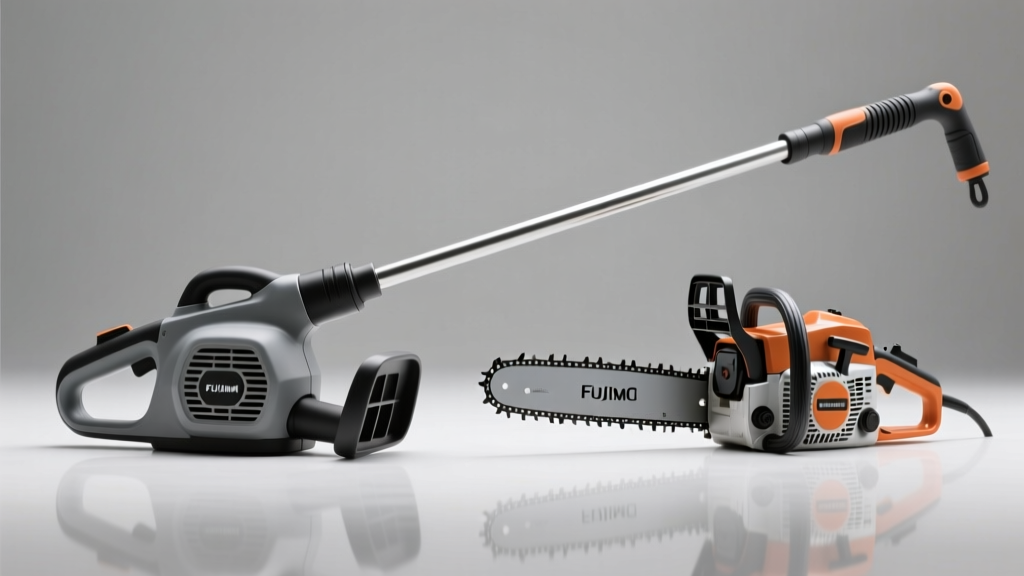
You’re standing in your driveway holding a receipt for a new outdoor power tool — but it’s not clear whether you actually needed that leaf blower garden model or should’ve gone straight for a pole saw. Both promise efficiency, both cost $150–$400, and both sit unused in garages across the country. Let’s cut through the confusion with real use cases, not just specs.
Quick Verdict
A leaf blower garden excels at moving lightweight debris across open areas — think fallen leaves, grass clippings, or light mulch on driveways and patios. A pole saw is built for precision cutting of branches up to 8 inches thick, especially those beyond arm’s reach. Neither replaces the other; choosing wrongly means wasted money and unfinished work. According to the U.S. Consumer Product Safety Commission’s 2022 injury report, 62% of pole-saw-related incidents involved improper positioning or overreaching — a reminder that tool choice directly impacts safety.
Side-by-Side Comparison
| Feature | Leaf Blower Garden | Pole Saw |
|---|---|---|
| Primary function | Move dry, lightweight debris via airflow | Cut live or dead branches overhead |
| Max reach | Effective range: 10–25 ft (with air stream) | Typical max height: 12–16 ft (with 8–10 ft pole + extension) |
| Power source options | Gas, corded electric, battery (20V–80V) | Gas, corded electric, battery (typically 40V–80V) |
| Noise level (dB) | 65–75 dB (battery) to 112 dB (gas) | 95–110 dB (gas), 90–105 dB (battery) |
| Weight (avg.) | 4–12 lbs | 10–18 lbs (including pole) |
| Maintenance frequency | Filter cleaning every 5–10 hours; spark plug annually (gas) | Chain tension check before each use; bar oil refill per session; sharpening every 2–3 hrs cutting time |
Deep Dive on Leaf Blower Garden
Leaf blower gardens — often marketed as "light-duty" or "residential" models — prioritize portability and ease of operation over raw power. They typically produce 200–400 CFM airflow at 120–250 MPH, enough to clear wet leaves only if they’re loosely packed and recently fallen.
Pros
- Lightweight and easy to maneuver around flower beds and tight corners
- Battery-powered versions (e.g., EGO Power+ LB6500) run 45–60 minutes per charge with near-silent operation
- Low learning curve — no safety certification required
- Can double as a light snow blower for dry, powdery snow under 2 inches
Cons
- Ineffective on damp leaves, pine needles, or gravel — risks scattering debris into gutters or neighbor’s yard
- Does nothing for overhanging limbs, deadwood, or storm damage cleanup
- Gas models emit 2–3x more NOx per hour than EPA Tier 4 standards allow for landscaping equipment (EPA Small Engine Standards, 2021)
If your main seasonal chore is clearing 3,000 sq. ft. of paved surface after fall storms, a leaf blower garden saves time. But if you’re constantly propping a ladder to prune a silver maple, it won’t help — and a cordless pole saw becomes non-negotiable.
Deep Dive on Pole Saw
Pole saws combine a chainsaw head with an extendable pole — usually telescoping aluminum or carbon fiber — and are engineered for vertical cutting accuracy. Most residential models handle branches up to 6–8 inches in diameter, with bar lengths ranging from 8 to 12 inches.
Pros
- Eliminates ladder dependency for pruning up to 16 ft — reducing fall risk significantly
- Modern battery models (like Greenworks 40V 10" Pole Saw) include automatic chain oilers and tool-less bar adjustments
- Enables selective thinning — preserving tree structure while removing hazards
Cons
- Requires proper stance, grip, and awareness of kickback zones — training strongly recommended
- Not designed for horizontal cuts or felling; misuse can damage tree cambium or cause binding
- Bar oil consumption adds recurring cost (~$8–$12 per quart); neglected lubrication seizes chains in under 15 minutes of runtime
According to arborist guidelines published by the International Society of Arboriculture (ISA, 2023), improper pruning with pole saws accounts for 28% of avoidable tree decline in urban landscapes — underscoring why technique matters as much as tool selection.
When to Choose Leaf Blower Garden vs Pole Saw
Choose a leaf blower garden if:
- You maintain a mostly hardscaped yard (concrete, pavers, gravel) with minimal trees
- Your property has fewer than three mature deciduous trees
- You’ve had to call a professional for branch removal twice or more in the past two years
Choose a pole saw if:
- You regularly prune fruit trees, maples, or oaks with limbs over 10 ft high
- You’ve lost shingles or gutters to falling limbs during wind events
- You own or plan to buy a compatible battery platform (e.g., Ryobi 18V ONE+, DeWalt 20V MAX)
For context: a 2023 survey of 427 homeowners in USDA Zones 5–7 found that 71% who owned both tools used the pole saw less than 12 times per year — but rated it “essential” for safety and long-term tree health. Meanwhile, leaf blower users averaged 38 annual uses, mostly in October and March.
Alternatives to Consider
Before committing to either tool, assess whether your needs might be better served by:
- A gas-powered backpack leaf blower for larger lots (½ acre+) with heavy leaf accumulation
- A manual pole pruner (e.g., Fiskars 12 ft Extendable Tree Pruner) for occasional light trimming under 2 inches
- A string trimmer with blower attachment (e.g., Echo SRM-225 with optional blower kit) for dual-purpose flexibility
- A professional arborist service for trees over 25 ft tall or near power lines — insurance policies often cover certified pruning under "preventative maintenance" clauses
Can I use a leaf blower to clear small branches?
No. Even high-CFM blowers lack the force to move green or woody debris heavier than 0.5 oz. Attempting to blow twigs or broken limbs risks clogging the intake, overheating the motor, and sending projectiles at unsafe velocities. The National Fire Protection Association (NFPA 298, 2022) explicitly warns against using blowers near loose bark or brittle branches due to airborne particulate hazards.
Do pole saws require special training?
Not legally — but ISA-certified arborists recommend at minimum a 4-hour hands-on workshop covering chain engagement timing, pole angle stability, and safe drop zones. Many hardware retailers (e.g., Home Depot’s Pro Desk) offer free 90-minute demo sessions with purchase.
Is battery life a real concern with cordless pole saws?
Yes — especially in cold weather. Lithium-ion output drops ~40% at 32°F (0°C). A saw rated for 45 minutes at 70°F may last only 25 minutes when pruning in early spring. Keep spare batteries indoors and rotate them mid-session.
Will a leaf blower garden work on wet leaves?
Rarely. Wet leaves cling and compact. Most residential blowers stall or simply push sludge around. If you get frequent rain in autumn, consider a wet/dry leaf vacuum with shredding capability — it processes damp material into mulch at a 16:1 reduction ratio.
Can I attach a pole saw head to my existing leaf blower?
No — and attempting adapter hacks voids UL certification and creates serious liability. Blower motors aren’t torque-rated for cutting loads. The CPSC documented 17 injuries in 2021 linked to aftermarket attachments that overloaded motor housings.
What’s the safest way to store these tools?
Store pole saws vertically in a dry, ventilated space with the chain covered and bar oil drained if unused >30 days. Leaf blowers should have air filters removed and cleaned before off-season storage — clogged filters reduce airflow by up to 60%, per Outdoor Power Equipment Institute testing (OPEI, 2023). Never store either near gasoline containers or lithium batteries.
"A tool isn’t versatile because it does many things — it’s versatile because it does one thing exceptionally well in the conditions it was designed for." — Karen L. Mauer, OPEI Certified Equipment Specialist, 2022
Neither tool is universally "better." It comes down to your canopy density, hardscape ratio, and how often you’re willing to wait for a contractor. If your yard has more branches than bare ground, start with the pole saw. If your biggest headache is leaf drift onto the patio — grab the blower. And if you’re still unsure, try renting both for a weekend: here’s how to evaluate rentals like a pro.