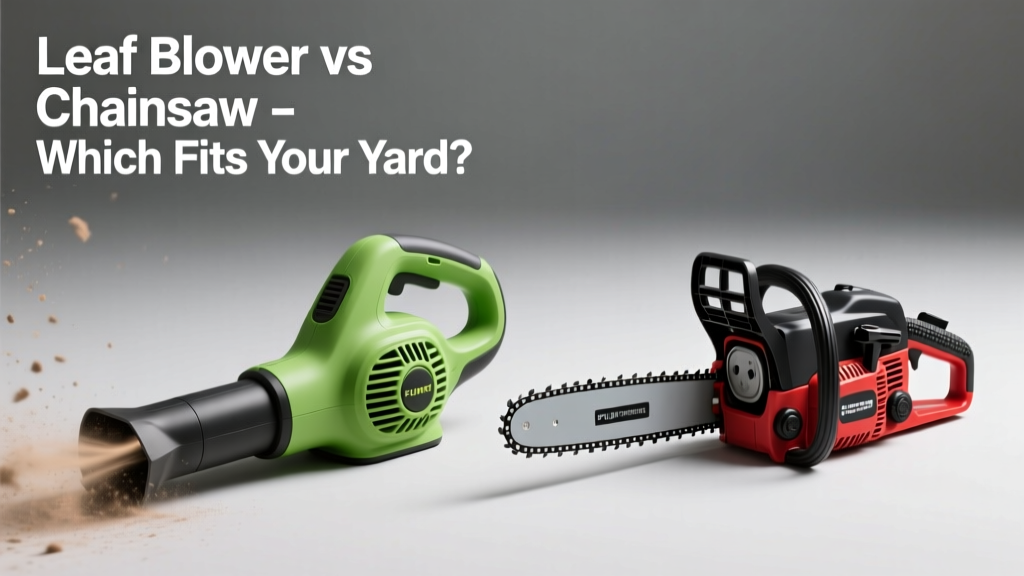
You’re standing in your yard holding a leaf blower in one hand and eyeing that fallen branch—or maybe that overgrown shrub—with a chainsaw in mind. Both tools roar, both clear space, but they solve fundamentally different problems. Confusing them can waste money, risk injury, or leave work half-done.
Quick Verdict
A leaf blower excels at moving lightweight, dry debris—leaves, grass clippings, pine needles—across open areas quickly and with minimal physical strain. A chainsaw is built for cutting live or dead wood: branches over 2 inches thick, storm-damaged limbs, or felling small trees. They’re not interchangeable; choosing wrongly means either fighting physics (trying to blow a 6-inch limb) or risking kickback (using a chainsaw to tidy a patio).
Side-by-Side Comparison
| Feature | Leaf Blower (Garden Use) | Chainsaw |
|---|---|---|
| Primary Function | Moving dry, lightweight organic debris | Cutting live or dead wood |
| Max Effective Material Size | Leaves, twigs under ¼ inch diameter | Branches up to 24+ inches (depending on bar length) |
| Average Noise Level (dB) | 65–75 dB (battery), 70–115 dB (gas) | 105–120 dB (even small models) |
| Typical Fuel/Power Source | Battery, corded electric, or 2-stroke gas | Gas (most common), battery (limited runtime), or corded (rare) |
| Safety Certification Required? | No formal certification (but OSHA recommends training for commercial use) | OSHA 1926.602 requires operator training for workplace use; many states require certification for public land work (e.g., California’s CAL/OSHA Title 8 §1512, 2022) |
Deep Dive on Leaf Blowers
Leaf blowers shine in seasonal cleanup—especially on hard surfaces like driveways, patios, and gravel paths. Gas-powered models move air at 150–250 mph and handle wet leaves poorly; battery models (like EGO Power+ LB6504) deliver ~650 CFM at 145 MPH but lose power after 20–30 minutes of continuous use.
- Pros: Lightweight (under 10 lbs for most handhelds), low learning curve, minimal setup, ideal for allergy sufferers (reduces raking-induced pollen exposure)
- Cons: Struggles with damp or matted leaves; ineffective on gravel (blows stones); banned outright in 12 U.S. municipalities including Washington, D.C. and Beverly Hills due to noise and particulate concerns (American Lung Association, 2023)
- Ideal for: Weekly leaf management on lawns under ½ acre, clearing gutters from ground level, prepping beds before mulching
According to the U.S. EPA, leaf blowers contribute up to 34% of total airborne particulate matter (PM10) during fall cleanup in suburban neighborhoods — a key reason cities restrict their use before 8 a.m. or within 50 feet of residences.
Deep Dive on Chainsaws
A chainsaw isn’t about moving material—it’s about controlled removal. Even compact models like the Husqvarna 435 (16-inch bar) cut through 8-inch green oak in under 12 seconds. But that power demands respect: kickback accounts for nearly 40% of chainsaw injuries treated in U.S. ERs annually (CDC National Electronic Injury Surveillance System, 2021).
- Pros: Unmatched speed for pruning, limbing, firewood prep; precise cuts with proper technique; essential for storm response
- Cons: Steep learning curve; requires PPE (cut-resistant chaps, helmet, hearing protection); high maintenance (sharpening, bar oil, air filter cleaning); unsafe near buried utilities or overhead lines
- Ideal for: Removing downed limbs after windstorms, reducing overgrown hedges (e.g., 4+ ft tall privet), harvesting firewood from deadfall, or managing invasive species like multi-flora rose
When to Choose Leaf Blower vs Chainsaw
Choose a leaf blower when your priority is speed and surface-level cleanup — especially if you’re managing allergies, have a sloped yard where raking is exhausting, or need to clear large paved areas fast. Opt for a chainsaw only when wood removal is unavoidable: a 5-inch maple limb across your walkway, a leaning dead ash tree, or trimming back a black walnut that’s shading out your vegetable bed.
- If the job takes more than 2 minutes of raking or dragging, test the blower first — unless moisture or weight rules it out.
- If the object won’t bend when you push it with your foot, it’s likely chainsaw territory.
- If you’re working near power lines, irrigation heads, or septic vent pipes — stop and call a pro. Neither tool replaces licensed arborist judgment.
Alternatives to Consider
Not every yard needs either tool full-time. For light-duty tasks, consider these lower-risk options:
- Stainless steel leaf rake — quieter, zero emissions, better control on delicate beds
- Bypass loppers — ideal for branches under 2 inches; no fuel, no noise, no kickback risk
- Electric chipper-shredder — handles small limbs and brush safely, turning waste into mulch on-site
Can I use a leaf blower to clear small branches?
No — not safely or effectively. Even ½-inch twigs jam most blowers’ intake, causing overheating or motor stall. A study by the University of Vermont Extension found blowers moved only 12% of debris over 0.3 inches in diameter, versus 98% for rakes in the same test conditions (2022).
Is a battery chainsaw powerful enough for backyard use?
Yes — for limbs under 6 inches and occasional pruning. Models like the Greenworks Pro 16″ deliver 1,800W output and match gas saws up to 40cc in torque. But battery life drops sharply above 80°F or during sustained cuts — expect 20–35 minutes per charge, depending on wood density.
Do I need hearing protection for a leaf blower?
Absolutely. OSHA mandates hearing protection for exposures over 85 dB for 8 hours. Most gas blowers exceed 100 dB at the operator’s ear — meaning damage can begin in under 15 minutes without protection (NIOSH Pocket Guide to Chemical Hazards, 2023).
Can I rent a chainsaw instead of buying one?
Yes — and often wisely. Rental units from Home Depot or local arborist suppliers include sharpened bars, fresh chain oil, and basic instruction. But verify insurance coverage: some homeowner policies exclude liability for rented equipment misuse.
What’s the safest way to start using a chainsaw?
Begin with a certified OSHA-aligned chainsaw safety course, then practice on dry, stationary logs on flat ground — never on slopes or overhead. Always use the “buckling position”: left hand on front handle, right hand on rear, thumbs wrapped fully around handles. As arborist and ISA-certified trainer Lena Torres advises:
“If you haven’t touched a chainsaw in 6 months, treat your first cut like it’s your first ever — check chain tension, oil flow, and throttle return *every time*.”
Are there quiet alternatives to gas leaf blowers?
Battery blowers are significantly quieter — the EGO LB7600 operates at 67 dB, comparable to normal conversation. Corded electric models (e.g., WORX WG520) run even quieter (~60 dB) but limit mobility to ~100 feet from an outlet. Note: Lower noise doesn’t mean lower PM emissions — all blowers resuspend soil and mold spores.
Neither tool is universally ‘better’ — they’re specialized instruments with non-overlapping core jobs. Match the tool to the task, not the noise level or neighbor’s opinion. A well-maintained leaf blower keeps your patio spotless in 90 seconds. A properly handled chainsaw turns a hazard into firewood before lunch. Choose deliberately, use respectfully, and always prioritize safety over speed.