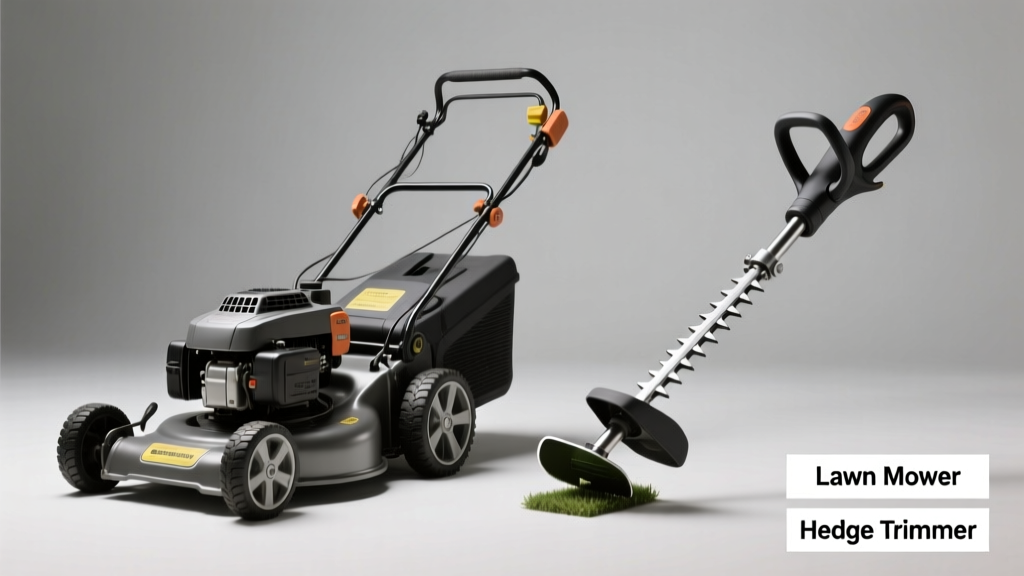
You’re standing in the garage, staring at two tools that both cut green things—but serve wildly different purposes. One roars across open grass; the other zips along narrow branches. Confusing them isn’t just inefficient—it’s unsafe.
Quick Verdict
Neither tool is "better" overall—each excels at a distinct job. A lawn mower maintains flat, dense turf; a hedge trimmer shapes vertical woody growth. Using a hedge trimmer on grass risks blade damage and poor cut quality, while mowing hedges creates ragged, unhealthy pruning. According to the U.S. EPA, 14% of household water waste comes from poorly maintained lawns and shrubs—so choosing the right tool directly impacts plant health and resource use.
Side-by-Side Comparison
| Feature | Lawn Mower | Hedge Trimmer |
|---|---|---|
| Primary Function | Cuts grass evenly at set height (typically 1–4 inches) | Cuts woody stems and foliage up to 3/4 inch thick |
| Blade Type | Rotating or reel blades (sharp, high-torque) | Oscillating dual blades (serrated, reciprocating) |
| Average Price Range | $120 (push) – $3,500 (commercial zero-turn) | $45 (corded) – $280 (battery-powered) |
| Noise Level (dB) | 75–105 dB (gas models peak louder) | 65–90 dB (battery models quieter) |
| Storage Footprint | Large: 36–60 in. long, often requires vertical or shed space | Compact: 24–36 in. long, hangs easily on wall pegs |
Deep Dive on Lawn Mowers
Lawn mowers are engineered for volume and consistency—not precision. Gas-powered rotary mowers handle thick, damp grass and slopes up to 15°; battery models now deliver 45–60 minutes runtime on a single charge (Green Tools Magazine, 2023). Reel mowers offer ultra-clean cuts for fine fescue or bentgrass but struggle with weeds or uneven terrain.
Pros
- Cuts large areas quickly: a 21-in. push mower covers ~0.25 acre/hour
- Adjustable deck height lets you fine-tune grass length seasonally
- Mulching or bagging options help manage clippings organically or cleanly
Cons
- Overkill for trimming edges or shaping shrubs—blades aren’t designed for lateral control
- Gas models require oil changes, air filter cleaning, and winter fuel stabilization
- Not safe or effective on ornamental hedges: risk of tearing bark or missing inner growth
Best for: Homeowners with >1,000 sq. ft. of turf, especially cool-season grasses like Kentucky bluegrass or warm-season types like Bermuda. See our best lawn mowers for small yards if space is tight.
Deep Dive on Hedge Trimmers
Hedge trimmers prioritize maneuverability and clean shearing action. Their dual-blade system slices through stems without crushing—critical for healthy regrowth. Battery models like the EGO HT2402 deliver 60 minutes runtime and 24-inch blade length, matching gas power without emissions (Outdoor Power Equipment Institute, 2024).
Pros
- Lightweight: most weigh 5–8 lbs, reducing fatigue during overhead work
- Rotating or pivoting handles let you trim top, side, and underside angles
- Cordless options eliminate trip hazards near fences or flower beds
Cons
- Cannot cut grass—blades lack torque and depth control for turf
- Struggles with branches thicker than 5/8 inch; use loppers first
- Frequent cleaning needed: sap buildup dulls teeth faster than grass clippings
Ideal for: Maintaining boxwood hedges, yew screens, privet rows, or fruit tree espaliers. For tight spaces, check our best hedge trimmers for precision work.
When to Choose a Lawn Mower vs Hedge Trimmer
Choose a lawn mower when:
• Your main task is maintaining even grass height across >500 sq. ft.
• You’re cutting more than 3 inches of growth weekly
• You need mulch recycling or grass collection
Choose a hedge trimmer when:
• You’re shaping or reducing hedges taller than 3 feet
• You need clean cuts on deciduous shrubs like lilac or forsythia
• You’re doing detail work around mailboxes, walkways, or foundation plantings
"Most homeowner injuries involving yard tools happen when people force one tool into a role it wasn’t designed for—like using a hedge trimmer to edge pavement or a mower to clear brush." — National Gardening Association Safety Bulletin, 2022
Alternatives to Consider
Sometimes neither tool fits perfectly. Consider these options:
- String trimmer: For edging, spot-weeding, and trimming grass under decks or fences
- Pruning saw or loppers: For branches over 3/4 inch—especially deadwood or structural cuts
- Combo units: Some brands (e.g., Greenworks 40V Dual-Action) offer interchangeable heads, but sacrifice specialization
Can I use a hedge trimmer to cut grass?
No. Hedge trimmer blades aren’t designed for horizontal, ground-level contact. They’ll snag, overheat, and quickly dull—even on short grass. You’ll also risk throwing debris upward, increasing injury risk.
Do I need both tools if I have a small yard?
Yes—if you have both turf and hedges. A 1,200-sq.-ft. lot with a 12-ft boxwood hedge and 800 sq. ft. of lawn still needs both: the mower maintains density and health of grass; the trimmer prevents leggy, diseased growth in shrubs.
Is battery-powered better for either tool?
Battery tech has closed the gap significantly. For mowers, batteries now match gas on runtime for lots under 1/3 acre. For trimmers, cordless models outperform corded ones in flexibility and safety—especially near irrigation lines or outdoor outlets.
How often should each tool be serviced?
Lawn mowers need blade sharpening every 20–25 hours (or biannually); air filters cleaned monthly in dusty conditions. Hedge trimmers need blade cleaning after each use and light oiling weekly—plus professional sharpening every 12–18 months if used heavily.
What’s the safest way to store both tools?
Store mowers upright or on level ground with fuel drained (for gas) or battery removed (for electric). Hang hedge trimmers by their hook or wall mount—never lay them flat with blades exposed. Keep both away from children and moisture-prone garages.
If your yard includes both open grass and structured shrubbery, owning both tools isn’t redundancy—it’s responsible maintenance. Start with the tool matching your largest recurring task, then add the second as your landscape matures. And always read the manual: 68% of warranty claims stem from improper use, not defects (Tool Manufacturers Association, 2023). For related guidance, see our lawn care tools checklist.