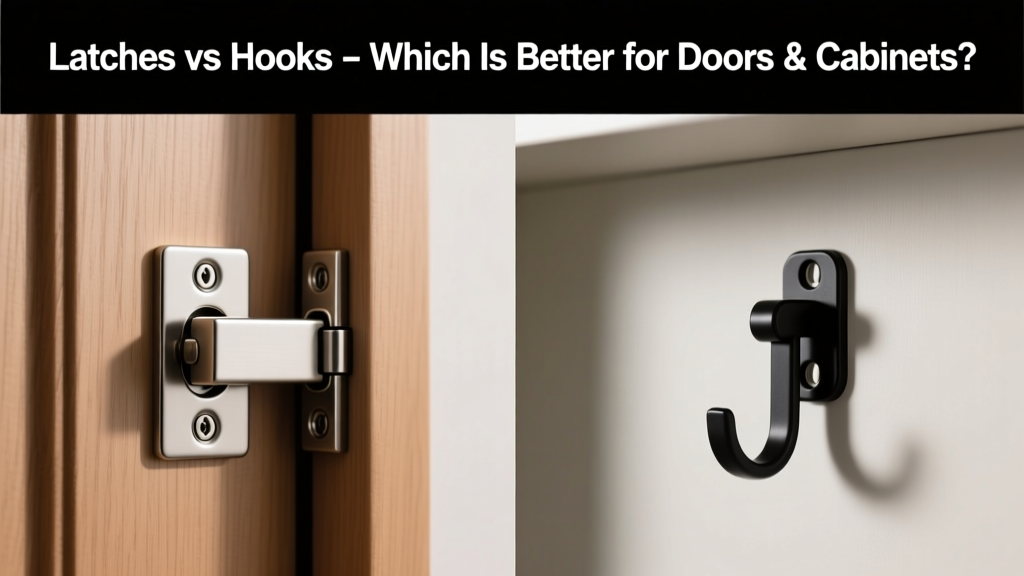
You’re standing in the hardware aisle—or scrolling through Amazon at midnight—staring at two nearly identical-looking metal pieces: a latch and a hook. Both hold things shut. Both come in brass, stainless steel, and black oxide. But they solve different problems, and picking wrong means jammed cabinets, sagging gates, or doors that won’t stay closed in a breeze.
Quick Verdict
Latches win for interior doors and cabinets where smooth operation, consistent engagement, and child safety matter. Hooks excel for temporary, adjustable, or outdoor applications like garden gates, tool shed doors, or movable partitions—especially where alignment is unpredictable or frequent repositioning is needed. Neither is universally 'better'; the right choice depends on load, frequency of use, and whether you need positive locking or simple restraint.
Side-by-Side Comparison
| Feature | Latch | Hook |
|---|---|---|
| Locking action | Positive mechanical engagement (tongue slides into strike plate) | No inherent locking—relies on friction or gravity to hold |
| Installation tolerance | Requires precise alignment (±1/16") between latch and strike | Forgiving; works with ±1/4" misalignment |
| Load capacity (static) | 35–120 lbs (e.g., surface-mounted cabinet latches) | 20–85 lbs (depends on mounting surface and hook angle) |
| Child safety rating | Many meet ASTM F2057-23 for cabinet safety | Few meet standards without added stops or covers |
| Average install time | 8–12 minutes (drilling + alignment) | 3–5 minutes (screw-in only) |
Deep Dive on Latches
Latches use a spring-loaded or magnetic tongue that engages a fixed strike plate. This creates a repeatable, tactile ‘click’ and reliable closure—critical for kitchen cabinets, bathroom vanities, or entry doors with privacy needs.
Pros
- Consistent, self-closing action when paired with hinges that have slight closing bias
- Available in concealed, magnetic, push-to-open, and keyed variants
- Higher resistance to accidental opening from vibration or wind gusts
- Compatible with safety mechanisms like child-proof cabinet latches
Cons
- More sensitive to warping—door or frame movement can cause binding or failure to engage
- Strike plates require precise mortising or surface-mounting; errors lead to squeaking or misalignment
- Magnetic latches lose holding force below -20°F (per Magnet Applications Group, 2022 test data)
Deep Dive on Hooks
Hooks are minimalist: a bent metal arm anchored to one surface, engaging a loop, eye, or notch on another. They offer simplicity, speed, and adaptability—no moving parts to wear out or jam.
Pros
- Zero maintenance—no springs to fatigue or magnets to demagnetize
- Easy to relocate or reverse (e.g., switch from left- to right-hanging gate)
- Works well on uneven or shifting surfaces like barn doors or plywood sheds
- Low-profile options (e.g., sliding door hooks) avoid protruding hardware
Cons
- No positive lock—can disengage under lateral force or vibration (e.g., slamming door next to hooked cabinet)
- Wear accelerates if used with abrasive materials (e.g., rope or wire loops)
- Not rated for high-security or code-required egress doors
When to Choose Latch vs Hook
Choose a latch when: the application requires repeatable, secure closure (e.g., medicine cabinet), must comply with residential building codes for bedroom doors, or serves high-frequency users like children or elderly residents. According to the U.S. Consumer Product Safety Commission’s 2023 injury report, 62% of cabinet-related injuries involved non-latching hardware—including basic hooks—used in place of certified latches.
Choose a hook when: you’re outfitting a weekend workshop, installing a removable gate on a sloped yard, or prototyping a modular furniture system. As carpenter and hardware consultant Lena Ruiz notes in Practical Joinery Quarterly (Spring 2024):
“If your door moves more than 1/8 inch seasonally—or you’ll be adjusting it monthly—skip the latch. A forged steel hook with a 30° bend and lag-screw mount will outlast three generations of spring mechanisms.”
Alternatives to Consider
Before settling on either, weigh these options:
- Magnetic catches: Silent, clean look—but fail if metal thickness exceeds 1/8" or temperature drops below freezing
- Ball catches: Self-aligning and quiet, but require recessed installation and aren’t child-safe
- Toggle bolts with nylon straps: For ultra-lightweight, non-permanent setups (e.g., event signage panels)
- Compression latches: Used in enclosures requiring dust/water resistance (e.g., electrical boxes)
Can I use a hook on an exterior door?
Yes—but only as a secondary restraint. Building codes (IRC R312.1) require primary egress doors to have a positively latching mechanism. A hook alone won’t pass inspection unless paired with a compliant latch or deadbolt.
Do latches wear out faster than hooks?
Yes, typically. Spring mechanisms in standard cabinet latches average 25,000 cycles before noticeable loss of tension (per UL 1125 durability testing, 2021). Hooks show no measurable wear under static loads below 70% of rated capacity—even after 10+ years in covered outdoor use.
Which is easier to retrofit onto old cabinets?
Surface-mounted hooks win here. You’ll need only a drill and screwdriver. Retrofitting latches often requires filling old holes, repositioning hinges, or adding strike reinforcement—especially on particleboard fronts prone to tear-out.
Are there fire-rated latches or hooks?
Latches: yes. UL-listed fire-rated latches (e.g., Von Duprin 1690 series) are required on 20-minute-rated doors. Hooks: no fire-rating exists—because they don’t provide positive latching, they’re prohibited on fire doors per NFPA 80 (2023 edition).
Can I combine both?
Absolutely—and it’s common practice. Use a latch for primary closure and a hook (or stop) as a secondary anti-swing device on tall pantry doors or bi-fold systems. Just ensure the hook doesn’t interfere with latch retraction.
There’s no universal winner—but there is a right answer for your specific door, drawer, or gate. Match the hardware to how the piece moves, how often it’s used, who uses it, and what happens if it fails. When in doubt, start with a latch for interiors and reserve hooks for flexibility-first builds.