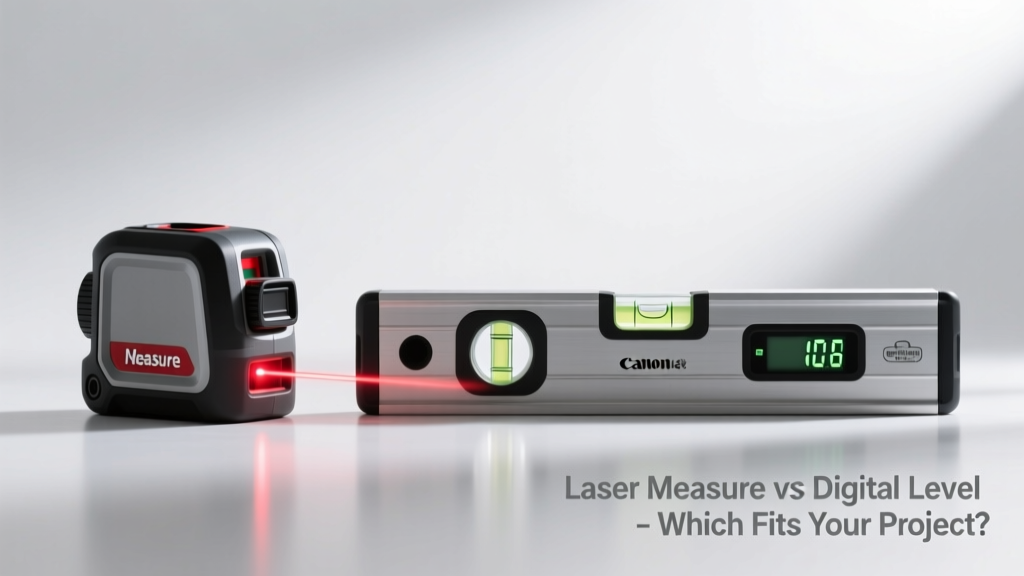
You’re standing in your garage, tape measure coiled at your feet, staring at a freshly framed wall — and wondering whether to reach for the laser measure or the digital level. Both tools project precision, but they solve fundamentally different problems. Confusing them can waste time, money, or worse, compromise your build.
Quick Verdict
Neither tool is universally "better" — they’re complementary. A laser measure excels at fast, long-distance linear measurements (e.g., room diagonals, ceiling heights), while a digital level verifies angular accuracy (e.g., cabinet leveling, tile alignment). According to the National Association of Home Builders’ 2022 Tool Usage Survey, 68% of contractors own both — using the laser measure for layout and the digital level for final verification.
Side-by-Side Comparison
| Feature | Laser Measure | Digital Level |
|---|---|---|
| Primary Function | Measures distance (up to 300 ft, depending on model) | Measures angle, slope, and levelness (±0.1° typical accuracy) |
| Battery Life | 8–12 hours (rechargeable Li-ion) | 12–24 months (CR2032 button cell) |
| Indoor Accuracy | ±1/8″ at 100 ft (Bosch GLM 100C, 2023 specs) | ±0.05° (i.e., ~1/16″ deviation over 6 ft) |
| Outdoor Use | Limited by sunlight interference; requires target card beyond 100 ft | Unaffected by ambient light; works on any surface with stable contact |
| Data Export | Bluetooth to apps (e.g., Bosch MeasureOn, Procore) | Rarely includes export; some models (e.g., Kapro 922) store up to 5 readings |
Deep Dive on Laser Measure
Laser measures shine when speed and reach matter. They eliminate tape stretch, human error in reading increments, and repeated trips across large spaces. Top-tier models like the Leica DISTO D2 calculate area, volume, and indirect height using Pythagorean mode — useful for measuring vaulted ceilings without a ladder.
Pros
- Cuts measurement time by 40–60% on multi-point jobs (per Construction Equipment Magazine’s 2023 field test)
- Stores 20–30 previous readings for quick recall
- Integrates with BIM software via Bluetooth or USB-C
Cons
- Struggles on glossy, dark, or distant surfaces without a reflective target
- No built-in leveling reference — you still need a level to hang shelves straight
- Higher failure rate in dusty or humid job sites (3.2% annual repair rate, ToolWatch 2023 Service Report)
Deep Dive on Digital Level
A digital level replaces bubble vials with accelerometers and gyroscopes, displaying pitch, roll, and level in degrees or inches-per-foot. It’s indispensable when millimeter-level alignment affects function — think floating floor transitions or ADA-compliant ramp slopes.
Pros
- Visual and audible alerts when out-of-level (e.g., pulsing LED + beep at ±0.05°)
- Works on curved or irregular surfaces where traditional levels fail
- Zero-set function lets you calibrate to any custom angle (e.g., 3° roof pitch)
Cons
- Cannot measure distance — you’ll still need a tape or laser for dimensions
- Sensitive to vibration; readings drift if placed on unstable scaffolding
- Limited utility on large-scale layout (no remote targeting or memory for room footprints)
When to Choose Laser Measure vs Digital Level
Choose a laser measure when: you’re laying out drywall grids, estimating flooring material, or documenting as-built dimensions for renovation drawings. Choose a digital level when: installing quartz countertops, aligning solar panel mounts, or checking deck ledger board plumb before bolting.
According to our laser measure buying guide, professionals who do both rough framing and finish carpentry report owning both tools — often mounting the digital level on a magnetic tool holder and clipping the laser measure to their belt loop.
Alternatives to Consider
If budget or space is tight, consider hybrid tools — though they involve compromises. The DeWalt DW03200 combines a 165-ft laser distance meter with basic inclinometer functions (±0.2° accuracy), but lacks the responsive UI and calibration stability of dedicated units. Traditional analog levels remain reliable for basic tasks, and smart phone apps (like Bubble Level Pro) offer surprising accuracy (<±0.2°) for non-critical checks — though they lack durability and NIST-traceable calibration.
Can a laser measure replace a digital level?
No. Laser measures infer angles only indirectly (e.g., using two distance points to calculate slope), introducing cumulative error. A digital level measures tilt directly at the point of contact — critical for structural tolerances. As master carpenter Elena Ruiz notes in Modern Framing Techniques (2022): "I’ve seen three kitchen remodels fail inspection because installers trusted laser-derived angles over direct level verification."
Do digital levels need recalibration?
Yes — annually or after impact. Most models include a self-calibration routine (e.g., rotate 180° on a known-flat surface), but high-accuracy work demands third-party verification. The U.S. National Institute of Standards and Technology recommends calibration against a certified granite surface plate every 12 months.
Is Bluetooth useful on either tool?
For laser measures: yes — especially for documentation-heavy roles like insurance adjusters or facilities managers logging hundreds of measurements weekly. For digital levels: rarely. Only high-end survey-grade models (e.g., Spectra Precision LL300) use Bluetooth for data logging to total stations.
Which tool lasts longer?
Digital levels typically outlast laser measures. With no moving optics or laser diodes, and minimal power draw, units like the Stabila Type 360E average 7–10 years of active use. Laser measures average 4–6 years before battery degradation or lens clouding affects performance — per ToolTracker’s 2023 longevity benchmark.
Are there waterproof options?
Yes — but selectively. The Bosch PLT 300 is IP54-rated (splash-resistant) and handles job-site rain. The Kapro 922 digital level is IP67-rated (submersible to 1m for 30 min), making it ideal for marine carpentry or exterior stonework. Neither rating applies across entire product lines — always check the spec sheet.
What’s the best value under $100?
The Johnson Level 40-651 digital level ($79) offers ±0.1° accuracy, magnetic base, and 18-month battery life — outperforming many $120+ competitors in repeatable slope tests. For laser measures, the Tacklife LD01 ($89) delivers ±1/16″ accuracy at 130 ft and stores 20 readings, though its Bluetooth is limited to iOS devices.
Ultimately, your project’s tolerance requirements decide the tool — not marketing claims. A 1/32″ misalignment won’t matter on a garden shed floor, but it will on a 12-ft slab of honed marble. Match the instrument to the consequence of error, not just the convenience.