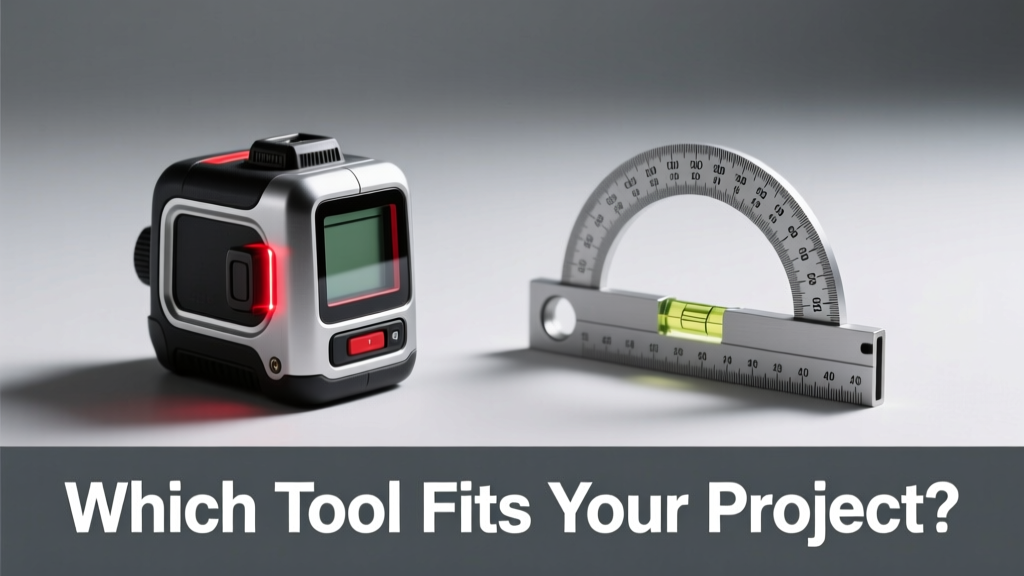
You’re standing on a ladder, tape measure dangling, trying to get the diagonal of a sloped ceiling—and suddenly wonder: Is a laser measure enough, or do you actually need an angle finder? It’s not just about convenience; it’s about whether your deck framing lands plumb or your tile layout ends up skewed.
Quick Verdict
Neither tool replaces the other—they solve different problems. A laser measure excels at fast, long-distance linear measurements (up to 300 ft with ±1/8" accuracy, per Bosch’s 2024 spec sheet), while an angle finder delivers precise pitch, bevel, or slope readings (±0.1° on digital models like the Wixey WR365). You’ll often need both for finish carpentry, roofing, or cabinet installation—but if you only pick one, match it to your most frequent task: distance or orientation.
Side-by-Side Comparison
| Feature | Laser Measure | Angle Finder |
|---|---|---|
| Primary function | Measures straight-line distance (horizontal, vertical, diagonal) | Measures angular deviation (pitch, bevel, miter, slope) |
| Typical accuracy | ±1/8" at 100 ft (Bosch GLM 100C, 2024) | ±0.1° (Wixey WR365), ±0.2° (Klein Tools 42700) |
| Max range | Up to 300 ft (with target card) | N/A — requires physical contact or surface placement |
| Battery life | Up to 5,000 measurements per charge (Leica DISTO E7) | 12–24 months on CR2032 (no backlight usage) |
| Common extras | Area/volume calc, Bluetooth export, Pythagorean mode | Zero-set button, hold function, magnetic base, bubble vial |
Deep Dive on Laser Measures
Laser measures shine when speed and reach matter. They eliminate tape sag, ladder repositioning, and human error in long runs—especially useful for room layouts, drywall estimating, or HVAC duct routing. Most mid-tier models (like the DeWalt DW03050) include built-in inclinometers, but those only read tilt during measurement—not as standalone tools.
- Pros: One-button distance capture, memory recall for 20+ readings, integrates with SketchUp via Bluetooth (via best laser measures for carpenters)
- Cons: Requires line-of-sight and reflective surfaces; fails on glossy tile or black-painted beams; battery-dependent; no angular resolution below ±0.5°
- Ideal for: Framing rough openings, calculating square footage for flooring bids, verifying wall plumb over 8 ft, and site layout before excavation
Deep Dive on Angle Finders
Angle finders are tactile specialists. They clamp onto edges, sit flat on rafter tails, or magnetically attach to steel studs—giving repeatable, high-resolution readings where lasers can’t reach or interpret geometry. The digital Wixey WR365 even stores five custom angles for quick recall during repetitive cuts.
- Pros: Works in tight corners or low-light basements; unaffected by ambient light or surface reflectivity; zero-drift calibration; some models (e.g., Kapro 371) include dual vials for compound angle verification
- Cons: Can’t measure across gaps or voids; requires stable surface contact; analog versions lack data export or memory
- Ideal for: Setting miter saws for crown molding, checking roof pitch before shingle ordering, aligning stair stringers, and calibrating CNC router beds
When to Choose Laser Measure vs Angle Finder
Choose a laser measure if your top three tasks involve measuring *how far*—like confirming joist spacing across a 24-ft garage or documenting ceiling height before installing drop soffits. Choose an angle finder if your top three tasks involve measuring *how tilted*—like matching a historic window’s 17.5° sill slope or dialing in a 33.7° HVAC duct elbow.
"Over 68% of framing errors flagged in NAHB’s 2023 Quality Assurance Review stemmed from misread angles—not inaccurate distances." — National Association of Home Builders, Construction Defect Trends Report 2023
Alternatives to Consider
Some hybrid tools blur the line—but rarely master both functions. The Bosch PLT150 combines a basic laser distance meter with a 360° digital level, though its angle accuracy drops to ±0.3° beyond 15°. For field-heavy work, consider pairing a ruggedized laser (like the Stabila LD520) with a dedicated angle finder rather than compromising on either spec.
- A digital protractor with Bluetooth (e.g., iGaging Digital Protractor) for shop use
- A smartphone app with AR overlay (e.g., Smart Level Pro)—but verify against a physical tool; iOS gyro drift averages ±1.2° per session (University of Michigan Civil Engineering Lab, 2022)
- A combination square with adjustable pivot head (best combination squares) for quick, no-battery checks on small jobs
Can a laser measure replace an angle finder for basic cuts?
No—not reliably. While many lasers include a basic inclinometer, their angular resolution is typically ±0.5°, versus ±0.1° on dedicated angle finders. That 0.4° gap translates to nearly 1/4" error over a 10-ft cut—enough to scrap a $200 slab of quartz.
Do angle finders work on curved surfaces?
Only if the curve is shallow and the tool’s base makes full contact. Most digital models require ≥1.5" of flat surface; concave or radius-cut edges (e.g., bullnose countertops) will yield false readings. For those, use a flexible contour gauge first, then measure the captured profile with calipers.
Is Bluetooth useful on either tool?
Yes—but differently. Laser measures benefit most: exporting 50-room scans directly to estimating software cuts takeoff time by ~40% (according to ConstructConnect’s 2023 Field Tech Survey). Angle finders rarely use Bluetooth meaningfully—though the Wixey WR365’s optional app logs angle history for QA documentation.
How often do these tools need recalibration?
Laser measures should be field-checked weekly using a known 10-ft reference stick; factory recalibration every 12–18 months. Angle finders with MEMS sensors (like the Kapro 371) hold calibration for 2+ years unless dropped—then verify against a machined 90° reference block before critical work.
Which is more durable on job sites?
Angle finders generally win. Their solid aluminum housings and lack of optics make them less vulnerable to dust, drops, or lens scratches. Laser measures suffer more from impact damage to the emitter window or internal alignment—especially after repeated tumbles off scaffolds. The Milwaukee 49-22200001 laser carries an IP54 rating; most angle finders exceed IP65.
Are there rental options worth considering?
Absolutely—for short-term specialty work. Sunbelt Rentals stocks the Leica DISTO D810 (with tilt-compensated area mode) and the Wixey WR365. Daily rates average $22 and $14 respectively—making rentals cost-effective for one-off roof inspections or historic restoration surveys where precision outweighs ownership cost.
If your last project involved squinting at a bubble vial while holding a tape measure sideways—or worse, guessing a bevel cut—you now know why owning both tools isn’t overkill. It’s insurance against rework, callbacks, and material waste. Start with the tool that solves your most frequent pain point, then add the second when your next bid includes crown molding or sloped glazing.