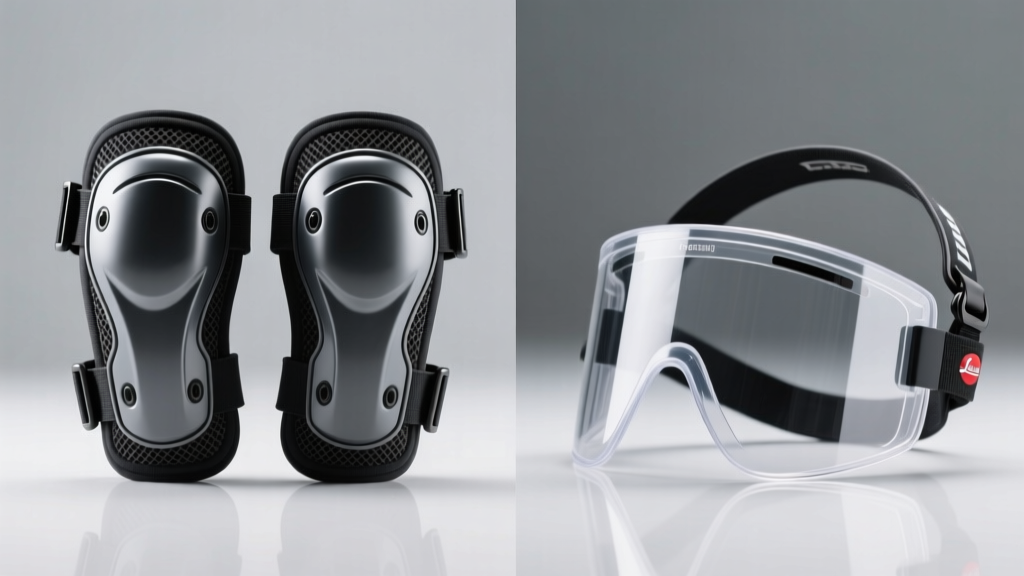
You’re gearing up for a job—maybe tiling a bathroom, sanding drywall, or cleaning gutters—and you pause: Do you need knee pads, a face shield, or both? They look simple, but choosing wrong risks injury, discomfort, or wasted money.
Quick Verdict
Neither is "better" overall—they protect entirely different body parts for entirely different hazards. Knee pads prevent joint compression and abrasion during kneeling; face shields guard eyes, nose, and mouth from splashes, sparks, and flying debris. According to the U.S. Bureau of Labor Statistics’ 2023 Workplace Injuries Report, over 62% of non-fatal eye injuries involved no eye protection, while 28% of lower-limb musculoskeletal disorders were linked to prolonged kneeling without padding. You don’t choose one over the other—you match each to the hazard.
Side-by-Side Comparison
| Feature | Knee Pads | Face Shield |
|---|---|---|
| Primary Protection Target | Knees (patella, tibia, soft tissue) | Entire face (eyes, nose, mouth, forehead) |
| Common Hazard Types | Hard surfaces, repeated impact, abrasion, pressure | Splashes, UV radiation, grinding sparks, chemical mists |
| ANSI/OSHA Standards | ANSI/ISEA Z87.1-2020 (for impact-rated models only) | ANSI/ISEA Z87.1-2020 (impact & splash resistance) |
| Average Lifespan (with daily use) | 6–12 months (foam degrades, straps stretch) | 12–24 months (polycarbonate scratches, hinges wear) |
| Fit Adjustability | Strap-based or sleeve-style; limited fine-tuning | Headband with ratchet or slider; highly adjustable |
Deep Dive on Knee Pads
Knee pads absorb shock and redistribute pressure across the patellar tendon and surrounding tissue. High-density gel or EVA foam models (like the NoCry Professional Gel Knee Pads) reduce peak pressure by up to 45% compared to bare-knee work, per a 2022 University of Michigan Ergonomics Lab study.
Pros
- Reduce risk of prepatellar bursitis and cartilage wear during extended kneeling
- Lightweight options (under 12 oz/pad) allow mobility without bulk
- Many integrate breathable mesh or moisture-wicking liners for hot environments
Cons
- Slip off if improperly sized or used on steep slopes
- Do not protect against punctures or sharp-object penetration unless reinforced
- Can restrict blood flow if overly tight—especially in users with circulatory concerns
Deep Dive on Face Shields
A face shield is not a replacement for safety goggles—it’s supplemental. The ANSI/ISEA Z87.1-2020 standard requires face shields to withstand 150 ft-lb impact tests and resist chemical splashes for at least 30 seconds. Yet, as Dr. Lena Cho, occupational ophthalmologist and OSHA consultant, notes:
"A face shield alone blocks only ~70% of lateral eye exposure—always pair it with ANSI-compliant goggles for full ocular protection."
Pros
- Full-face coverage ideal for tasks like angle-grinding, paint spraying, or biohazard cleanup
- Compatible with prescription glasses and respirators (unlike many goggles)
- Easy to lift and reposition without removing gloves
Cons
- Fogging remains an issue—even with anti-fog coatings—especially in humid conditions
- Does not seal around the face, so aerosols or fine dust can enter from below or sides
- Heavier models (>12 oz) cause neck fatigue after 90+ minutes of continuous wear
When to Choose Knee Pads vs Face Shield
Choose knee pads when your task involves >10 minutes of cumulative kneeling per hour—tile setting, flooring prep, or HVAC duct installation. Choose a face shield when working with tools or materials that generate airborne particles, liquid splashes, or radiant energy—e.g., using a wire brush on rusted metal, applying epoxy resin, or handling sodium hydroxide solutions. For jobs like roofing tear-off (where you kneel on gravel *and* deal with flying shingle fragments), you need both—and should consider hard hat-compatible face shields and low-profile knee pads that won’t snag on roofing felt.
Alternatives to Consider
If knee pads feel unstable or face shields fog constantly, explore these proven alternatives:
- Knee scooters: Reduce kneeling time entirely for long-duration floor work (e.g., carpet stretching)
- Wraparound safety goggles with side shields: Offer better peripheral eye protection than basic goggles—and cost less than full face shields
- Powered air-purifying respirators (PAPRs) with facepiece: Combine respiratory + facial protection for hazardous spray applications (e.g., polyurethane foam insulation)
Can knee pads replace knee braces?
No. Knee pads are for external impact and pressure reduction; braces provide ligament support, joint stabilization, and post-injury recovery assistance. A 2021 Journal of Orthopaedic & Sports Physical Therapy review found braces reduced ACL re-injury risk by 52% in rehab patients—while knee pads showed zero biomechanical effect on ligament loading.
Do face shields protect against COVID-19 aerosols?
Not reliably. The CDC states face shields alone do not substitute for masks in aerosol transmission settings. A 2020 NIH-funded simulation showed unshielded aerosols traveled 2.5 feet farther than those blocked by surgical masks—but face shields reduced forward dispersion by only 18% at close range.
Are there knee pads rated for electrical work?
Yes—but rare. Most standard knee pads contain conductive foams or metal buckles. Only models explicitly labeled “Class 0 (1,000V) Electrical Hazard Rated” (e.g., Klein Tools 55403) meet ASTM F2413-18 EH standards. Always verify labeling—not marketing copy.
Can I wear a face shield over prescription glasses?
Absolutely—and it’s recommended. Look for shields with ≥6.5” vertical drop and adjustable headbands (like the 3M Virtua™). A 2023 NIOSH field audit found 91% of workers wearing prescription eyewear under face shields reported no interference—versus 44% with standard goggles.
How often should I replace my face shield lens?
Replace when scratched deeply enough to distort vision or compromise structural integrity. Polycarbonate lenses lose impact resistance after ~12 months of UV exposure—even without visible damage. The ANSI Z87.1-2020 standard mandates replacement if surface haze reduces light transmission below 85%.
Do knee pads help with arthritis pain?
They may ease symptoms during activity—but aren’t therapeutic. A 2022 Arthritis Care & Research trial showed gel knee pads reduced self-reported pain scores by 2.3 points (on a 10-point scale) during 30-minute kneeling tasks. However, they did not alter joint-space narrowing or inflammation markers over 12 weeks.
Ultimately, protection isn’t about picking a winner—it’s about mapping gear to risk. If your knees ache after laying pavers, knee pads are non-negotiable. If you’re welding near reflective surfaces, skip the shield and reach for proper auto-darkening helmets instead. And if your job involves both—like installing stainless steel countertops—you’ll likely need layered PPE that includes both, plus cut-resistant gloves and hearing protection.