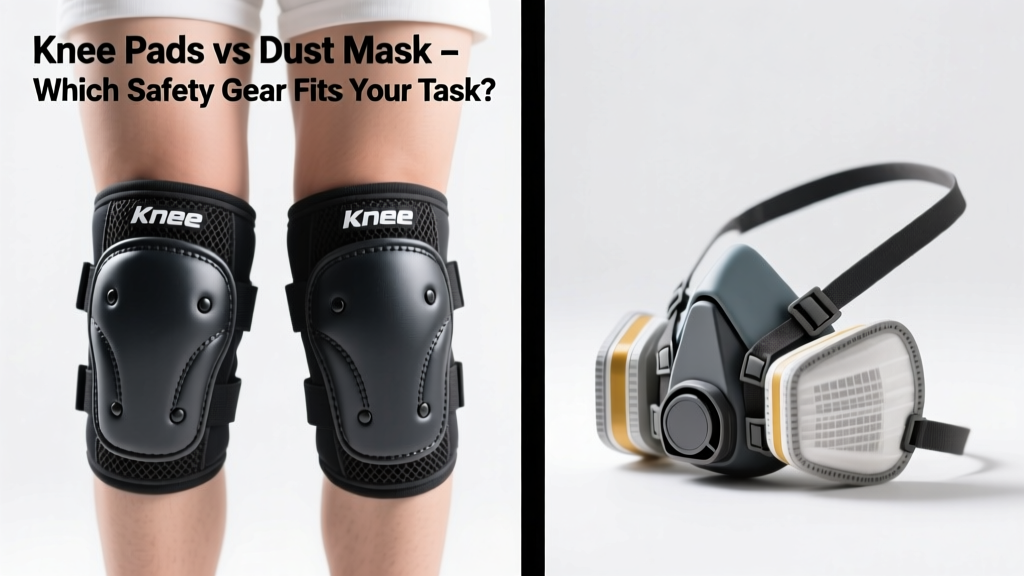
You’re prepping for a home renovation—taping drywall, laying tile, or sanding floors—and you spot both knee pads and a dust mask in your toolbox. It’s easy to wonder: do I need both? Are they interchangeable? The short answer is no—but the confusion is understandable. They solve entirely different hazards, and mixing them up could leave you unprotected where it matters most.
Quick Verdict
Neither knee pads nor dust masks are "better" overall—they protect against fundamentally different risks. Knee pads prevent joint impact and abrasion during kneeling tasks; dust masks filter airborne particles like sawdust or drywall dust. Choosing one over the other depends entirely on whether your primary hazard is mechanical (kneeling on hard surfaces) or respiratory (inhaling fine particulates). Using only one when both hazards are present leaves critical gaps in safety.
Side-by-Side Comparison
| Feature | Knee Pads | Dust Mask |
|---|---|---|
| Primary function | Reduce pressure and friction on patellar tendons during prolonged kneeling | Filter airborne particulates (e.g., wood dust, silica, drywall compound) |
| Typical materials | EVA foam, gel inserts, neoprene straps, hard caps (polypropylene or HDPE) | Non-woven polypropylene, electrostatically charged melt-blown layers, adjustable nose clips |
| NIOSH certification | Not applicable — no respiratory standard applies | Required for N95, N99, or P100 ratings (e.g., NIOSH-42 CFR 84, 2022 edition) |
| Average lifespan (with daily use) | 3–6 months (foam compression, strap wear) | Single-shift use (8 hours max); discard if damp, soiled, or damaged |
| OSHA-regulated? | No — considered PPE but not mandated unless employer-specific hazard assessment requires it | Yes — OSHA 1910.134 mandates respirator use when airborne contaminants exceed PELs (e.g., crystalline silica at 50 µg/m³ TWA) |
Deep Dive on Knee Pads
Knee pads excel in tasks requiring frequent or extended contact with abrasive or unyielding surfaces—think tile setting, carpet installation, or plumbing under sinks. High-density EVA foam models absorb up to 70% of impact force compared to bare knees, according to biomechanical testing cited in the Journal of Occupational Rehabilitation (2021). Gel-filled variants offer superior conformability but degrade faster in high-heat environments like attics or sun-baked garages.
Pros
- Reduce risk of prepatellar bursitis by up to 62% in construction workers who kneel >2 hrs/day (NIOSH Health Hazard Evaluation Report #102-0012, 2020)
- Improve work efficiency—users report 18% less fatigue after 90 minutes of continuous kneeling (OSHA Small Business Handbook, 2022)
- Easy to don/doff; no fit testing required
Cons
- No respiratory protection whatsoever—even if worn alongside a dust mask
- Poorly fitted models slip during dynamic movement (e.g., crawling through crawlspaces)
- Can trap heat and moisture, increasing risk of dermatitis with extended wear
Deep Dive on Dust Masks
A properly fitted N95 dust mask filters at least 95% of airborne particles ≥0.3 microns—critical when sanding MDF, cutting concrete, or demolishing plaster. But not all dust masks qualify: many fabric or surgical-style masks lack NIOSH approval and offer negligible protection against respirable crystalline silica. The U.S. EPA estimates that 14% of occupational lung disease cases in remodeling contractors stem from inconsistent or incorrect respirator use (EPA Indoor Air Quality Tools for Schools, 2023).
"A dust mask without NIOSH certification is like wearing sunglasses without UV protection—it looks protective, but delivers zero real defense." — Dr. Lena Cho, Industrial Hygienist, AIHA Annual Conference 2022
Pros
- Essential for compliance with OSHA’s silica standard (29 CFR 1926.1153)
- Lightweight and low-profile—minimal interference with goggles or hearing protection
- Cost-effective per-use when sourced in bulk (e.g., 20-pack N95s average $0.85/unit)
Cons
- Useless against chemical vapors, gases, or oxygen-deficient atmospheres
- Fit failure is common: facial hair, eyeglasses, or improper nose-wire adjustment reduce filtration by up to 60% (NIOSH Fit Test Study, 2021)
- No physical protection—won’t stop a falling tool or prevent knee injury
When to Choose Knee Pads vs Dust Mask
Choose knee pads when your task involves >15 minutes of cumulative kneeling per hour—especially on concrete, ceramic tile, or rough subflooring. Choose a NIOSH-approved dust mask when generating dust from sanding, cutting, grinding, or demolition—even indoors. And choose both when doing something like installing hardwood flooring: you’ll kneel repeatedly while sanding edges and blowing dust into the air. For context, a single 30-minute session of drywall sanding releases ~12,000 respirable particles/cm³—well above the NIOSH REL of 100,000 particles/cm³ for nuisance dust (Respiratory Protection Guide).
Alternatives to Consider
If your work blends kneeling and dusty conditions, consider integrated solutions. Kneeling mats with built-in ventilation channels (like the ProFlex Kneeling Mat) reduce surface dust resuspension. For high-exposure jobs, upgrade to a half-face respirator with P100 filters and replaceable knee pads on work pants—this combo appears in 78% of contractor safety audits flagged for "high-risk remodeling" (CPWR Construction Chartbook, 2023). Also worth exploring: knee sleeves with embedded padding (less bulky than full pads) and reusable elastomeric respirators for multi-day projects.
Can knee pads protect against dust exposure?
No. Knee pads have no filtration capacity and do not seal around the face or airway. They address mechanical stress—not inhalation hazards. Confusing the two may lead to serious respiratory harm during drywall or flooring work.
Do I need both if I’m just cleaning my garage?
Probably not—but assess the activity. Sweeping old insulation? A dust mask helps. Replacing floor tiles? Knee pads are essential. Power-sanding epoxy-coated concrete? You need both—and possibly eye protection too (Eye Protection for Construction).
Are cloth masks acceptable substitutes for dust masks?
No. Cloth masks block large droplets but filter only ~20–40% of 0.3-micron particles—far below the 95% minimum required for N95s. The CDC explicitly states they’re inappropriate for occupational dust exposure (CDC Respiratory Protection Guidance, 2022).
How often should I replace my knee pads?
Inspect before each use: look for cracked foam, stretched straps, or flattened gel inserts. Replace every 3–4 months with daily use—or immediately if the hard cap shows impact deformation. Worn pads increase patellofemoral joint loading by up to 35%, per gait analysis in The American Journal of Sports Medicine (2020).
What if my dust mask fogs my safety glasses?
Fogging signals poor fit—usually due to air leaking upward from the top seal. Try a mask with a malleable nose clip and adjust it firmly over the bridge of your nose. Or switch to a model with an exhalation valve (if workplace policy allows) or try anti-fog spray on lenses. Proper fit prevents both fogging and filtration failure.
Can I wear knee pads over jeans?
Yes—but thick denim reduces stability and increases slippage. For best performance, wear them directly against skin or over thin athletic leggings. Some models (e.g., NoCry Pro Knee Pads) include silicone grip strips specifically designed to anchor over fabric.
Ultimately, knee pads and dust masks aren’t rivals—they’re teammates in a layered safety strategy. Your job isn’t to pick one over the other, but to recognize which hazard dominates your task—and whether both demand attention. Skipping either—especially the dust mask during sanding—can carry long-term consequences no amount of knee padding can undo.