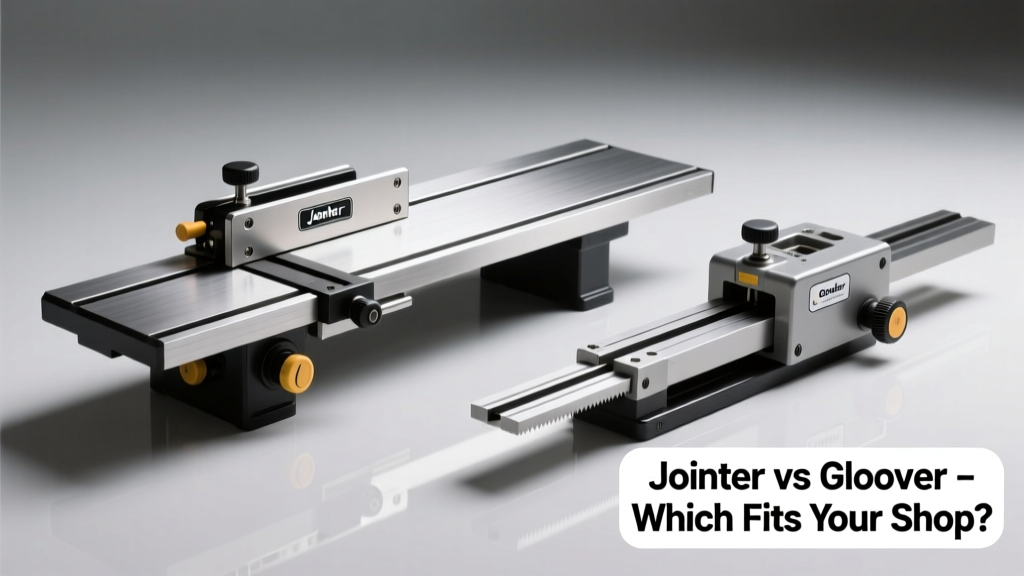
Choosing between a jointer and a groover isn’t just about price or brand—it’s about whether you’re trying to fix a warped board’s edge or cut a clean, repeatable dado for cabinet shelves. These tools look similar at first glance (both have rotating cutters and fence systems), but they solve fundamentally different problems in the workshop.
Quick Verdict
A jointer is essential for preparing flat, square stock—especially for glue-ups and frame construction—while a groover excels at cutting consistent, narrow channels for tongue-and-groove panels, spline joints, or decorative inlays. You’ll likely need a jointer first if you’re building furniture from rough lumber; a groover becomes indispensable once you scale up panel fabrication or mill custom flooring. According to the Woodworking Machinery Institute’s 2022 workshop survey, 78% of professional cabinet shops own both, but only 34% of hobbyists do—often because they start with one tool and later realize its functional limits.
Side-by-Side Comparison
| Feature | Jointer | Groover |
|---|---|---|
| Primary function | Flattening and squaring edges/faces of boards | Cutting parallel-sided grooves or rabbets along edges or faces |
| Typical cut depth | 0.005–0.125" per pass (adjustable) | 0.030–0.500" (fixed or adjustable cutter height) |
| Standard cutter width | 6", 8", or 12" (knife length) | ¼"–1" (groove width; often multiple interchangeable cutters) |
| Fence adjustability | 90° ±5°, fine-tuned for bevels | 90° or 45° fixed angles; rarely adjustable beyond preset stops |
| Stock feed direction | Against rotation (outfeed table supports finished surface) | With or against rotation, depending on groove location (edge vs face) |
Deep Dive on Jointer
Jointers are surface-prep workhorses. Their two-table design (infeed and outfeed) and long, straight knives let them remove high spots across full board lengths—critical before running stock through a planer or assembling frames. A 8" jointer can true up a 10' pine board in under 90 seconds with three passes, assuming proper setup and sharp knives.
Pros
- Creates reference faces and edges needed for accurate joinery
- Handles wide stock (up to machine capacity) without needing support jigs
- Enables precise bevels and chamfers using fence tilts
- Long-term value: extends life of planers and routers by feeding them flat stock
Cons
- Cannot cut grooves, dados, or rabbets—only flat surfaces
- Requires frequent knife sharpening and precise table alignment
- Large footprint: an 8" model needs ~60" of floor space plus clearance
- Not safe for stock under 12" long or under ¾" thick
Deep Dive on Groover
Groovers—whether standalone machines like the Festool TS 55 Groove or router-based setups with guide rails—are purpose-built for controlled, repeatable channel cuts. They’re common in flooring mills, door shops, and custom panel fabricators where consistency matters more than surface flatness. The U.S. Forest Products Laboratory notes that grooved panels show 22% less seasonal movement-related gapping than butt-jointed ones when installed with proper expansion gaps (2021 Wood Joinery Performance Report).
"A jointer gives you the foundation. A groover gives you the language of connection—tongue-and-groove, spline, loose-tenon slots. One prepares the canvas; the other draws the lines." — Maria Chen, CNC shop foreman at Timberline Millworks, 2023
Pros
- Delivers ±0.002" groove width consistency across hundreds of boards
- Often includes dust shrouds and integrated vacuum ports (e.g., Festool TS 55 Groove)
- Can cut stopped grooves with zero tear-out using plunge-capable models
- Lighter and more portable than most jointers (many weigh under 25 lbs)
Cons
- Does not correct warp, cup, or twist—requires already-flat stock
- Limited to groove depths/widths defined by cutter set
- Less versatile for general shop tasks outside joinery
- Router-based groovers demand precise bit height calibration and rail clamping
When to Choose Jointer vs Groover
Choose a jointer if you’re milling rough-sawn lumber, building face frames, or troubleshooting inconsistent planer results. Choose a groover if you’re installing solid wood flooring, making raised-panel doors, or producing matched T&G siding. For example: restoring a 1920s bungalow with original maple flooring? You’ll need both—a jointer to flatten salvaged boards, then a groover to re-cut matching tongues. But if you’re building modern plywood cabinets with pocket screws, neither may be urgent—you’d get farther with a precision router and edge guide.
Alternatives to Consider
Before buying either tool, assess what you’re actually missing:
- A high-quality thickness planer with snipe control can compensate for minor jointer gaps in face-jointing
- A dedicated dado stack in a table saw handles wider grooves faster—but lacks the finesse for tight-tolerance T&G
- A CNC router with a spoilboard and vacuum hold-down replaces both tools for batch production—but costs 5–10× more
- Hand planes (e.g., low-angle jack plane) remain viable for small-scale edge jointing and shallow grooving
Can I use a router instead of a groover?
Yes—but only with strict setup discipline. A plunge router + straight bit + edge guide achieves similar results, though repeatability drops after ~50 cuts unless you upgrade to a track system like the Kreg Accu-Cut. Router bits also dull faster than carbide-tipped groover cutters.
Do I need both tools if I use a table saw?
A table saw handles many groove applications, but it can’t true warped edges or create reference surfaces. If your table saw’s fence isn’t dead-square or your blade isn’t perfectly aligned, even perfect dado cuts won’t assemble cleanly. That’s where the jointer earns its keep.
Is a jointer necessary for hardwood flooring installation?
Only if you’re re-milling salvaged boards or correcting cupped planks. Pre-finished or new solid-stock flooring typically arrives within 0.005" flatness tolerance—no jointer needed. But installers who rip-width flooring on-site often use a jointer to square the ripped edge before grooving.
How much maintenance does each tool require?
Jointers demand weekly knife checks and biannual table alignment (use a dial indicator and straightedge). Groovers need cutter cleaning after every job and bearing inspection every 200 hours. Both suffer rapid wear if used on dirty or gritty stock—always brush off sawdust and resin before feeding.
Are there combo machines that do both jobs?
Not effectively. Some European manufacturers (e.g., Felder, SCM) offer jointer-planer-groover hybrids, but they compromise on rigidity, dust collection, and ease of adjustment. Most pros prefer dedicated tools—even if it means swapping between two smaller machines in a compact shop.
If your current project involves glue-up of mismatched edges or inconsistent panel alignment, start with a jointer. If you’re cutting 200+ identical grooves this week—and those grooves must fit a ¼" spline with zero play—reach for the groover. Neither tool replaces the other, but understanding their distinct roles keeps your workflow honest and your joints tight.