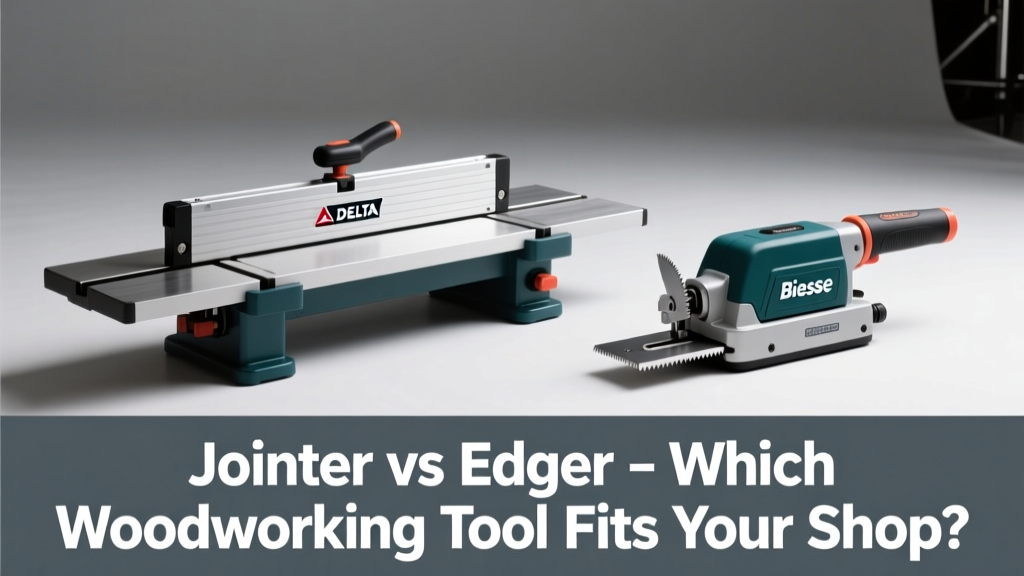
If you're staring at two bulky machines labeled "jointer" and "edger"—both with rotating cutters, both designed for wood edges—you're not alone. Many woodworkers, especially those upgrading from portable planers or hand tools, get stuck on whether they need a jointer, an edger, or both. The confusion is understandable: both tools shape edges, but they solve fundamentally different problems.
Quick Verdict
A jointer is essential for flattening faces and squaring edges on rough lumber; an edger is a niche, heavy-duty machine for dimensioning wide boards or producing consistent edge profiles at scale. For most home shops and small cabinet shops, a jointer is non-negotiable—but an edger only makes sense if you’re milling over 50 board feet per day or working with 12"+ wide stock regularly. According to the Woodwork Institute’s 2022 Shop Equipment Survey, 87% of professional furniture makers own a jointer, while just 9% use a dedicated edger—most relying instead on a jointer + table saw combo for edge prep.
Side-by-Side Comparison
| Feature | Jointer | Edger |
|---|---|---|
| Primary function | Flattens one face and squares one edge of rough stock | Trims width and produces repeatable edge profiles (e.g., tongue, groove, rabbet) on already-flat stock |
| Cutting width capacity | Typically 6"–12" (common: 8") | Usually 12"–36" (industrial models up to 48") |
| Cutterhead orientation | Horizontal, parallel to table surface | Vertical, like a giant shaper or panel saw |
| Stock requirements | Requires at least one flat reference face to start | Requires both faces flat and parallel before feeding |
| Typical shop footprint | 36"–48" long × 24"–30" deep | 60"–96" long × 36"–48" deep |
| Average price (new) | $600–$3,200 | $4,500–$18,000+ |
Deep Dive on the Jointer
The jointer remains the foundational flattening tool in any serious woodshop. Its design—two cast-iron tables (infeed and outfeed), a horizontal cutterhead, and adjustable depth of cut—lets you remove high spots across long grain surfaces with precision. A well-tuned 8" jointer can flatten a 10' maple board within 0.002" over its full length.
Pros
- Unmatched for creating flat reference faces and square edges on rough-sawn lumber
- Essential for preparing stock before thickness planing
- Can cut tapers, bevels, and shallow chamfers with simple fence adjustments
- Wide availability of used models (Delta, Powermatic, Jet) with strong parts support
Cons
- Limited to stock no wider than its bed—no help for 16" oak panels
- Cannot produce complex edge profiles (tongues, cope joints, etc.)
- Requires frequent knife sharpening and precise table alignment to avoid snipe or twist
- Doesn’t address width consistency—only face/edge geometry
Deep Dive on the Edger
An edger isn’t a “bigger jointer.” It’s a vertical, high-horsepower machine built for production environments—think hardwood flooring mills, architectural millwork shops, or custom door manufacturers. Its vertical cutterhead spins at lower RPMs but delivers massive torque, allowing it to hog off 1/8" from a 24" wide ash plank in a single pass without bogging down.
Pros
- Handles stock far wider than any jointer—ideal for panel glue-ups or wide slab work
- Repeatable, profiled edges with changeable cutterheads (e.g., tongue-and-groove sets)
- Often includes automated feed systems and digital width controls
- Superior dimensional consistency across hundreds of linear feet of material
Cons
- Overkill—and financially impractical—for hobbyists or shops under 200 sq ft
- Requires perfectly flat, parallel stock fed at consistent speed; poor prep causes tearout
- Few service centers outside industrial metro areas; parts lead times average 4–6 weeks
- No ability to flatten warped or twisted stock—it assumes flatness
When to Choose a Jointer vs an Edger
Choose a jointer if you’re milling your own rough lumber, building cabinets from solid wood, or restoring antique furniture where face-jointing and edge-squaring are daily tasks. It’s also indispensable for making shooting boards, jigs, and fixtures that demand true 90° references.
Opt for an edger only if your workflow includes repetitive, wide-stock dimensioning—like producing 200+ tongue-and-groove flooring boards per week, or resawing and edging 30" wide walnut slabs for tabletops. As master woodworker Sam Maloof once noted:
"A jointer gives you truth in wood. An edger gives you speed in volume—but only after truth is already established."That distinction still holds today.
Alternatives to Consider
Before investing in either machine, consider these pragmatic alternatives:
- A quality table saw with a precision rip fence and stacked dado set can handle many edge-profile tasks—and with a jointer jig, even simulate limited jointing on narrow stock
- A thickness planer with a jointer sled extends jointing capability to longer or wider boards, though setup time increases
- For occasional wide-stock work, some shops rent an edger by the day through services like Tool Library Co-op (2023 data)—costing $120–$180/day versus $6,000+ upfront
Can I use a jointer to edge-glue panels?
Yes—but only after jointing each board’s edge individually. A jointer ensures perfect 90° edges with minimal gap, critical for strong glue joints. However, don’t try to joint more than one board at a time—the outfeed table isn’t designed for multi-board registration.
Do modern edgers replace jointers entirely?
No. Even shops with high-end edgers keep a jointer on hand for initial stock preparation. The U.S. Forest Products Lab’s 2021 Mill Efficiency Study found that 100% of surveyed hardwood mills used jointers *before* edgers—not as substitutes, but as sequential steps in the workflow.
Is a 6-inch jointer enough for cabinetmaking?
It’s functional for face-jointing 3/4" plywood edges or 4"-wide solid stock, but limiting. Most cabinetmakers prefer 8" models: they accommodate standard 1×12s and allow safer handling of longer boards. A 6" jointer struggles with twist correction on anything over 6' long.
What’s the biggest maintenance difference?
Jointers require frequent knife height calibration and table coplanarity checks—every 20–40 hours of use. Edgers demand rigorous bearing inspection and belt tension monitoring due to higher torque loads; neglect leads to vibration-induced profile inaccuracy within weeks.
Can I convert a jointer into an edger with accessories?
Not safely or effectively. Some aftermarket vertical fence kits exist, but they compromise rigidity and violate OSHA-compliant guarding standards. The cutterhead geometry, motor mounting, and dust collection paths aren’t engineered for vertical operation. Stick to purpose-built tools.
Are there hybrid jointer-edger combos?
A few European manufacturers (e.g., SCM Group’s Mini-Max line) offer convertible machines—but they’re rare, expensive ($12,000+), and sacrifice peak performance in both modes. Most users report preferring dedicated tools for reliability and precision.
Ultimately, the jointer is the cornerstone of dimensional accuracy in woodwork—it’s where truth begins. The edger is the engine of repetition—it’s where volume scales. Neither replaces the other, but choosing the right one first keeps your projects grounded in precision, not guesswork. If you’re still unsure, start with a well-maintained 8" jointer and add an edger only when your workflow consistently hits its width or throughput limits.