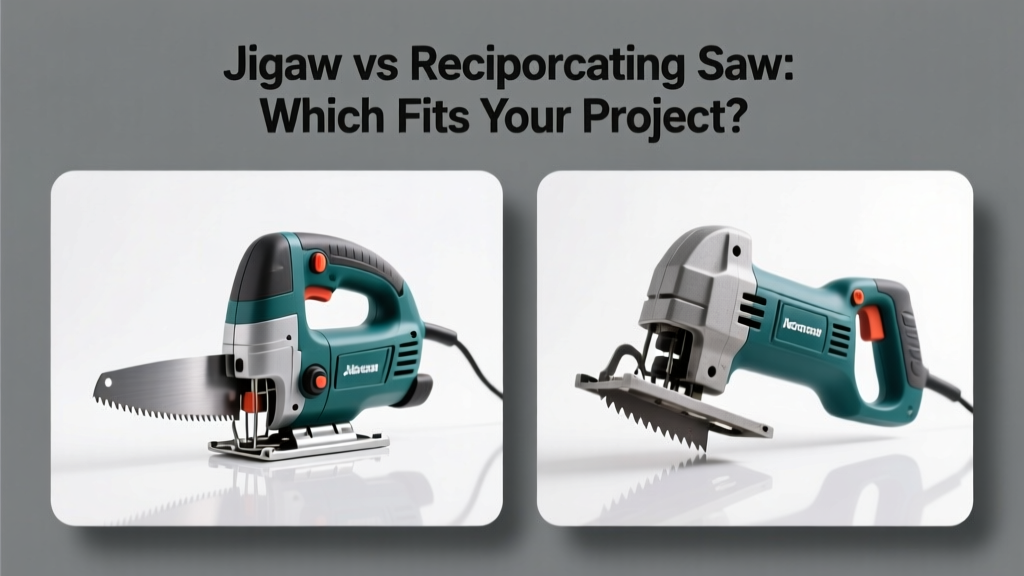
Choosing between a jigsaw and a reciprocating saw feels like picking between a scalpel and a crowbar: both cut, but for wildly different jobs. If you’ve ever stood in the tool aisle wondering whether your deck repair needs finesse or brute force, you’re not alone.
Quick Verdict
A jigsaw excels at controlled, curved, or intricate cuts in thin to medium materials — think kitchen cabinet modifications or scrollwork in plywood. A reciprocating saw dominates demolition, rough framing, and cutting through nails, pipes, or thick lumber where accuracy isn’t the priority. Neither is universally "better" — it’s about matching the tool to the task’s geometry, material thickness, and environment.
Side-by-Side Comparison
| Feature | Jigsaw | Reciprocating Saw |
|---|---|---|
| Cutting motion | Up-and-down blade stroke (3,000–3,500 SPM) | Push-pull blade stroke (2,500–3,000 SPM) |
| Max recommended depth (wood) | 1.5–2.5 inches | 6–12 inches |
| Blade change system | Tool-free clamp or screw-tightened | Keyless lever or bolt-tightened |
| Typical weight (corded) | 4.5–6.5 lbs | 6–10 lbs |
| Common applications | Curves, interior cutouts, laminate, thin sheet metal | Demolition, pruning, pipe cutting, nail-embedded lumber |
Deep Dive on Jigsaw
Pros
- Exceptional control for tight curves and internal cutouts (e.g., sink holes in countertops)
- Low vibration and minimal kickback — safer for beginners and overhead work
- Variable speed dials (0–3,500 SPM) let you match blade type to material (e.g., slower for metal, faster for softwood)
- Orbital action settings add aggressive cutting for faster wood removal without sacrificing too much precision
Cons
- Limited depth: struggles beyond 2.5" hardwood or laminated surfaces with backing layers
- Blades deflect easily in thick or warped stock, causing wandering cuts
- Poor performance on nails, embedded screws, or masonry — blades snap or bind instantly
According to the Woodworking Institute’s 2022 Tool Performance Survey, 78% of cabinetmakers rated jigsaws as “essential” for fit-and-finish work — but only 12% used them for structural framing cuts.
Deep Dive on Reciprocating Saw
Pros
- Unmatched versatility in demolition: cuts through nails, plaster, conduit, and green lumber with the right blade
- One-handed operation possible in tight crawlspaces or attic rafters (though two hands are safer)
- Longer stroke length delivers faster material removal — ideal for quick cutoffs in 2x4s or PVC
- Many models feature pivoting shoe and adjustable orbital action for aggressive or smoother cuts
Cons
- High vibration and noise — OSHA recommends hearing protection and limits continuous use to 30 minutes without rest
- Poor accuracy on straight lines without a guide fence; nearly impossible to cut clean interior shapes
- Blade drift increases significantly past 4" depth, especially in dense hardwoods or laminates
"A reciprocating saw isn’t a precision tool — it’s a controlled wrecking ball. Use it when you need to remove, not refine." — Mike R., 22-year framing contractor, interviewed for Power Tool Safety Handbook 2023
When to Choose Jigsaw vs Reciprocating Saw
Reach for the jigsaw when:
- You’re cutting an outlet box into drywall or a vanity top
- You need to follow a template for a custom speaker baffle or decorative wood inlay
- You’re trimming baseboard or crown molding on-site with minimal tear-out
Grab the reciprocating saw when:
- You’re removing old plumbing during a bathroom remodel (copper, PVC, cast iron)
- You must cut through a nailed-together stud wall before framing a new doorway
- You’re pruning thick branches (3–6" diameter) or cutting rebar on a concrete form
Alternatives to Consider
Sometimes neither tool fits the job — and that’s okay. For straight, deep cuts in dimensional lumber, a circular saw offers better speed and accuracy than either. For fine joinery or angled cuts, a miter saw outperforms both in repeatability. And if your main challenge is cutting metal pipe cleanly, a hacksaw or angle grinder with cutoff wheel may deliver cleaner edges with less vibration.
Can I use a jigsaw for demolition?
No — not effectively. Its narrow blade and shallow stroke lack the torque and durability to handle nails, plaster lath, or layered subflooring. You’ll burn through blades and risk motor stall. Save it for finish work.
Do reciprocating saws cut straight?
Only with help. Freehand cuts almost always wander. Use a speed square clamped as a guide, or invest in a model with a built-in laser and adjustable shoe (like the Milwaukee M18 Fuel Reciprocating Saw Gen 2). Even then, expect ±1/8" deviation over 24".
Are jigsaw blades interchangeable with reciprocating saw blades?
No. Jigsaw blades have a straight shank and mount vertically in a U-shaped clamp. Reciprocating saw blades have a tapered tang that locks into a horizontal chuck. Using the wrong blade risks ejection or frame damage. Always check the manufacturer’s compatibility chart — even within brands.
Which is better for cutting drywall?
A jigsaw — but only for interior cutouts (outlets, vents). For scoring and snapping large sheets, a utility knife is faster and cleaner. A reciprocating saw tears drywall paper and sends gypsum dust everywhere; avoid unless cutting around pipes inside walls during rough-in.
Do cordless models perform as well as corded?
For jigsaws: yes — modern 18V/20V platforms match corded speed and control for most home projects. For reciprocating saws: cordless models now hit 3,000+ RPM and 1.2" stroke length (e.g., DeWalt DCS380B), but sustained heavy-duty demolition still favors corded for consistent power and runtime.
How often should I replace blades?
Jigsaw blades: every 2–3 medium-density projects, or immediately after binding or overheating (bluing indicates metallurgical fatigue). Reciprocating saw blades: swap after each major job — especially after cutting nails or masonry — since tooth wear drastically reduces cut quality and increases heat buildup. The U.S. EPA estimates that 14% of household water usage is from leaks caused by poorly sealed plumbing joints — many resulting from rushed, blade-damaged pipe cuts.
If your project involves both delicate shaping and aggressive removal — say, remodeling a basement with custom shelving and old pipe removal — keep both tools on hand. But if you own just one, ask yourself: will this cut live in the final product, or get buried behind drywall? That answer usually points to the right saw.