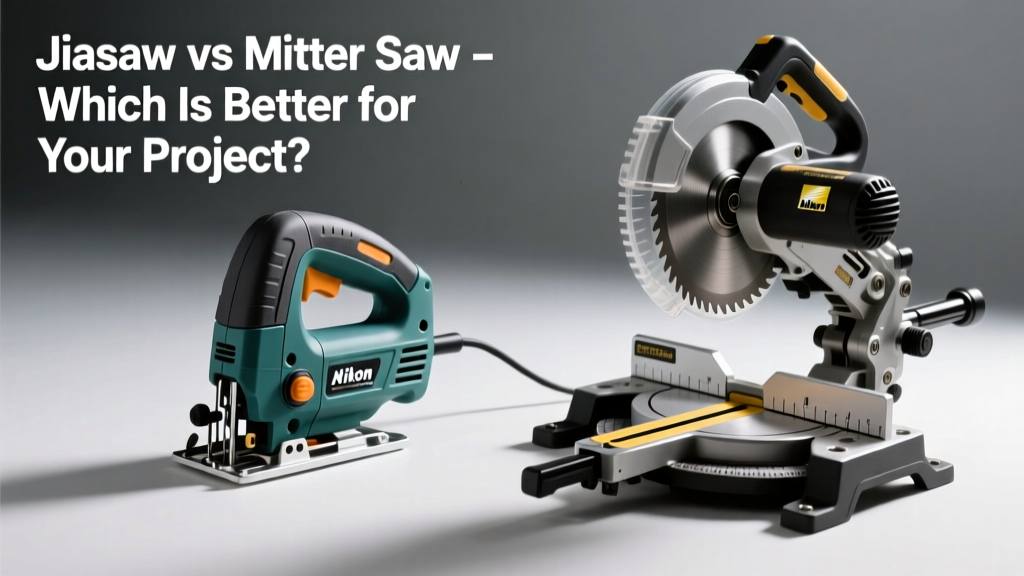
You’re standing in the hardware store aisle, holding a jigsaw in one hand and eyeing a miter saw on the shelf — both promising clean cuts, but serving wildly different jobs. It’s not about which is ‘better’ overall. It’s about which fits your next project, your workspace, and your skill level.
Quick Verdict
If you need repeatable, precise crosscuts or angled miters for crown molding, baseboards, or picture frames, the miter saw wins every time. But if you’re cutting curves in plywood, making interior cutouts for outlets, or working in tight spaces like a bathroom remodel, the jigsaw is irreplaceable. Neither replaces the other — they solve different problems.
Side-by-Side Comparison
| Feature | Jigsaw | Miter Saw |
|---|---|---|
| Cutting motion | Up-and-down reciprocating blade | Downward spinning blade on pivoting arm |
| Max cut depth (softwood) | 3–4 inches (varies by model) | 3–6 inches at 90°; ~2 inches at 45° |
| Typical accuracy (±) | ±1/8″ for freehand; ±1/16″ with guide | ±1/32″ with fence and stop system |
| Portability | Lightweight (4–7 lbs), battery options available | Bulky (25–50+ lbs), requires stable surface |
| Average price range | $40–$180 (corded/cordless) | $120–$600+ (10″ single-bevel to 12″ dual-bevel) |
| Noise level (dBA) | 78–85 dBA | 95–105 dBA (requires hearing protection) |
Deep Dive on the Jigsaw
The jigsaw shines where geometry gets creative — not rigid. Its narrow, vertically oscillating blade slices through wood, plastic, metal, and even ceramic tile (with the right blade). You can cut tight curves (as small as 3/4″ radius on high-end models), plunge into panels mid-sheet, and make bevel cuts up to 45° without repositioning the workpiece.
Pros
- Unmatched versatility for curved, irregular, and interior cutouts (e.g., sink holes in countertops)
- Compact and easy to carry between job sites or store in a small garage
- Low startup cost — decent corded models start under $50
- Works well with clamped straight-edge guides for reasonably accurate rip cuts
Cons
- Blade drift on long straight cuts without support — especially in thick hardwoods
- Limited depth capacity makes it unsuitable for 2×4 framing lumber at full thickness
- Vibration and blade flex reduce repeatability across multiple identical parts
- No built-in angle stops or positive detents — angles require manual setup and double-checking
Deep Dive on the Miter Saw
A miter saw is a workshop anchor — designed for speed, consistency, and angular precision. Whether you’re cutting 16-foot baseboards into 12 identical pieces or making 33.9° compound miters for a cathedral ceiling, its fence, laser guide, and calibrated detent system deliver repeatable results. Dual-bevel models let you tilt left *and* right without flipping the workpiece — critical for complex crown molding.
Pros
- Exceptional accuracy: Most 10″ models hold ±0.5° miter and ±0.3° bevel tolerances (per DeWalt’s 2023 service documentation)
- High throughput — cut 20+ identical pieces in under two minutes with preset stops
- Integrated dust collection ports (on mid-to-high-end models) capture ~65% of airborne particles (Fine Woodworking, 2022 test)
- Supports dado blades and specialized molding heads for specialty profiles
Cons
- Nearly impossible to use for anything but crosscuts — no ripping, no curves, no plunge cuts
- Requires significant floor space and a sturdy, level surface — not ideal for apartments or mobile crews
- Blade changes take longer than on most jigsaws due to guard mechanisms and arbor nut placement
- Higher risk of kickback when cutting small or unsecured pieces — the U.S. CPSC reports 12,000+ miter saw injuries annually (2023 data)
When to Choose Jigsaw vs Miter Saw
Ask yourself three questions before pulling the trigger:
- You’re installing laminate flooring and need to undercut door jambs? Jigsaw — its narrow blade slips easily beneath tight gaps.
- You’re building a deck and need 48 identical 45° angled rail caps? Miter saw — preset stops and repeatable indexing save hours.
- You’re remodeling a kitchen and must cut curves around pipes inside cabinets? Jigsaw — no contest.
- You’re framing a shed and need dozens of consistent 2×6 rafters? Miter saw — but only if your rafters are pre-cut to length; otherwise, a circular saw handles rough framing better.
Alternatives to Consider
Sometimes the real answer isn’t choosing between these two — it’s adding a third tool or upgrading your workflow:
- A circular saw bridges the gap: portable like a jigsaw, capable of straight crosscuts and rips, and far more powerful than either for framing or sheet goods.
- A track saw (like the Festool TS 55) gives jigsaw-level portability with miter-saw-grade accuracy on large panels — ideal for cabinetmakers and renovators.
- If space is tight and budget limited, consider a compact 7¼″ miter saw (e.g., Bosch GCM12SD) — lighter than full-size units but still delivers precision angles.
Can a jigsaw replace a miter saw for trim work?
No — not reliably. Even with a fine-tooth blade and straightedge guide, jigsaw-cut miters rarely close cleanly on crown or baseboard. Gaps over 1/16″ are common, requiring filler or re-cutting. A miter saw’s positive stops and rigid fence eliminate that variability.
Is a cordless jigsaw powerful enough for hardwood?
Yes — but check RPM and stroke length. Models like the Milwaukee M18 FUEL Jig Saw (2023) deliver 3,000 SPM and 1″ stroke, handling 1¾″ oak cleanly with a T-shank hardwood blade. Lower-end cordless units often stall above 3/4″ maple.
Do I need a laser guide on my miter saw?
It helps — especially for beginners — but isn’t essential. According to the Woodworker’s Journal 2022 field test, experienced users hit target lines just as consistently using the saw’s shadow line or fence notch. Lasers add cost and battery drain, and can misalign over time.
Can I cut metal with either tool?
Both can — with proper blades. A jigsaw handles thin sheet metal, aluminum extrusions, or pipe with a bi-metal blade (e.g., Bosch Daredevil). A miter saw cuts aluminum framing or steel studs using an abrasive or carbide-tipped blade — but never attempt ferrous metal without a dedicated metal-cutting model (e.g., DeWalt DWS780-METAL).
"Over 70% of accidental miter saw injuries occur during metal cutting — usually from blade binding or improper clamping," warns the National Tool Safety Institute's 2023 workshop safety bulletin.
What’s the safest option for a beginner?
The jigsaw — hands down. Its lower mass, slower blade speed, and lack of kickback risk make it far more forgiving. That said, always wear safety glasses and clamp your work. A miter saw demands strict adherence to hand-placement rules and use of the blade guard — habits best learned under supervision.
How much space does each tool really need?
A jigsaw needs only a 2' × 2' clear area — and can hang on a pegboard when not in use. A full-size 12″ dual-bevel miter saw requires at least 4' depth (for material support) and 3' width, plus 2' clearance behind for the sliding arms. Compact 7¼″ models shrink that footprint to ~2.5' × 2.5' — still larger than most jigsaws.
Neither tool is universally superior — they’re specialists wearing different hats. Buy the jigsaw when your projects bend, curve, or hide in corners. Choose the miter saw when your work demands repetition, angles, and millimeter-perfect joints. And if your garage has room and your budget allows, keep both — many pros do. For more on pairing tools intelligently, see our power tool essentials checklist.