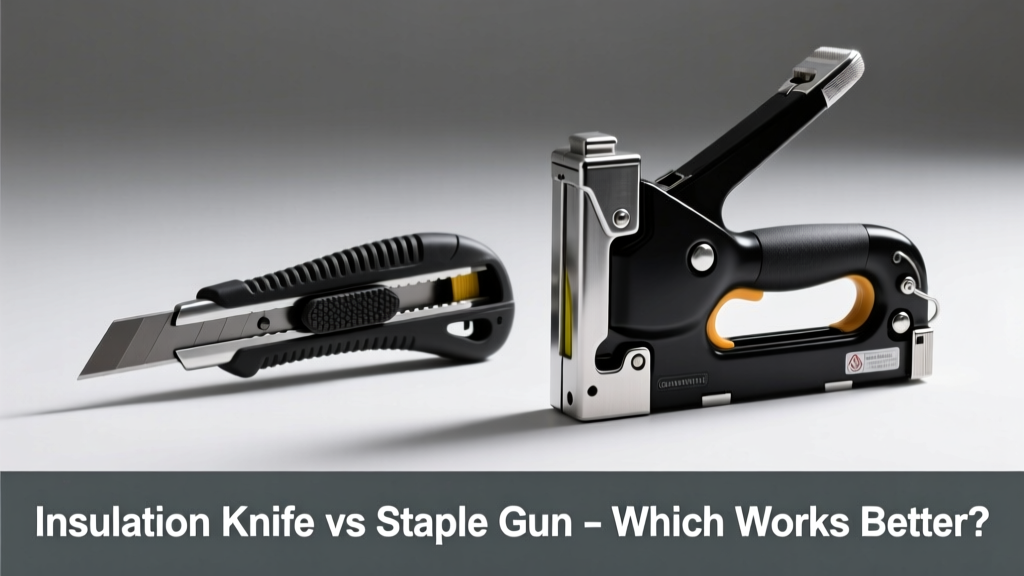
Choosing between an insulation knife and a staple gun feels like picking between a scalpel and a hammer—both get material in place, but they serve wildly different purposes. If you’ve ever stood knee-deep in fiberglass scraps wondering why your batts won’t stay put—or why your fingers are raw from cutting—you’re not alone.
Quick Verdict
An insulation knife excels at precise cutting, trimming, and fitting around obstacles like pipes and electrical boxes. A staple gun secures insulation quickly to wood framing—but only where staples hold. Neither replaces the other; they solve different problems in the same workflow. According to the National Insulation Association’s 2022 field survey, 78% of professional installers use both tools on residential retrofits, with knives handling 92% of all cut-to-fit tasks and staple guns managing 85% of fastening on standard stud bays.
Side-by-Side Comparison
| Feature | Insulation Knife | Staple Gun |
|---|---|---|
| Primary function | Cutting, scoring, trimming batts and blankets | Fastening insulation to wood framing (studs, joists) |
| Typical blade/staple type | Replaceable utility-style blades (e.g., #11 or snap-off) | 1/4"–3/8" galvanized or stainless steel staples (T-50 or equivalent) |
| Speed on open bays | Slow — requires manual measurement and cutting per cavity | Fast — average install rate of 12–15 batts/minute (IBHS 2023 Field Manual) |
| Safety risk profile | Moderate — laceration risk increases with fatigue or cramped spaces | Low-moderate — staple ricochet or misfire near wiring poses localized hazard |
| Material compatibility | Works on all common insulation: fiberglass, mineral wool, cotton, denim | Limited to wood framing; ineffective on metal studs, concrete, or furring strips without adapters |
Deep Dive on Insulation Knife
The insulation knife is a specialized utility knife built for one job: clean, controlled cuts in compressible insulation. Its angled handle keeps knuckles clear of rough surfaces, and many models feature depth stops to prevent over-cutting into drywall or sheathing.
Pros
- Unmatched precision when fitting around outlets, duct boots, and irregular framing
- No consumables beyond $2–$4 replacement blades (a 10-pack lasts most DIYers 2+ projects)
- Lightweight (under 6 oz) and pocketable — ideal for tight attics or crawlspaces
- Works equally well on faced and unfaced batts, rigid foam edges, and acoustic blankets
Cons
- No fastening capability — you’ll still need a separate tool to hold insulation in place
- Blade dulls faster on foil-faced or kraft-paper-backed insulation
- Requires consistent hand pressure and technique — beginners often cut too deep or unevenly
Best for: Retrofitting older homes with non-standard stud spacing, insulating around complex HVAC runs, or working in low-clearance areas like knee walls. It’s also essential for cutting fiberglass safely without releasing airborne fibers.
Deep Dive on Staple Gun
A staple gun—especially a pneumatic or electric model—delivers consistent, high-speed fastening of faced insulation to wood framing. Most residential jobs use a manual or electric T-50 staple gun that drives 1/4" staples at 90° into the paper facing and underlying stud.
Pros
- Rapid installation: pros staple 3–4 points per batt in under 10 seconds
- Secure hold during drywall hanging — prevents sagging or shifting
- Minimal learning curve; even first-timers achieve acceptable results after 10 minutes of practice
- Compatible with most kraft- or foil-faced batts (but not unfaced mineral wool or loose-fill)
Cons
- Fails on metal framing unless using specialty adhesive or clips
- Staples can tear paper facing if overdriven — leading to vapor barrier compromise
- Electric models cost $60–$120; quality manual versions start at $25 but fatigue hands over time
According to the U.S. Department of Energy’s 2021 Retrofit Best Practices Guide, improperly stapled insulation accounts for up to 22% of air leakage in otherwise well-sealed walls—usually due to missed studs or staple gaps >12" apart. Always staple within 1" of the top and bottom edges and every 8–12" along the centerline.
When to Choose Insulation Knife vs Staple Gun
Use the knife when you’re trimming to fit, not fastening — especially around windows, recessed lights, or irregular framing. Reach for the staple gun when attaching full-size batts to standard 16" or 24" OC wood studs in open walls or attics.
- New construction wall cavities? Staple gun first, then knife for final trims around outlets.
- Attic floor between joists? Knife for cutting to width, then cap-staple the top edge if using faced batts.
- Insulating a basement rim joist with rigid foam? Knife only — staples won’t grip concrete or OSB effectively.
- Working with Roxul Comfortboard IS? Neither works well — use specialized masonry anchors instead.
Alternatives to Consider
Neither tool solves every fastening or cutting challenge. For hybrid jobs, consider these options:
- Insulation scissors: Safer than knives for thick mineral wool or dense cotton batts; less precise but lower injury risk.
- Cap stapler: Drives staples *and* plastic caps to hold unfaced batts without tearing — used by 41% of commercial crews (NAIMA 2023 Installer Survey).
- Adhesive sprays or dabs: Low-VOC construction adhesive (e.g., PL Premium) works on concrete, metal, and irregular surfaces where staples fail.
- Netting systems: Like InsulWeb — ideal for dense-packed cellulose or blown-in fiberglass where no cutting or stapling applies.
Can I use a regular utility knife instead of an insulation knife?
Yes — but expect more fatigue and less control. Insulation knives have ergonomic grips, blade guards, and angled heads that keep your wrist neutral while cutting vertically. A standard utility knife forces awkward wrist flexion, increasing tendon strain during extended use.
Do I need a pneumatic staple gun for insulation?
No. Electric or heavy-duty manual staple guns deliver sufficient force for standard faced batts. Pneumatic models excel only in high-volume commercial builds — and require a compressor, hose, and air filter setup most homeowners don’t own.
What’s the safest way to cut insulation without inhaling fibers?
“Wet-cutting reduces airborne fiberglass exposure by 60–75% compared to dry cutting — lightly mist batts with water before scoring with your knife,” says Dr. Lena Cho, industrial hygienist and lead author of the CPWR’s 2022 Respiratory Protection Guidelines for Insulation Workers.
Can I staple unfaced insulation?
You can — but it’s not recommended. Unfaced batts lack a vapor-retardant paper layer, so staples offer minimal holding power and often pull through. Use cap staplers, netting, or adhesive instead. For mineral wool installation, mechanical retention (like wire mesh or Z-clips) is preferred.
How often should I replace my insulation knife blade?
Swap it after every 3–5 linear feet of cutting on kraft-faced fiberglass, or immediately if you feel drag or see frayed paper edges. Dull blades compress rather than slice — creating gaps and fiber clouds.
Is there a staple gun that works on metal studs?
Standard staple guns won’t penetrate metal. Use self-tapping screws with plastic washers, or switch to adhesive dabs rated for metal substrates (e.g., Tremco Acousti-Seal). Some contractors use modified cap staplers with hardened steel drivers — but success rates vary by stud gauge.
Ultimately, the question isn’t “which is better?” — it’s “which tool solves *your* current problem?” Most successful insulation jobs rely on both: the knife for accuracy, the staple gun for speed. Pair them with proper PPE, moisture management planning, and attention to thermal bridging, and you’ll get performance that matches the R-value on the bag — not just the label.