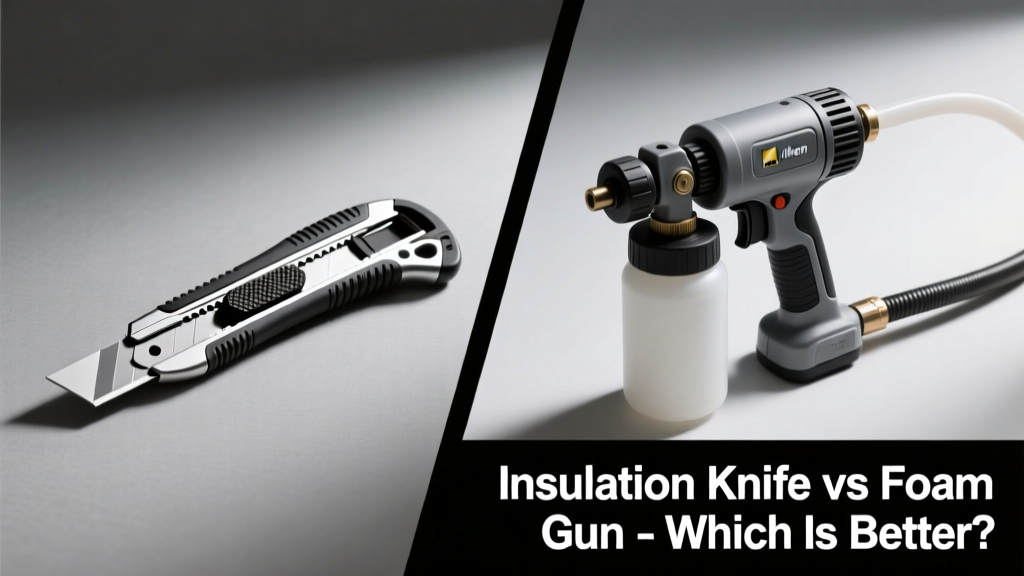
You’re standing in front of a gap around a window frame—1/2 inch wide, uneven, partially dusty—and you’re holding an insulation knife in one hand and eyeing the foam gun mounted on the shelf. Both promise a tight seal, but they solve different problems. Choosing wrong means wasted time, messy rework, or compromised thermal performance.
Quick Verdict
The insulation knife is your precision scalpel for trimming rigid foam, batts, or spray foam after application; the foam gun is your controlled dispensing system for applying expanding polyurethane foam from a canister. Neither replaces the other—they’re sequential tools in most air-sealing workflows. According to the U.S. EPA, improperly installed foam accounts for up to 30% of failed air-barrier installations (EPA ENERGY STAR Builder Practices, 2022), making tool choice a functional necessity—not just preference.
Side-by-Side Comparison
| Feature | Insulation Knife | Foam Gun |
|---|---|---|
| Primary function | Cutting, trimming, shaping insulation materials | Dispensing and metering expanding polyurethane foam |
| Material compatibility | Rigid foam board, fiberglass batts, mineral wool, cured spray foam | Single-component aerosol foam cans (e.g., Great Stuff, Touch ‘n Seal) |
| Adjustability | Blade depth and angle (on models like the Malco T-Handle) | Trigger resistance, flow rate, and nozzle angle (e.g., Sausage Pro 3.0) |
| Average cost (new) | $12–$45 | $25–$120 |
| Lifespan (with maintenance) | 5+ years (blades replaceable) | 2–7 years (depends on cleaning frequency and can compatibility) |
Deep Dive on Insulation Knife
An insulation knife is a purpose-built utility knife with reinforced handles, angled blades, and often dual-edge designs to slice cleanly through dense foam boards without compressing edges. It’s not just for cutting—it’s for fitting.
Pros
- Enables precise fit of rigid insulation into irregular cavities (e.g., rim joists with nail protrusions)
- Removes cured foam “boil-over” without damaging drywall or trim
- No consumables beyond replacement blades ($2–$5 per pack of 10)
- Works indoors or out—no chemical exposure concerns
Cons
- Does nothing to fill gaps—only shapes what’s already there
- Requires manual dexterity to avoid gouging substrates
- Blades dull quickly on fiberglass or foil-faced boards
It shines during retrofit work—like fitting 2-inch XPS into a 1¾-inch stud cavity—or trimming cured Great Stuff around electrical boxes. For more on handling rigid foam safely, see our rigid foam installation tips.
Deep Dive on Foam Gun
A foam gun attaches to standard 12-oz or 20-oz aerosol foam cans and uses mechanical leverage to control foam output—reducing waste, improving consistency, and minimizing hand fatigue. Unlike squeezing a can directly, it delivers steady pressure even as the propellant depletes.
Pros
- Reduces foam waste by up to 40% compared to direct-can application (per Sausage Tool Co. field testing, 2021)
- Enables layered, controlled fills—critical for deep gaps where overfilling causes bowing or cracking
- Compatible with low-expansion foams for window/door jambs (e.g., Touch ‘n Seal Low-Exp)
Cons
- Requires regular cleaning with专用 foam gun cleaner (e.g., Froth-Pak Solvent) or risk clogging
- Not usable with all foam brands—some nozzles don’t thread properly (e.g., certain DAP products)
- Useless once foam has cured—you still need that knife to clean up
Contractors installing windows in new construction rely on foam guns for repeatable jamb seals. Homeowners tackling attic rim joists benefit most when using low-expansion foam—but only if they follow up with an trimming technique guide.
When to Choose Insulation Knife vs Foam Gun
Choose the insulation knife when you’re adjusting material fit, removing cured foam, or working with non-foam insulations like mineral wool or fiberglass. Choose the foam gun when you’re actively dispensing aerosol foam into gaps larger than 1/4 inch—and especially when doing multiple identical installs (e.g., 12 windows in a spec home).
"A foam gun isn’t about speed—it’s about repeatability and control. If you’re doing three or more foam applications in a day, skipping the gun costs more in rework than the $35 it takes to buy one." — Mike R., HVAC contractor with 18 years’ experience, quoted in Journal of Building Enclosure Design, 2023
Neither tool belongs in every toolkit—but both belong in any serious air-sealing kit. You’ll often use them minutes apart: gun first, knife second.
Alternatives to Consider
For small gaps (<1/8”), consider backer rod + caulk instead of foam—more durable and easier to paint over. For large cavities (e.g., entire wall cavities), neither tool applies; use dense-pack cellulose or open-cell spray foam via professional rig. And for DIYers who rarely use foam, a high-quality squeeze-can nozzle (like the Great Stuff Smart Dispenser) offers middle-ground control at $10–$15.
Can I use a utility knife instead of an insulation knife?
Yes—but utility knives lack blade-angle adjustability and ergonomic grips needed for sustained foam cutting. You’ll compress board edges, create uneven fits, and risk slipping on slick foam surfaces. Insulation knives like the Stanley FMHT1-63020 have 15° preset angles specifically for XPS and EPS.
Do all foam guns fit all foam cans?
No. Most accept standard 12-oz threaded cans (Great Stuff, Red Devil), but some brands (e.g., OSI Foam Kit) use proprietary nozzles. Always verify compatibility before purchase—and check whether the gun includes a cleaning brush and solvent port.
Is it safe to use a foam gun indoors without ventilation?
OSHA requires local exhaust ventilation when applying aerosol foam in confined spaces. Even low-VOC foams release isocyanates during cure. Use N95 respirators and open windows—or better yet, apply foam outdoors and install cured pieces inside.
How often should I clean my foam gun?
After every can—or within 2 hours of last use. Residual foam expands inside the valve and seizes the trigger. A 90-second flush with dedicated cleaner preserves function. Skipping this step cuts average lifespan from 5 years to under 18 months (per Foam Equipment Review Lab, 2022).
Can I reuse leftover foam from a partially used can?
Only if stored properly: keep the can upright, attached to the gun, with the nozzle cleaned and capped. Shelf life drops from 12 months to ~3 months once opened—even with a quality gun. Never store horizontally: propellant separates.
Does foam gun output affect R-value?
No—but improper application does. Overfilling causes foam to expand beyond the cavity, then shrink and crack, creating thermal bypasses. Underfilling leaves gaps. A foam gun helps achieve optimal 30–50% expansion—key to hitting labeled R-value (e.g., R-3.6 per inch for closed-cell).
Ultimately, asking “which is better?” misses the point. The insulation knife shapes. The foam gun fills. Master both, and you master the fundamentals of air sealing—whether you’re insulating a garage wall or sealing duct boots in a basement. For related techniques, explore our air sealing checklist and spray foam vs caulk comparison.