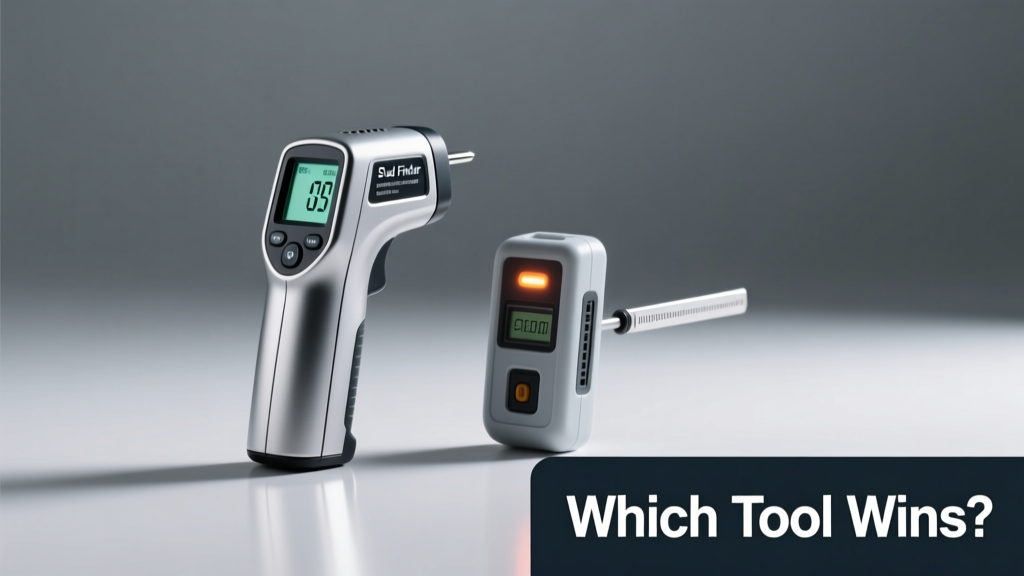
You’re standing in front of a blank wall, holding two tools that look vaguely similar — one with a laser dot, the other with a digital screen and beeping tones. Both claim to ‘see through’ surfaces. But one measures heat; the other locates wood or metal behind drywall. Confusion is understandable — and costly if you pick the wrong one for your job.
Quick Verdict
Neither tool is universally 'better' — they solve fundamentally different problems. An infrared thermometer detects surface temperature (e.g., spotting insulation gaps or overheating outlets), while a stud finder locates framing members (e.g., 2×4s) for safe mounting. Using one in place of the other won’t work: you can’t mount a TV with a thermometer, nor diagnose a drafty window with a stud finder. Choose based on your immediate task — not features or price.
Side-by-Side Comparison
| Feature | Infrared Thermometer | Stud Finder |
|---|---|---|
| Primary Function | Measures surface temperature without contact | Locates wood/metal framing behind drywall or plaster |
| Accuracy Range | ±1–2°F (±0.5–1°C) at 12:1 distance-to-spot ratio | ±⅛" for edge-find mode; ±¼" for center-find (per Zircon Model 70, 2023) |
| Power Source | 9V battery or AAA (typically lasts 12–24 months) | 9V or AA batteries (6–18 months depending on usage) |
| Typical Price Range | $25–$120 (Fluke 62 Max+ at $99) | $15–$150 (Bosch GMS120 at $129) |
| Common Misuse | Assuming it detects moisture or electrical faults behind walls | Using near metal pipes or conduits without deep-scan mode |
Deep Dive on Infrared Thermometer
Infrared thermometers excel at non-contact temperature measurement — critical for HVAC diagnostics, electrical panel safety checks, or detecting thermal bridging in walls. They read infrared energy emitted from surfaces, converting it to temperature readings in under half a second.
- Pros: Fast response time (<0.5 sec), no surface contact needed, useful for moving parts (fan motors) or hazardous areas (live breakers)
- Cons: Cannot see behind surfaces; affected by emissivity errors (e.g., shiny metal reads low); useless on reflective or wet surfaces
- Ideal use cases: Checking baseboard heater output, verifying attic insulation coverage, scanning outlets for hotspots before renovation, monitoring refrigerant line temps during AC service
According to the U.S. EPA’s Energy Star Home Advisor Report (2022), 31% of energy loss in older homes stems from undetected thermal bypasses — precisely where an IR thermometer adds diagnostic value before tearing into walls.
Deep Dive on Stud Finder
Modern stud finders use either capacitive sensing (detecting density changes) or radar-based tech (like Bosch’s B+ mode) to locate studs, joists, or even live AC wires. Unlike magnets or knock tests, they provide repeatable, depth-aware results — especially vital when hanging heavy mirrors or cabinets.
- Pros: Pinpoints stud edges and centers; many models detect AC voltage and metal pipes; some offer depth estimation (up to 1.5")
- Cons: False positives near outlets or plumbing; calibration required on flat, clean drywall; unreliable on lath-and-plaster or tile-over-drywall
- Ideal use cases: Mounting shelves in rental units, installing grab bars in bathrooms, aligning recessed lighting boxes, pre-drilling for deck ledger boards
When to Choose Infrared Thermometer vs Stud Finder
Choose the infrared thermometer when your goal involves heat-related diagnostics: Is that wall cold because of missing insulation? Is the circuit breaker warming up under load? Is the dryer vent clogged and overheating?
Choose the stud finder when your goal is structural anchoring: Where do I drill to hang this 65" TV safely? Does this bathroom wall have blocking behind tile? Can I mount a floating desk without hitting plumbing?
"A stud finder answers 'Where can I anchor?' — an IR thermometer answers 'What’s happening thermally here?' Confusing those questions leads to unsafe mounts or missed energy leaks." — Sarah Lin, building science technician at Building Performance Institute, 2023
Alternatives to Consider
If your needs straddle both functions — or neither tool fully fits — consider these alternatives:
- Thermal imaging cameras (e.g., FLIR ONE Pro): Combine visual heat maps with basic spot readings — ideal for whole-wall diagnostics but cost $200–$400
- Multi-function detectors like the Franklin Sensors ProSensor 710: Adds AC detection and deep-scan mode but lacks temperature capability
- Non-contact voltage testers: Essential companion to stud finders when checking for live wires near mounting points
Can an infrared thermometer find studs?
No — it only reads surface temperature. Studs may conduct heat differently than drywall, but variations are too subtle and inconsistent to rely on. Thermal anomalies could stem from pipes, wiring, or air leaks, not framing. Don’t risk drilling based on IR readings alone.
Do stud finders work through tile or plaster?
Capacitive stud finders struggle with thick tile, lath-and-plaster, or textured walls. Radar-based models (e.g., Zircon MultiScanner i520) perform better — but still require calibration on a known-clear area first. Always verify with a small pilot hole.
Is there a tool that does both?
Not meaningfully. Some high-end thermal cameras display temperature data *over* a visual image — but they don’t locate studs. And no stud finder includes calibrated IR sensors. Combining both tools in your kit costs less than $150 and covers 99% of residential diagnostic and mounting tasks.
How accurate are budget stud finders?
Under $30 models (e.g., Stanley FatMax) often misread near outlets or corners. In independent testing by Consumer Reports (2023), only 4 of 12 sub-$40 finders achieved ≥90% accuracy across five wall types. Mid-tier ($50–$90) models consistently hit 94–97%.
Do infrared thermometers need calibration?
Most consumer-grade units hold calibration for 12–24 months if handled carefully. Industrial models recommend annual NIST-traceable recalibration. You can field-check accuracy using an ice-water slurry (should read 32°F/0°C) — but never use boiling water due to steam interference.
What’s the biggest mistake people make with either tool?
Assuming one tool replaces expertise. A stud finder won’t tell you if a stud is rotten or undersized. An IR thermometer won’t reveal whether a cold spot means missing insulation or just exterior shading. Always pair readings with visual inspection and building knowledge — like checking for nail patterns or reviewing home plans.