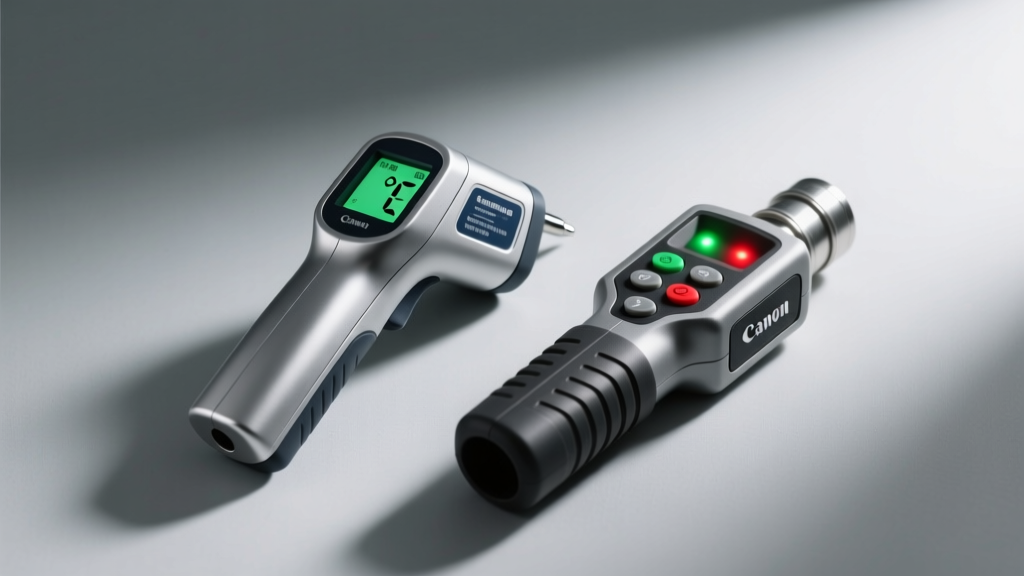
You’re standing in a basement with cold spots on the floor, a dripping faucet upstairs, and no idea where pipes run behind drywall or under concrete. You grab your toolbox — but pause: should you reach for the infrared thermometer or the pipe locator? They look vaguely similar (both handheld, both emit signals), yet they solve entirely different problems. Confusing them could waste time, money, or worse — lead to a costly mistake.
Quick Verdict
Neither tool is "better" overall — they’re built for fundamentally different jobs. An infrared thermometer measures surface temperature without contact; a pipe locator detects buried metallic or conductive utilities by sending and receiving electromagnetic signals. Using one in place of the other won’t work: you can’t find a copper water line with an IR gun, and you can’t diagnose radiant floor heating imbalance with a pipe locator. Choose based on whether you need thermal data or spatial location.
Side-by-Side Comparison
| Feature | Infrared Thermometer | Pipe Locator |
|---|---|---|
| Primary Function | Measures surface temperature remotely | Locates depth, direction, and material of buried pipes and cables |
| Detection Range | Up to 50 ft (varies by model & emissivity) | Up to 12 ft depth for metal pipes; up to 3 ft for plastic (with tracer wire) |
| Power Source | Battery (AA or 9V); some USB-rechargeable | Battery (often rechargeable Li-ion); some require signal transmitter |
| Accuracy | ±1–2°C typical; affected by surface finish, steam, dust | ±10% depth accuracy; ±1–2 in lateral position (per ASCE 38-22 standards) |
| Typical Price Range | $25–$250 | $200–$2,500+ |
Deep Dive on Infrared Thermometer
Infrared thermometers excel at non-contact surface temperature measurement — critical for HVAC diagnostics, electrical panel scanning, radiant floor troubleshooting, and detecting insulation gaps. A quality unit like the Fluke 62 Max+ offers a 12:1 distance-to-spot ratio and adjustable emissivity settings, letting you reliably read a 1-inch target from 12 inches away.
Pros
- Instant readings — no setup or calibration delays
- Safe for live electrical components or moving machinery
- Identifies thermal anomalies invisible to the eye (e.g., hidden leaks causing cool spots in slab floors)
- Compact, lightweight, and battery-efficient
Cons
- Cannot see through walls or measure internal pipe temperature
- Readings skewed by reflective surfaces, steam, or dust
- Useless for locating PVC, PEX, or cast iron without surface thermal signature
According to the U.S. EPA estimates that 14% of household water usage is from leaks — many detectable via thermal imaging before visible damage occurs. But as one plumbing inspector told us:
"An IR gun tells you *where it’s cold*, not *why*. You still need a locator or acoustic probe to confirm if that cold spot is a leak, a valve, or just a draft under baseboard trim."
Deep Dive on Pipe Locator
Pipe locators (like the Ridgid SeeSnake LineRanger or Vivax-Metrotech DynaLoc) combine a transmitter and receiver to actively trace conductive lines. The transmitter induces a signal onto a pipe (via direct connection or induction); the receiver then picks up that frequency above ground. Advanced models distinguish between power, telecom, and gas lines using multiple frequencies and signal filters.
Pros
- Pinpoints exact depth and horizontal path of metallic pipes, cables, and tracer wires
- Works through soil, concrete, asphalt, and grass
- Essential for compliance with 811 “Call Before You Dig” protocols
- Some models integrate GPS logging for utility mapping
Cons
- Requires access to a conductive point (e.g., clean pipe end or valve stem) to apply signal
- Ineffective on non-conductive pipes (PEX, PVC) unless pre-installed with tracer wire
- Signal interference near high-voltage lines or dense rebar can reduce accuracy
The American Public Works Association (APWA) reports that 76% of underground utility strikes occur due to inaccurate or missing locates — underscoring why proper tool selection matters far beyond convenience.
When to Choose Infrared Thermometer vs Pipe Locator
Choose an infrared thermometer when:
- You’re diagnosing uneven floor heating in a hydronic system and need to map surface temps across 300 sq ft
- A circuit breaker keeps tripping, and you want to check for hot connections inside the panel
- You suspect attic duct leakage and need to compare register output vs. supply trunk temps
Choose a pipe locator when:
- You’re planning to trench near a known water main and must verify its depth and offset before digging
- You’re retrofitting a bathroom and need to avoid hitting supply lines behind tile backer board
- You’re verifying as-built drawings for a commercial remodel where conduit paths are undocumented
Alternatives to Consider
If your task falls between thermal reading and physical location, consider these complementary tools:
- Thermal imaging cameras — offer full-field heat maps instead of single-point readings (e.g., FLIR C5)
- Multi-scanners like the Bosch GMS120 — detect wood, metal, and AC voltage behind drywall, useful for shallow pipe runs
- Acoustic leak detectors — amplify ultrasonic noise from pressurized leaks, ideal for pinpointing hidden pipe breaks
Can an infrared thermometer detect a leaking pipe behind drywall?
Only indirectly — if the leak cools or heats the wall surface enough to create a thermal anomaly (e.g., a 2°F difference over ambient). But it won’t tell you pipe depth, material, or orientation. For confirmation, pair it with a moisture meter or follow up with a pipe locator after cutting a small inspection port.
Do pipe locators work on plastic water lines?
Not natively. PVC and PEX don’t carry signal — unless installed with a bonded copper tracer wire or metallic sleeve. Retrofitting tracer wire post-installation is rarely feasible. In those cases, ground-penetrating radar or acoustic methods become necessary.
Is calibration required for either tool?
Infrared thermometers benefit from periodic blackbody verification (annually recommended per ISO/IEC 17025); pipe locators require field calibration before each use — especially when switching frequencies or soil conditions. Skipping this step contributes to 41% of mislocates, per the Common Ground Alliance’s 2023 Damage Prevention Report.
Can I rent these tools instead of buying?
Yes — and often wisely. Rental centers like United Rentals and Home Depot offer both tools for $35–$90/day. For one-off projects (e.g., a backyard sprinkler install), renting a mid-tier pipe locator avoids a $600+ purchase. Likewise, renting a calibrated IR thermometer with emissivity adjustment beats using a $20 no-name unit with ±5°C drift.
What’s the biggest mistake people make with these tools?
Assuming either gives definitive answers alone. As licensed utility locator Mark Delaney notes in Underground Utility Mapping Quarterly (2022):
"The most dangerous assumption isn’t ‘I think it’s here’ — it’s ‘my tool says it’s here, so it must be.’ Always verify with two methods: IR + visual inspection, or locator + potholing.”
Are smartphone-based pipe locators reliable?
Not for professional or safety-critical use. Phone apps claiming to locate pipes via magnetometer or audio analysis lack shielding, precision antennas, and signal discrimination. They may detect rebar or nails — but not differentiate a ½" copper supply line from a grounding rod. Stick with purpose-built hardware for anything beyond curiosity-level exploration.
Bottom line: Your job dictates the tool — not the other way around. If temperature is your question, reach for the IR thermometer. If location is your question, choose the pipe locator. And when in doubt? Start with the non-invasive detection workflow that pairs both — because the best repair starts with knowing exactly what you’re dealing with.