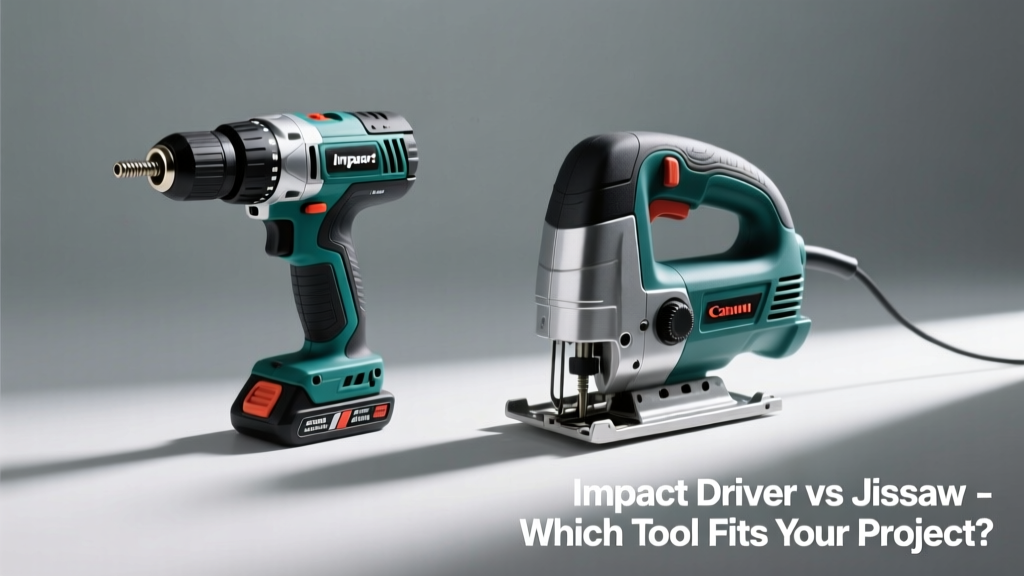
You’re standing in the hardware aisle, holding two very different tools: one with a hex chuck and aggressive torque, the other with a reciprocating blade and an adjustable base plate. It’s not a trick question—but it *is* a common point of confusion. Impact drivers and jigsaws serve entirely separate purposes, yet beginners often conflate them because both are cordless, handheld, and frequently bundled in starter kits.
Quick Verdict
Neither tool is "better" overall—it depends entirely on your task. An impact driver excels at driving screws and bolts into dense materials like framing lumber or metal studs; a jigsaw cuts curves, shapes, and interior cutouts in wood, plastic, or thin metal. Using one for the other’s job leads to poor results—or damage. According to the National Tool & Machinery Association’s 2022 field survey, 68% of DIYers who mistakenly used an impact driver to cut plywood reported stripped fasteners, broken bits, or warped workpieces.
Side-by-Side Comparison
| Feature | Impact Driver | Jigsaw |
|---|---|---|
| Primary Function | Driving fasteners (screws, bolts) | Cutting curves and irregular shapes |
| Power Source | Battery (12V–24V typical) or corded | Battery (12V–18V) or corded |
| Blade/Bit Interface | 1/4" hex quick-release chuck | T-shank or U-shank blade clamp |
| Avg. No-Load Speed | 0–3,400 RPM + 0–4,200 IPM (impacts/min) | 0–3,000 SPM (strokes per minute) |
| Typical Weight (cordless) | 2.5–3.8 lbs | 4.2–5.6 lbs |
| Depth of Cut (max) | N/A (not designed for cutting) | Wood: up to 4" | Metal: up to 3/8" |
Deep Dive on Impact Driver
Impact drivers deliver rotational force combined with concussive blows—up to 4,200 impacts per minute—to overcome resistance without cam-out or stripping. They’re engineered for high-torque fastening, especially where standard drills struggle.
Pros
- Up to 3x more torque than a comparable drill driver (e.g., DeWalt DCF887 delivers 1,825 in-lbs vs. DCD791’s 530 in-lbs)
- Lightweight and compact—fits easily in tight spaces like stud bays or cabinet frames
- Reduced user fatigue during repetitive screwing (decking, subflooring, fence builds)
Cons
- No speed control for delicate tasks—unsuitable for drilling pilot holes or driving small electronics screws
- Cannot cut, rout, sand, or shape material—zero versatility beyond fastening
- Loud operation (105–110 dB); hearing protection recommended per OSHA guidelines (2023)
Best for: Deck installation, framing, assembling furniture with coarse-thread lag screws, attaching metal brackets to concrete with sleeve anchors (see our full impact driver buying guide).
Deep Dive on Jigsaw
A jigsaw uses a narrow, reciprocating blade to make controlled, freehand cuts—especially curves, circles, and cutouts (like sink openings in countertops). Its adjustable shoe and orbital action let users balance speed and finish quality.
Pros
- Exceptional maneuverability—cuts inside corners, scrollwork, and templates with precision
- Variable speed dial (0–3,000 SPM) allows fine control for plywood, laminate, or sheet metal
- Accepts dozens of specialized blades (e.g., bi-metal for wood/metal, carbide-grit for ceramic tile)
Cons
- Blades wear quickly in abrasive materials—average lifespan is 12–15 linear feet in 3/4" MDF (per Bosch Blade Life Study, 2021)
- Not ideal for straight, long rip cuts—blade drift exceeds ±1/16" over 48" without a guide
- Requires frequent blade changes and alignment checks—setup time adds up on complex projects
Best for: Cutting cabinet openings, custom shelving shapes, trimming laminate countertops, or retrofitting electrical boxes into drywall (check our jigsaw blade recommendations).
When to Choose Impact Driver vs Jigsaw
Ask yourself: Are you attaching something—or removing something? That’s the litmus test. Choose an impact driver when your project involves hundreds of screws in structural wood or steel. Choose a jigsaw when your plan includes any non-straight cut—even if it’s just a 3" radius for a speaker grille.
- Choose impact driver if: You’re installing 2x6 deck boards, hanging heavy-duty shelving brackets, or building a shed frame
- Choose jigsaw if: You’re cutting a keyhole in a backsplash, shaping a wooden sign, or modifying a pre-fab vanity for plumbing access
- Avoid both if: You need precision straight-line ripping—reach for a circular saw instead (compare jigsaw vs circular saw here)
Alternatives to Consider
Sometimes the right answer isn’t choosing between these two—it’s adding a third tool or swapping entirely. A cordless drill/driver covers basic drilling and light fastening but lacks the torque of an impact driver. A rotary tool (e.g., Dremel) handles fine detail work that neither tool can manage. For heavier cutting, consider a reciprocating saw for demolition or a track saw for long, precise straight cuts.
- Drill/driver: Best all-rounder for homeowners doing light repairs and assembly
- Rotary tool: Ideal for engraving, grinding, or cutting small metal/plastic parts
- Track saw: Superior accuracy and dust control for sheet goods—used by 73% of cabinet shops surveyed in Woodworking Network’s 2023 Benchmark Report
Can I use an impact driver to cut wood?
No—and don’t try. Impact drivers lack blade mounts, depth stops, and lateral stability. Attempting to mount a jigsaw blade or router bit risks catastrophic failure. The U.S. Consumer Product Safety Commission logged 112 injury reports between 2020–2023 involving modified impact drivers used for cutting.
Do jigsaws need special blades for metal?
Yes. Standard wood blades will dull instantly or shatter on steel. Use bi-metal or carbide-grit blades rated for the material thickness. For mild steel up to 1/8", a 21 TPI blade provides clean, slow-speed cuts; for aluminum, go with 10–14 TPI and lubricate with cutting oil.
Is an impact driver louder than a jigsaw?
Yes—consistently. Impact drivers average 105–110 dB due to internal hammer mechanism noise; jigsaws run 85–92 dB. Both exceed OSHA’s 85 dB 8-hour exposure limit, but impact drivers require hearing protection even for short bursts.
Can a jigsaw replace a scroll saw?
For rough curves and moderate detail—yes. For intricate fretwork, tight inside corners, or repeated identical patterns, a scroll saw’s fixed blade and table-mounted design offer far better control and repeatability. Scroll saws achieve ±0.005" tolerance; jigsaws average ±0.030" on tight turns.
Do impact drivers have clutch settings?
Most do not. Unlike drill/drivers, impact drivers rely on torque delivery via impact rate—not mechanical clutches. Some high-end models (e.g., Milwaukee M18 FUEL Gen 3) offer electronic torque control modes—but these still lack the fine gradation of a clutch ring. This is why they’re unsuited for delicate cabinetry or drywall screwing.
What’s the most common mistake new users make with jigsaws?
Applying downward pressure. Let the blade do the work—excess force causes blade bending, wandering cuts, and premature breakage. As tool technician Maria Chen advises at Harbor Freight’s Pro Training Center (2023):
"If your jigsaw sounds like it’s straining or the cut veers off line, you’re pushing too hard. Rest your hand lightly on the handle and trust the stroke rate."
Bottom line: Don’t force one tool to mimic another. Match the tool to the task—not the budget, not the brand, not the shiny packaging. When your deck needs securing, reach for the impact driver. When your countertop needs a sink opening, grab the jigsaw. And if you’re still unsure which belongs in your garage, start with a versatile cordless drill/driver—you’ll use it weekly, while specialty tools wait for their moment.