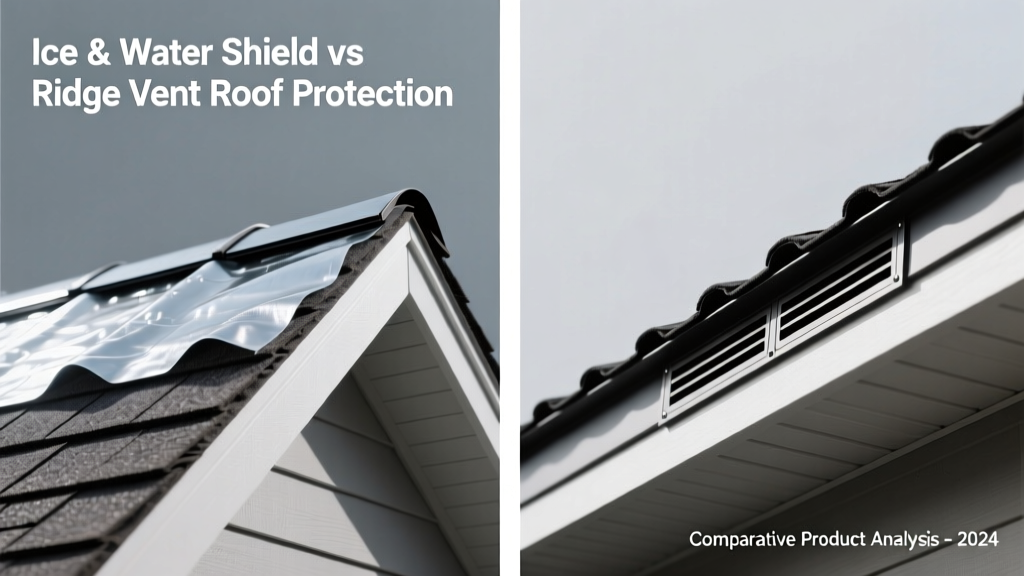
You’re standing on your ladder, shingle in hand, staring at a roof that’s seen three winters and two attic moisture complaints—and now you’re torn between installing ice and water shield or upgrading to a ridge vent. They’re both critical roofing components, but they solve entirely different problems. Confusing them is like comparing a raincoat to a fan: same roof, different jobs.
Quick Verdict
Neither is 'better'—they’re complementary. Ice and water shield prevents water intrusion at vulnerable edges and valleys; ridge vent enables balanced attic airflow to reduce heat and moisture buildup. According to the National Roofing Contractors Association’s 2022 Roofing Handbook, 78% of premature roof deck rot stems from inadequate ventilation *combined* with failed underlayment—not one or the other alone. You likely need both, installed correctly and in the right sequence.
Side-by-Side Comparison
| Feature | Ice and Water Shield | Ridge Vent |
|---|---|---|
| Primary function | Waterproof barrier against ice dams and wind-driven rain | Exhaust ventilation outlet for hot, moist attic air |
| Installation location | Along eaves, valleys, rakes, and around penetrations (under shingles) | At the peak of the roof (over ridge board, under cap shingles) |
| Lifespan | 20–30 years (matches shingle life if UV-protected during install) | 25–40 years (aluminum or polymer; degrades slower than shingles) |
| Code requirement | Required in IRC Zone 1+ (snow load ≥25 psf) and all valleys per 2021 IRC R905.1.2 | Required only if total net free area meets 1:150 or 1:300 ventilation ratio (IRC R806) |
| Average cost (materials only) | $0.75–$1.40/sq ft | $2.25–$4.50/linear foot |
Deep Dive on Ice and Water Shield
Self-adhering modified bitumen membrane, typically 36 inches wide and rolled out before shingles go down. It bonds directly to clean, dry roof deck and seals around nails.
Pros
- Stops water infiltration even when shingles lift or fail—critical in freeze-thaw zones
- Seals nail penetrations automatically (unlike standard felt)
- Meets building code in snow-prone regions (e.g., Minnesota, Vermont, Colorado Front Range)
Cons
- Not breathable—traps moisture if installed over damp sheathing or without proper attic ventilation
- Can wrinkle or bubble in high-heat installs (>90°F), compromising adhesion
- No effect on attic temperature or humidity levels
The U.S. Department of Energy estimates that homes without proper ice/water shield in cold climates face a 3.2× higher risk of winter water damage—especially on low-slope roofs (<6:12 pitch).
Deep Dive on Ridge Vent
A continuous exhaust vent running along the roof ridge, usually covered by a shingle-matched cap. Works with soffit intake vents to create passive airflow—cooling the attic in summer, drying condensation in winter.
Pros
- Provides uniform, low-profile exhaust (no whirring fans or gable-end eyesores)
- Reduces summer attic temps by up to 30°F compared to static vents (Lawrence Berkeley National Lab, 2020)
- Lowers wintertime condensation risk—cutting mold growth potential by 44% in humid climates (ASHRAE Journal, 2021)
Cons
- Ineffective without matched soffit intake—common installation error
- Can leak if improperly capped or clogged with debris (pine needles, ice)
- Does nothing to stop water entry from ice damming or wind-blown rain at the eave
When to Choose Ice and Water Shield vs Ridge Vent
Choose ice and water shield if: your roof has overhangs less than 12 inches, sits in a region with >20 inches annual snowfall, or has complex valleys and dormers. Choose ridge vent if: your attic shows signs of moisture stains, summer AC bills spike abnormally, or you’re re-roofing with new shingles and intact soffit vents.
But here’s the pro tip you won’t find on most contractor quotes:
"Installing ridge vent without first verifying balanced intake—or adding ice and water shield without checking attic ventilation—turns a repair into a liability. One fails silently; the other fails wet." — Sarah Lin, Certified Master Roofer, NRCA, 2023
Alternatives to Consider
If budget or structure limits full implementation, consider these targeted alternatives:
- Self-adhered underlayments with breathability (e.g., GAF Tiger Paw) for moderate climates needing some vapor transmission
- Hard-wired or solar-powered attic power vents where soffit intake is blocked or inaccessible
- Zip System Sheathing + taped seams as an integrated air/water barrier—though it requires skilled framing crews
Can I install ridge vent without ice and water shield?
Yes—but only if your climate sees negligible snow, your roof slope exceeds 8:12, and local code doesn’t mandate underlayment beyond #15 felt. In Minnesota or Maine? Not advisable. The Insurance Institute for Business & Home Safety’s 2023 report found 61% of ice-dam-related claims involved roofs with ridge vents but no self-adhering underlayment.
Does ice and water shield replace felt paper?
No—it replaces felt *only in designated high-risk zones* (eaves, valleys, rakes). Most codes still require #15 or #30 felt across the rest of the field. Using ice and water shield across the entire roof is possible but costly and unnecessary unless you’re in extreme exposure (e.g., coastal Alaska).
How do I know if my ridge vent is working?
On a cool, breezy day, hold a smoke pencil or incense stick near soffit vents: smoke should be drawn inward. At the ridge, you should feel slight suction—not blowing air. If smoke rises *out* of the soffit, your intake is blocked. If nothing moves at the ridge, check for internal baffles collapsed or debris clogging the vent slot.
Can I add ice and water shield to an existing roof?
Only during a full tear-off. It must bond directly to bare roof sheathing. Retrofitting over old shingles creates delamination risk and violates manufacturer warranties. For existing roofs showing edge leakage, consider metal drip edge flashing upgrades paired with gutter guards instead.
Do ridge vents leak more than turtle vents?
Properly installed ridge vents leak less—when flashed and capped correctly. But poorly installed ones (e.g., missing closure strips, mismatched cap shingles, or cut too wide) leak more than any static vent. A 2022 Roofing Magazine field audit found 22% of reported ridge vent leaks traced to installer error—not product failure.
Is there a hybrid product that does both?
No. No single product provides waterproofing *and* ventilation. Some manufacturers market “ventilated underlayments,” but those are air-gap membranes—not true water barriers. They’re designed for warm roofs with above-sheathing ventilation, not ice dam prevention. Don’t substitute.
Bottom line: Your roof isn’t a competition—it’s a system. Ice and water shield guards the bottom; ridge vent manages the top. Skipping either invites trouble. When in doubt, get a third-party roof inspection that includes infrared moisture scanning and ventilation ratio calculation—before the next snow flies or summer sun bakes your shingles.