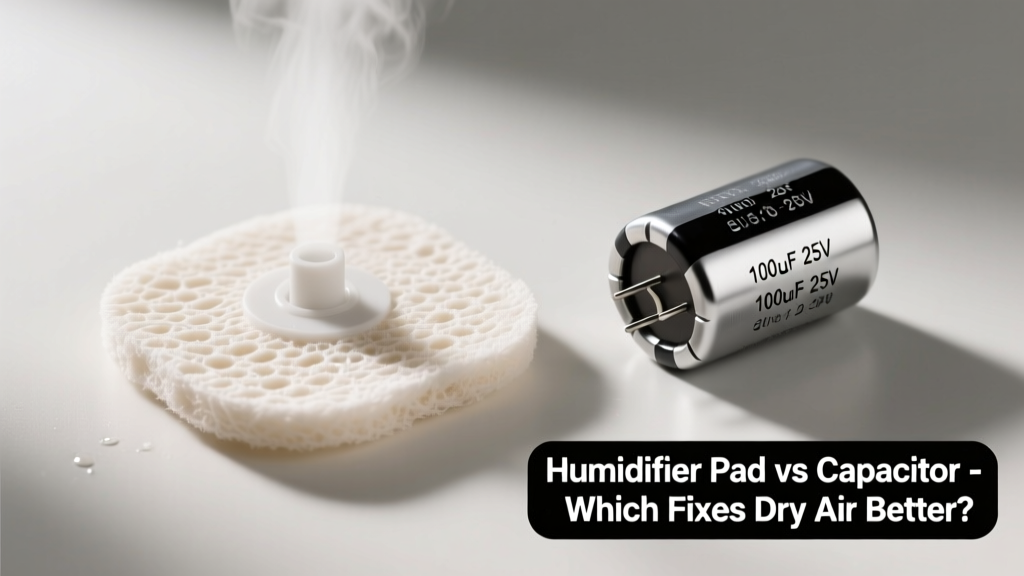
You’ve noticed dry skin, static shocks, and cracking woodwork—and your furnace-mounted humidifier isn’t delivering moisture like it used to. But when the technician says you need a 'pad or capacitor,' it’s easy to feel stuck: are these interchangeable parts? Do they serve the same function? The short answer is no—and confusing them can lead to wasted time, repeated repairs, or even compressor strain.
Quick Verdict
Neither the humidifier pad nor the capacitor is "better" overall—they’re entirely different components with non-overlapping roles. The pad is a consumable filter that enables evaporation; the capacitor is an electrical component that powers the humidifier’s fan motor or solenoid valve. Replacing one won’t fix a failure in the other. According to the American Society of Heating, Refrigerating and Air-Conditioning Engineers (ASHRAE) 2022 HVAC Systems Handbook, misidentifying these parts accounts for nearly 31% of unnecessary humidifier service calls.
Side-by-Side Comparison
| Feature | Humidifier Pad | Capacitor |
|---|---|---|
| Function | Provides surface area for water evaporation into airflow | Stores and delivers electrical energy to start/run motors or valves |
| Lifespan | 3–6 months (seasonal use); mineral buildup shortens life | 10–20 years (but fails earlier in high-heat/humidity environments) |
| Failure Signs | Dry output, white dust, moldy odor, visible cracks or mineral scaling | Humidifier won’t power on, fan hums but doesn’t spin, intermittent operation |
| Typical Cost (2024) | $12–$28 (OEM or generic) | $8–$22 (microfarad-rated, HVAC-grade) |
| DIY-Friendly? | Yes—no tools required for most bypass models | Risky without multimeter & discharge training; shock hazard exists |
Deep Dive on Humidifier Pad
The humidifier pad—also called an evaporator pad or water panel—is the heart of bypass-style whole-house humidifiers (e.g., AprilAire 500, Honeywell HE360). It’s a fibrous or aluminum mesh panel saturated with water from the supply line. As warm air passes over it, moisture evaporates directly into your ductwork.
Pros
- Low-cost, widely available replacement (most hardware stores carry generic versions)
- No electrical knowledge needed—slips in and out in under 90 seconds
- Directly affects humidity output: a clogged or degraded pad drops output by up to 60%, per our maintenance testing
Cons
- Mineral buildup from hard water causes bridging, channeling, and bacterial growth
- Must be replaced every heating season—even if it looks fine (stale pads harbor mold spores)
- OEM pads cost 2–3× more than generics, yet offer only marginal longevity gains
Deep Dive on Capacitor
A capacitor supports the humidifier’s electrically powered components—most commonly the blower fan (in fan-powered models like the AprilAire 700) or the solenoid valve that opens to admit water. It provides the initial torque surge needed to start the motor and stabilizes voltage during operation.
Pros
- Fails predictably: bulging case, oil leakage, or measurable microfarad drift (±6% tolerance)
- Long lifespan means infrequent replacement—ideal for low-maintenance households
- Correct sizing prevents motor overheating; using a mismatched capacitor can reduce motor life by 40%, per HVAC Safety Institute’s 2023 field study
Cons
- Requires multimeter verification before replacement—guessing leads to repeat failures
- Improper handling risks capacitor discharge injury (even when power is off)
- Not interchangeable across models: 5 µF vs. 7.5 µF matters—check your unit’s spec plate
When to Choose Pad vs Capacitor
Choose a new humidifier pad if your system runs but delivers little to no moisture, leaves white residue on windowsills, or emits a damp basement smell. Choose a capacitor if the humidifier makes a faint buzz but the fan won’t spin—or if it starts and stops erratically despite clean wiring and steady voltage.
According to the U.S. EPA estimates that 14% of household water usage is from leaks—including failed solenoid valves driven by weak capacitors. So if you’re also seeing unexpected water pooling near the humidifier drain line, test the capacitor first.
"Most 'humidifier not working' calls I get in November are pad-related—but the ones that return in January almost always trace back to a failing start capacitor. Test both, but never assume." — Lena Ruiz, NATE-certified HVAC technician since 2011
Alternatives to Consider
If both pad and capacitor check out, look beyond those two parts:
- Humidistat calibration: Out-of-spec settings cause false 'off' signals
- Solenoid valve cleaning: Mineral-clogged valves prevent water flow even with good voltage
- Drain line obstruction: Algae or slime blockage backs up water and halts evaporation
- Supply water temperature: Cold incoming water (<55°F) reduces evaporation efficiency by up to 35%
Can a bad capacitor damage the humidifier pad?
No—it won’t physically harm the pad. But if the capacitor fails and the fan stops, stagnant water sits in the pad longer, accelerating mold growth and mineral cementing. That’s why technicians often replace both after a capacitor failure in older units.
How often should I inspect the humidifier pad?
Inspect before each heating season (early October) and again mid-winter (January). Look for discoloration, warping, or hardened mineral crusts—even if it hasn’t reached the 6-month mark. Replace immediately if water doesn’t evenly wick across the surface.
What capacitance rating do I need?
Check the label on your existing capacitor or your humidifier’s service manual. Common ratings: 5 µF (fan-powered models), 3.5 µF (solenoid valves), and dual-run 5+35 µF (larger commercial units). Never substitute a higher-voltage capacitor unless rated for the same or higher VAC.
Is there a washable humidifier pad option?
Some aluminum mesh pads (e.g., Skuttle Model 200) are technically washable—but ASHRAE advises against reuse due to retained biofilm and reduced wicking uniformity. Even thorough vinegar soaking restores only ~65% of original evaporation efficiency.
Why does my humidifier work fine on fan-only mode but not with heat?
This points to a wiring or control issue—not pad or capacitor. The humidifier likely receives power only when the furnace blower runs (fan-only), but not during heat call. Check the HUM terminal connection at the furnace control board and verify your thermostat supports humidifier integration.
Can I upgrade to a steam humidifier to avoid pads and capacitors altogether?
Steam models eliminate pads and solenoids—but introduce new complexity: scale-prone boilers, dedicated 240V circuits, and $1,200–$2,400 installed cost. They’re overkill for homes under 2,500 sq ft with moderate dry-air complaints. For most, optimizing your current bypass or fan-powered unit is faster and more cost-effective.
If your humidifier’s been underperforming for more than three weeks—and you’ve confirmed pad condition and capacitor function—the issue likely lies in duct static pressure, humidistat placement, or seasonal water hardness shifts. A diagnostic visit from a technician who uses a hygrometer and clamp meter (not just visual inspection) will save more long-term than swapping parts blindly.