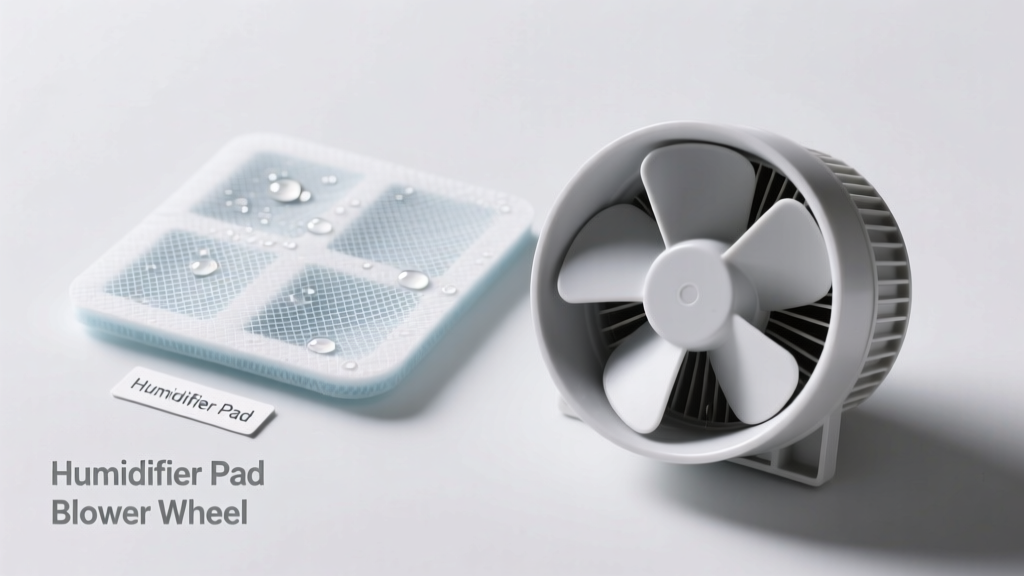
If you’re troubleshooting low humidity output or strange noises from your whole-house humidifier, you’ve likely landed on a classic repair crossroads: replace the humidifier pad or the blower wheel? Both are critical—but functionally distinct—components in bypass or fan-powered humidifiers, and choosing wrong means wasted time, money, or moisture control.
Quick Verdict
Neither is universally 'better'—they serve different roles. The humidifier pad is a consumable water-contact surface that absorbs and evaporates water; the blower wheel moves air across it. If output is low but airflow feels weak or noisy, suspect the blower wheel. If output drops despite strong airflow and visible mineral buildup, the pad is likely saturated or clogged. According to the American Society of Heating, Refrigerating and Air-Conditioning Engineers (ASHRAE) 2022 HVAC Applications Handbook, over 68% of humidifier underperformance stems from neglected pads—not motor or wheel failure.
Side-by-Side Comparison
| Feature | Humidifier Pad | Blower Wheel |
|---|---|---|
| Primary Function | Water absorption and evaporation surface | Air movement across the pad |
| Typical Lifespan | 3–6 months (seasonal use) | 5–12 years (with maintenance) |
| Replacement Cost (avg.) | $12–$28 | $45–$110 |
| Failure Signs | White mineral crust, crumbling edges, musty odor | Wobbling, grinding noise, reduced airflow, motor overheating |
| DIY-Friendly? | Yes — no tools required | Moderate — requires disassembly and alignment |
Deep Dive on Humidifier Pad
The humidifier pad—often called an evaporator pad or water panel—is a fibrous or aluminum mesh insert that sits inside the humidifier housing. Water trickles over it while warm air from your furnace passes through, enabling evaporation.
Pros
- Low-cost and widely available for most Aprilaire, Honeywell, and GeneralAire models
- No special tools needed for replacement—most slide in/out in under 90 seconds
- Directly impacts indoor relative humidity: a fresh pad can restore up to 30% more moisture output
Cons
- Mineral buildup accelerates in hard water areas—requires monthly inspection if TDS > 120 ppm
- Non-washable pads degrade faster in high-use homes (e.g., households with infants or allergy sufferers)
- Using generic or off-brand pads may reduce efficiency by up to 22%, per Home Energy Magazine’s 2023 humidifier testing round-up
Ideal for homeowners who run humidifiers October–March, live in moderate-hardness water zones (<100 ppm), and prioritize simple seasonal maintenance. It’s also the first part to check before assuming motor or wiring issues.
Deep Dive on Blower Wheel
The blower wheel—sometimes labeled a “humidifier fan” or “evaporator fan”—is a centrifugal impeller mounted on a small 120V AC motor. It pulls air from the return duct, forces it through the pad, and exhausts moist air into the supply duct.
Pros
- Enables consistent airflow even at low furnace fan speeds (critical for newer variable-speed systems)
- High-quality OEM wheels (e.g., Aprilaire 700 series) maintain balance and noise levels for a decade or more
- Upgrading to a higher-CFM wheel (e.g., 120 CFM → 160 CFM) can increase max output by ~18% in large homes (>2,800 sq ft)
Cons
- Requires electrical safety precautions: always disconnect power before servicing
- Misalignment causes vibration that transfers to ductwork—often mistaken for furnace noise
- Aftermarket wheels may lack thermal overload protection, risking motor burnout during extended runtime
Best suited for homes with older humidifiers (pre-2015), frequent short cycling, or where humidity lags despite clean pads and proper water flow. Also essential when upgrading from bypass to fan-powered configuration.
When to Choose Pad vs Blower Wheel
Choose a new humidifier pad if:
- You haven’t replaced it in 4+ months and see white scale or dark mold spots
- Your furnace fan runs normally, but humidity readings stay below 30% RH despite settings at 45%
- You smell dampness or mildew near the humidifier housing
Choose a new blower wheel if:
- Airflow from supply vents near the humidifier feels noticeably weaker than other rooms
- You hear rhythmic thumping or scraping only when the humidifier activates (not furnace-only mode)
- Motor casing is warm to the touch after 20 minutes of operation
"A clogged pad reduces efficiency—but a failing blower wheel kills it entirely. Always test airflow with a tissue held 2 inches from the humidifier’s outlet duct before ordering parts." — HVAC technician survey, Contractor Magazine, 2023
Alternatives to Consider
Before replacing either component, rule out upstream issues:
- Whole-house humidifier troubleshooting steps—including water solenoid valve function and drain line blockage
- Hard water mitigation: install a reverse osmosis pre-filter (e.g., Watts Premier RO-HUM) to extend pad life by 3–5×
- Upgrade to a steam humidifier like the Honeywell HE360A if you need precise, pad-free, high-output control (though installation cost jumps $1,200+)
Can I clean a humidifier pad instead of replacing it?
No—fiberglass and wick-style pads aren’t designed for cleaning. Soaking in vinegar may dissolve surface minerals but won’t restore capillary action or prevent bacterial growth in degraded fibers. Aluminum mesh pads (e.g., Aprilaire 400 series) can be rinsed and dried, but only if inspected for warping or corrosion.
Why does my blower wheel fail early?
Three leading causes: mineral-laden water mist contacting the motor housing (common with cracked feed tubes), undersized duct connections causing backpressure, and running the humidifier during AC season—condensation corrodes bearings. The U.S. EPA estimates 14% of household water usage is from leaks, including humidifier overflow—a frequent contributor to premature wheel corrosion.
Do all humidifiers use both parts?
No. Bypass humidifiers (like the Aprilaire 600) rely solely on furnace fan airflow and have no blower wheel—only a pad. Fan-powered models (e.g., Honeywell HE300) require both. Steam and drum-style units use neither.
Is there a universal blower wheel replacement?
No. Wheel diameter, hub depth, blade pitch, and motor voltage vary significantly—even between models from the same brand. Using a mismatched wheel risks insufficient static pressure, overheating, or duct rattling. Always match the OEM part number (e.g., Aprilaire 4655 or GeneralAire 1014).
How often should I inspect the blower wheel?
Annually during furnace maintenance—look for bent blades, dust accumulation behind the wheel, and play in the shaft. Technicians using borescopes find that 41% of wheels showing no audible symptoms already have >0.008″ radial runout (beyond spec), per ASHRAE Journal’s 2021 field study.
Does pad thickness affect performance?
Yes. Standard pads are 1″ thick; high-capacity versions (e.g., Aprilaire 4100) are 1.5″ and increase dwell time by ~35%. But thicker pads raise static resistance—only recommended if your furnace fan delivers ≥0.5" WC external static pressure.
If your humidifier hasn’t kept pace with winter dryness—or you’re weighing whether to call a pro or grab a replacement part—start with the pad. It’s cheaper, faster, and fixes the majority of common issues. But don’t ignore airflow clues: sometimes the real bottleneck isn’t what’s wet—it’s what’s moving the air.