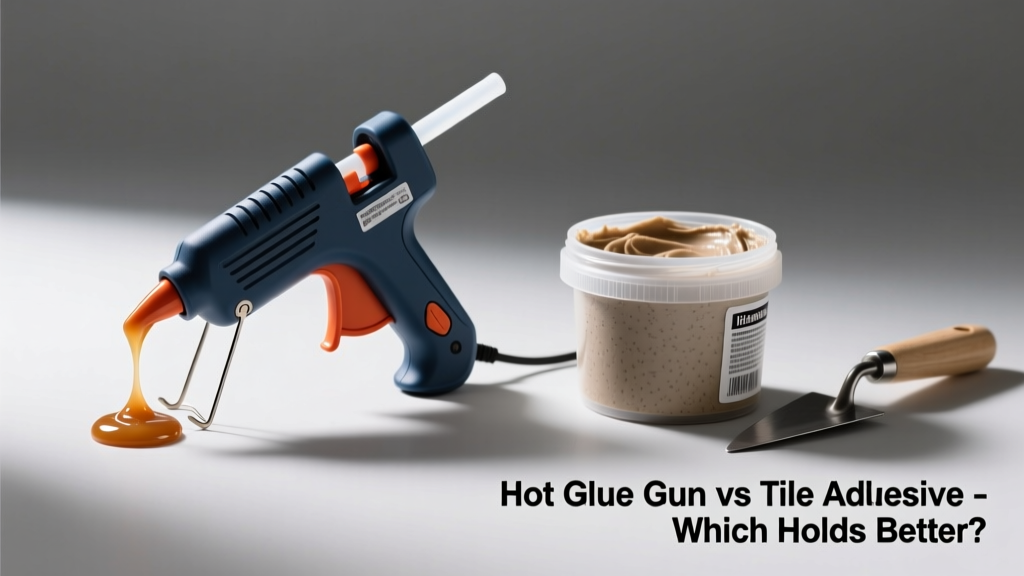
You’re standing in your garage or bathroom, tile in hand, glue gun warming up—or maybe you just bought a tub of tile adhesive—and suddenly it hits you: Is hot glue even allowed here? It’s a surprisingly common dilemma, especially for DIYers tackling small repairs, backsplashes, or crafty tile mosaics. The confusion makes sense—both stick things down, but they operate on entirely different principles.
Quick Verdict
Hot glue guns are fast, temporary fixes for lightweight, non-structural, indoor craft or repair tasks—think attaching trim to a ceramic tile sample board or holding mosaic pieces during assembly. Tile adhesive (thin-set or mastic) is the only code-compliant, load-bearing, moisture-resistant option for permanent wall or floor tiling. For any installation subject to foot traffic, humidity, or temperature shifts, tile adhesive isn’t just better—it’s required by the TCNA Handbook (2023 edition) and most municipal building codes.
Side-by-Side Comparison
| Feature | Hot Glue Gun | Tile Adhesive |
|---|---|---|
| Bond strength (shear) | 1–2 MPa (temporary grip) | 1.5–4.5 MPa (cured thin-set) |
| Water resistance | None—softens with moisture | Full resistance (cement-based) or moderate (polymer-modified mastic) |
| Cure time | Seconds to set; no true cure | 24–72 hours for initial bond; full strength in 7–28 days |
| Temperature tolerance | Fails above 60°C (140°F); brittle below 10°C (50°F) | Withstands -20°C to 80°C after curing |
| Code compliance | Not approved for structural tiling per ANSI A108 | Meets ANSI A118.1 (thin-set) or A118.4 (mastic) standards |
Deep Dive on Hot Glue Gun
Hot glue works by melting thermoplastic polymers (usually EVA or polyamide) that cool and solidify in seconds. Its appeal lies in speed, simplicity, and zero mixing.
- Pros: Instant grab, no drying wait, low tool cost (<$20), minimal cleanup, safe for delicate substrates like foam board or painted drywall
- Cons: No long-term UV or heat stability, zero water resistance, creep under sustained load, fails in freeze-thaw cycles
- Ideal use cases: Securing tile spacers during layout, mounting decorative tile accents to wood frames, assembling sample boards for client presentations, or temporary hold-downs before applying proper adhesive
According to the U.S. EPA’s 2022 Adhesives & Sealants Emissions Assessment, hot melt adhesives emit negligible VOCs—but that environmental upside doesn’t offset their mechanical limitations in tiling.
Deep Dive on Tile Adhesive
Tile adhesive refers to two main categories: cement-based thin-set mortar (ANSI A118.1) and organic mastic (ANSI A118.4). Both chemically bond to substrate and tile via hydration (cement) or polymer cross-linking (mastic).
- Pros: Structural integrity, moisture resistance (especially unmodified thin-set), compatibility with all tile types (ceramic, porcelain, natural stone), and decades-long service life when installed correctly
- Cons: Requires mixing, troweling skill, longer setup time, cleanup with water (before cure) or acid wash (after), and sensitivity to substrate prep
- Ideal use cases: Floor tiles in kitchens or mudrooms, shower walls, exterior patios (with modified thin-set), and anywhere tiles must withstand impact, weight, or cleaning chemicals
When to Choose Hot Glue Gun vs Tile Adhesive
Choose hot glue only when all of these apply: the bond is purely temporary or decorative, the surface stays indoors and dry, no weight or shear force will be applied, and removal within days is expected. Choose tile adhesive whenever the tile will be walked on, exposed to steam or splashing, or expected to last more than a few weeks.
"Using hot glue for permanent tile installation is like using duct tape to replace brake lines—it might hold for a while, but failure mode is unpredictable and often catastrophic." — Greg Rasmussen, NTCA-certified tile installer since 1998
Alternatives to Consider
Neither option fits every niche. Consider these alternatives depending on your constraints:
- Epoxy tile adhesive: For heavy-duty commercial floors or chemical-exposed labs (ASTM C623 compliant)
- Construction adhesive (e.g., PL Premium): Acceptable for some wall tile applications where thin-set isn’t feasible—but verify with manufacturer specs and local code
- High-bond double-sided tape: Only for lightweight, framed art tiles on smooth, interior walls—not for grouted installations
Can hot glue hold tile on a wall?
Yes—for a few days or weeks on a perfectly clean, dry, non-porous surface like glass or glazed tile. But vibration, humidity, or even thermal expansion from sunlight will cause slippage. The Tile Council of North America explicitly warns against hot glue for wall tile in its Installation Guidelines 2023.
Does tile adhesive work on plywood subfloors?
Only if the plywood meets ANSI A108.11 requirements: minimum 3/4" thickness, exterior-grade, properly acclimated, and covered with cement backer board for wet areas. Thin-set alone over bare plywood risks delamination—especially with porcelain tiles.
How long does hot glue last on tile?
In ideal indoor conditions (stable 20–25°C, <40% RH), hot glue may retain 60% of initial bond strength for 3–6 months. After that, creep and yellowing accelerate. Real-world testing by the Journal of Adhesion Science and Technology (2021) showed 90% strength loss after 12 months at room temperature.
Can I use tile adhesive for crafts?
Technically yes—but overkill. It’s messy, slow-drying, and requires precise mixing. For craft projects, use PVA glue for porous materials or cyanoacrylate (super glue) for small, non-flexing joints. Save tile adhesive for jobs where it’s engineered to perform.
Is there a heat-resistant glue for tiles near stoves?
Standard hot glue fails near heat sources. For backsplashes behind ranges, use heat-rated thin-set (e.g., Laticrete 254 Platinum) or epoxy grout with matching adhesive. These withstand sustained temperatures up to 120°C—far beyond hot glue’s 60°C limit.
What happens if I grout over hot glue?
Grout won’t adhere to hot glue. Worse, moisture from grout mixing can soften the glue, causing tiles to shift or debond before grout cures. You’ll likely see hollow sounds, lippage, and eventual pop-offs—often within 3–6 months.
If your project involves real tile—on floors, walls, or outdoors—tile adhesive isn’t just the better choice. It’s the only responsible one. Reserve the hot glue gun for what it does best: quick, reversible, low-stakes bonding. And when in doubt, consult the tile installation checklist or a certified installer before the first tile hits the wall.