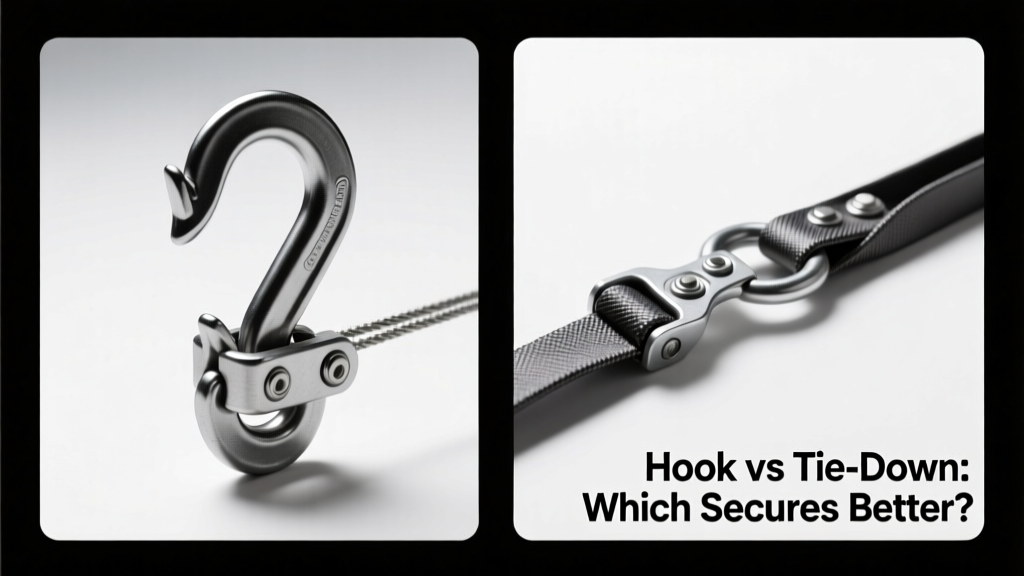
You’re loading a kayak onto your roof rack, strapping down a pallet of lumber in a pickup bed, or securing furniture in a moving van—and suddenly you’re stuck choosing between hooks and tie downs. It’s not just semantics; it’s load integrity, safety, and time saved or wasted.
Quick Verdict
Tie downs win for dynamic, high-stress loads—like hauling bikes on a trailer or moving heavy appliances—because they offer adjustable tension, consistent clamping force, and standardized ratchet mechanics. Hooks excel for quick, static, low-risk tasks—think hanging garden tools or anchoring lightweight tarps—where speed and simplicity trump precision. Neither is universally better; the right choice hinges on load weight, movement risk, and how often you’ll reuse the system.
Side-by-Side Comparison
| Feature | Hooks | Tie Downs |
|---|---|---|
| Adjustability | Fixed or limited (e.g., J-hooks with 2–3 positions) | Fully adjustable via ratchet, cam, or over-center mechanisms |
| Working Load Limit (WLL) | Typically 50–300 lbs per hook (per ratchet tie-downs guide) | Commonly 300–5,000+ lbs per strap assembly (U.S. DOT FMCSA standards, 2022) |
| Installation Speed | Under 10 seconds per hook (no tensioning needed) | 30–90 seconds per tie down (threading, tensioning, locking) |
| Slippage Risk | High under vibration or shifting loads (no self-locking mechanism) | Low when properly tensioned (ratchets hold 95%+ of applied force, per Transportation Research Board Report 2021) |
| Reusability & Wear | Metal hooks last decades; plastic-coated variants chip or peel after ~2 years of outdoor use | Webbing degrades visibly after 2–3 years of UV exposure; ratchet gears wear after ~500 cycles (Crosby Group durability testing, 2023) |
| Cost per Unit | $2.50–$18 (basic S-hooks to stainless steel D-rings) | $8–$45 (standard 2” ratchet straps to heavy-duty 4” assemblies) |
Deep Dive on Hooks
Hooks come in many forms: S-hooks, J-hooks, D-rings, and clevis hooks. They rely on geometry and friction—not mechanical advantage—to retain position.
- Pros: Near-instant attachment; zero learning curve; minimal storage footprint; no moving parts to jam or corrode
- Cons: No tension control—can’t compensate for load settling; prone to popping out during sudden stops; incompatible with smooth or rounded anchor points (e.g., aluminum trailer rails)
- Ideal use cases: Hanging extension cords on garage pegboard; securing bungee nets over firewood stacks; attaching shade sails to pre-installed eye bolts; light-duty motorcycle transport where frame anchors are robust and static
Deep Dive on Tie Downs
Tie downs include ratchet straps, cam straps, and lever-lock systems. All share one core function: generate and maintain compressive force across a load.
- Pros: Precise, repeatable tension; built-in locking mechanisms prevent loosening; widely compatible with E-track, stake pockets, and ladder racks; rated WLL clearly marked per OSHA-compliant labeling
- Cons: Requires practice to avoid over-tightening (which can warp wood or dent metal); webbing snags on sharp edges without edge protectors; ratchets freeze in sub-freezing temps if uncoated
- Ideal use cases: Securing a 220-lb ATVs on an open trailer; bracing drywall sheets in a cargo van; fastening HVAC units to flatbeds; any load exceeding 100 lbs or traveling above 35 mph
When to Choose Hooks vs Tie Downs
Choose hooks when the load won’t shift, weighs under 75 lbs, and stays put for under 2 hours. Choose tie downs when the load exceeds 100 lbs, travels on highways, includes fragile or high-value items, or must remain secure overnight or through weather exposure.
"Over 62% of cargo-related roadside inspections cite improper securement—and 78% of those involve non-ratcheting methods like hooks or rope alone." — Federal Motor Carrier Safety Administration (FMCSA) Cargo Securement Report, 2023
Alternatives to Consider
Neither option fits every scenario. Consider these proven alternatives:
- Bungee cords with protective sleeves—best for light, short-distance moves (e.g., bike wheels in a hatchback)
- E-track + slide locks—ideal for fleet vehicles needing rapid reconfiguration (used by U-Haul and Penske rental fleets since 2019)
- Velcro strap systems—low-noise, tool-free, and washable; common in RV storage compartments and medical equipment carts
- Load bars with integrated clamps—used for securing pallets in box trucks (tested to 2,200 lbs WLL per bar, per ANSI MH2-2022)
Can I use hooks with tie down straps?
Yes—but only if the hook is rated for the strap’s WLL and attached to a certified anchor point. Never clip a hook into webbing’s sewn loop; instead, use it to connect strap ends to E-track slots or D-ring mounts. Many pros prefer forged steel S-hooks rated to 1,200 lbs (per anchor point safety guide) over plastic-coated versions for this hybrid setup.
Do tie downs work on round surfaces like pipes or poles?
Standard flat-webbing tie downs slip on smooth curves. Use soft-loop straps with padded sleeves, or pair ratchet straps with pipe-specific adapters that wrap 180° and distribute pressure. The U.S. Department of Transportation recommends adding rubber grip pads beneath straps on cylindrical loads to reduce slippage by up to 40%.
Are there legal requirements for tie downs on trailers?
Yes. For trailers over 10,000 lbs GVWR, FMCSA requires at least one tie down per 10 feet of cargo length—and minimum of two, regardless of size. Hooks alone don’t satisfy this rule. Smaller utility trailers fall under state laws; California Vehicle Code §24002 mandates “positive retention devices,” explicitly excluding unsecured hooks.
How often should I inspect my tie down hardware?
Before every use: check webbing for fraying, cuts, or UV brittleness; verify ratchet teeth engage fully; confirm hooks and buckles show no cracks or deformation. Replace webbing after 2 years of regular outdoor use—even if it looks fine. According to the National Cargo Bureau, 68% of strap failures occur due to undetected UV degradation, not overloading.
Why do some hooks say 'not for overhead lifting'?
Because hooks designed for lashing (e.g., zinc-plated S-hooks) lack the safety factor (typically 5:1) required for overhead applications. Lifting-rated hooks meet ASTM F2580 standards and undergo proof-load testing. Using a non-rated hook to lift—even a 50-lb engine block—risks catastrophic failure. Always match the hook’s stamped rating to the application’s hazard level.
Can I repair a torn tie down strap?
No. Sewn-end straps must be retired immediately if stitching is compromised, even partially. Field repairs violate OSHA 1910.184 and void manufacturer warranties. Replacement end fittings cost $12–$28, but installing them requires professional crimping tools—not DIY pliers. When in doubt, replace the full strap assembly.
If your priority is speed and simplicity for light, stationary loads, hooks earn their place in your toolkit. But if you haul, tow, or transport anything that moves, shifts, or carries liability, tie downs aren’t just better—they’re the baseline for responsible securement. Match the tool to the consequence, not just the convenience.