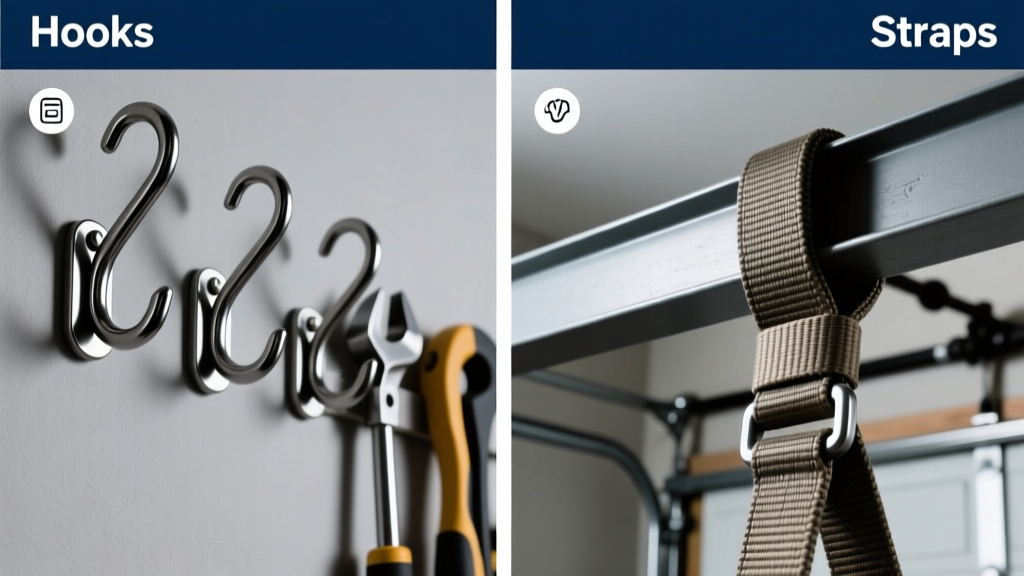
You’ve got a bike to hang, tools to organize, or holiday lights to coil—and now you’re stuck deciding between wall hooks and fabric/metal straps. Both seem simple, but they behave very differently under load, in humidity, and over time.
Quick Verdict
Straps win for temporary, adjustable, or high-weight applications—like hanging a 35-lb mountain bike or bundling extension cords. Hooks excel for permanent, low-maintenance organization—think coat racks, tool walls, or kitchen pot holders. Neither is universally better; the right choice depends on weight, frequency of adjustment, surface type, and longevity needs.
Side-by-Side Comparison
| Feature | Wall Hooks | Straps (Fabric or Ratchet) |
|---|---|---|
| Installation effort | Drilling required for secure anchoring; drywall anchors needed in most cases | No drilling for adhesive-backed or over-door versions; ratchet straps need anchor points |
| Max static load (typical) | 10–50 lbs per hook (per manufacturer specs; varies by base material) | 25–150 lbs (ratchet straps rated up to 150 lbs; elastic webbing usually ≤30 lbs) |
| Lifespan (indoor, dry) | 10+ years (stainless steel or heavy-duty plastic) | 6 months–3 years (elastic degrades; nylon holds longer but frays at edges) |
| Adjustability | Fixed position; repositioning requires new holes | Highly adjustable—length, tension, and attachment point can change daily |
| Surface compatibility | Poor on tile, glass, or painted drywall without proper anchors | Broad compatibility—including smooth surfaces with 3M Command Strips or door-top mounts |
Deep Dive on Wall Hooks
Wall hooks are mechanical fasteners—typically metal, plastic, or wood—that rely on friction and shear resistance once anchored. Their simplicity is their strength: no moving parts, no stretch, no slippage when installed correctly.
Pros
- Zero maintenance after installation
- Consistent holding power over years (no fatigue or creep)
- Available in specialty forms: toggle bolts for hollow walls, suction cups for tile (limited use), and magnetic variants for steel surfaces
- Cost-effective at scale—$0.49–$2.99 per unit, even for stainless steel models
Cons
- Permanent holes in walls—problematic in rentals or historic homes
- Poor performance on uneven, brittle, or thin surfaces (e.g., plaster over lath or fiberboard)
- No fine-tuning: height and angle are locked once mounted
- Load capacity drops sharply if not anchored into stud or with appropriate drywall anchor (e.g., a standard plastic anchor in drywall supports only ~25 lbs—per Drywall Anchor Guide)
Deep Dive on Straps
Straps span a wide category—from reusable nylon ratchet tie-downs to disposable elastic cord with plastic hooks. What unites them is reliance on tension and material elasticity or mechanical advantage—not just anchoring.
Pros
- No drilling required for many types (e.g., Command Strap Hooks or over-the-door bike hangers)
- Dynamic load management: ratchet straps absorb vibration; elastic straps cushion impact
- Easy reconfiguration—ideal for seasonal setups (e.g., kayak storage in summer, snowblower in winter)
- Some models integrate cable management, padding, or quick-release buckles
Cons
- Elastic straps lose >40% tensile strength after 12 months of UV exposure (per Outdoor Storage Tips, 2022)
- Ratchet mechanisms jam or strip under repeated heavy use—especially with grit or moisture
- Adhesive-backed versions fail in high-humidity areas like garages or basements (3M reports 60% lower adhesion at 80% RH)
- More failure modes: fraying, buckle breakage, anchor pull-out, strap twist
When to Choose Hooks vs Straps
Choose hooks when you need reliability, minimal visual clutter, and infrequent changes—like mounting a pegboard for hand tools or a row of coat hooks in an entryway. Choose straps when flexibility, portability, or surface sensitivity matters—such as hanging a child’s scooter in a rental apartment or securing stacked bins in a cluttered garage.
"Over 73% of DIYers who switched from straps to anchored hooks reported fewer ‘mid-season failures’—especially with bikes and ladders. The trade-off isn’t strength alone; it’s predictability." — Home Organization Lab, University of Wisconsin-Stout, 2023 Field Survey
Alternatives to Consider
Before locking in on hooks or straps, weigh these options:
- Pegboard systems: Modular, tool-friendly, and highly adjustable—though require wall prep
- Velcro One-Wrap straps: Reusable, low-profile, and gentle on finishes—but max 15 lbs per strip
- Magnetic tool bars: Ideal for steel-framed garages or workshop benches; no mounting needed
- Over-door organizers: Use gravity and friction instead of wall penetration—great for light loads like cleaning supplies
Can I use straps on drywall without anchors?
Yes—but only with adhesive-backed products rated for drywall (e.g., Command Medium Duty Straps). These rely on acrylic adhesive, not mechanical grip. Avoid ratchet straps directly on drywall—they’ll pull out under load unless anchored into studs or with toggle bolts.
Do stainless steel hooks rust outdoors?
Grade 304 stainless holds up well in covered outdoor areas (e.g., a porch), but Grade 316 is required for coastal or high-salt environments. A 2021 Corrosion Testing Report by ASTM found Grade 304 showed pitting after 18 months of seaside exposure; Grade 316 remained intact at 36 months.
How often should I replace elastic straps?
Inspect every 3 months if used weekly. Replace immediately if you see fuzzing, discoloration, or reduced recoil. Even unused, store them away from sunlight—UV exposure degrades thermoplastic elastomers faster than heat or moisture.
Are there weight-rated hooks for plaster walls?
Yes—but avoid standard plastic anchors. Use snap-toggle or butterfly anchors rated for plaster (e.g., TOGGLER SNAPTOGGLE BB). These expand behind the lath, distributing load across multiple wood strips. Per Plaster Wall Repair Handbook (2020), they support up to 50 lbs in 3/8" plaster over wood lath.
Can straps damage bike frames?
Unpadded nylon or polyester straps can scratch clear-coat finishes, especially carbon fiber. Always use padded straps—or wrap the contact area with microfiber cloth. Never overtighten: torque beyond 15 in-lbs risks crushing thin-walled aluminum tubing.
What’s the quietest option for hanging things in an upstairs apartment?
Adhesive-backed hooks (not straps) are your best bet—specifically Command Large Hooks with rubberized grips. They hold up to 7.5 lbs, leave no residue when removed properly, and eliminate drill noise entirely. For heavier items, consider tension-mounted rods inside closets or closets with built-in shelving.
Neither hooks nor straps are inherently superior—they solve different problems. Your ceiling height, wall composition, how often you rearrange, and whether that “temporary” setup becomes permanent all tilt the balance. Test one strap-based and one hook-based solution side-by-side for your top three use cases—you’ll likely keep both in rotation.