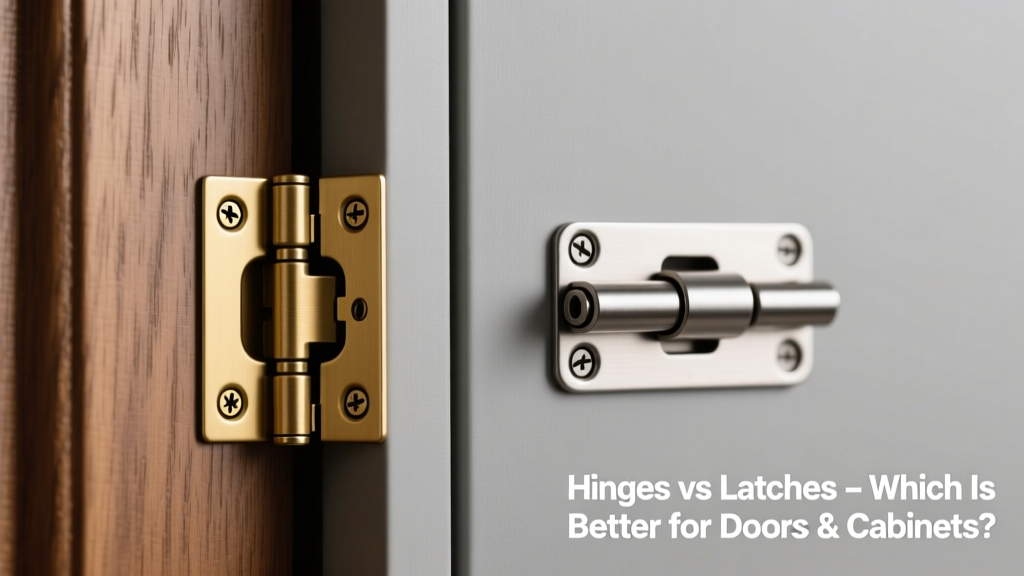
You’re standing in the hardware aisle—or scrolling through a supplier’s site—staring at two seemingly similar metal parts labeled 'hinge' and 'latch,' wondering which one actually belongs on your shed door, kitchen cabinet, or tool chest. They both hold things shut, right? Not quite. Their jobs are fundamentally different—and mixing them up leads to doors that won’t close, cabinets that swing open unexpectedly, or worse, compromised safety.
Quick Verdict
Hinges and latches aren’t interchangeable—they serve distinct mechanical roles. Hinges enable controlled rotation (like a door swinging), while latches secure position (like keeping that door closed). You almost always need both working together. Choosing one over the other isn’t about 'better'—it’s about matching function to purpose. A pantry door needs hinges and a latch; a barn door needs heavy-duty hinges but may skip the latch entirely if it’s meant to stay open.
Side-by-Side Comparison
| Feature | Hinges | Latches |
|---|---|---|
| Primary Function | Enable pivoting motion between two surfaces | Hold components in a fixed, closed position |
| Load-Bearing Capacity | High—supports full weight of door/cabinet front | Low to moderate—resists pull-open force only |
| Installation Location | Mounted along the vertical edge (or top/bottom for specialty uses) | Mounted on face frame, edge, or strike plate opposite hinge side |
| Typical Materials | Stainless steel, brass, zinc-plated steel | Steel, die-cast zinc, plastic (for low-duty applications) |
| Average Lifespan (residential use) | 25+ years with proper maintenance (U.S. Department of Housing and Urban Development, 2022) | 8–12 years; springs and cams wear faster under frequent use |
Deep Dive on Hinges
Hinges are rotational joints—mechanical pivot points that let one object swing relative to another. They come in dozens of types: butt, concealed (Euro), pivot, continuous (piano), and spring-loaded. Their strength lies in load distribution: a standard 3.5" stainless steel butt hinge can support up to 120 lbs per pair, making them indispensable for entry doors and tall cabinets.
Pros of Hinges
- Handle structural weight and repeated motion without fatigue (when correctly sized)
- Allow precise control over swing arc, clearance, and soft-close behavior
- Available in fire-rated, security-grade, and ADA-compliant versions
Cons of Hinges
- Require accurate mortising or surface mounting—misalignment causes binding or gaps
- Concealed hinges demand exact drilling templates; mistakes are hard to correct
- Pivot hinges need reinforced framing and floor/wall anchors—overkill for most interior doors
For cabinet doors where alignment and smooth operation matter most, concealed hinge installation is worth the learning curve. For exterior gates exposed to wind and rain, consider stainless steel hinges rated for marine environments.
Deep Dive on Latches
Latches are retention devices—not movement enablers. They engage via spring tension, magnetism, gravity, or manual cam action to prevent unintended opening. Common types include magnetic catches, roller latches, tubular latches (in doorknobs), and hook-and-eye sets. Unlike locks, most latches offer no real security—just convenience or light resistance.
According to the U.S. EPA estimates that 14% of household water usage is from leaks—including those caused by cabinet doors left ajar due to failed magnetic latches letting steam loosen seals. That’s why reliability matters—even in low-stakes applications.
“A latch isn’t a lock—it’s a positional limiter. If your cabinet door swings open when you yank a drawer below it, the issue isn’t the hinge alignment. It’s almost always insufficient latch retention.” — Sarah Lin, Cabinet Hardware Specialist, National Kitchen & Bath Association (2023)
Pros of Latches
- Simple, low-cost installation—often just two screws and a strike plate
- Enable soft-close, push-to-open, or silent engagement (e.g., Blum Tandembox latches)
- Available in child-safe, keyed, or adjustable-tension variants
Cons of Latches
- Wear out faster than hinges—especially spring mechanisms in high-cycle areas like laundry rooms
- Offer zero resistance against forced entry or strong drafts
- Magnetic latches lose holding power near heat sources or if paint builds up on contact surfaces
When to Choose Hinges vs Latches
Ask yourself: Does this component need to move—or just stay put? If movement is required (door, lid, gate), hinges are non-negotiable. If the goal is preventing drift, rattling, or accidental opening, add a latch—but never substitute it for a hinge.
- Choose hinges when: Installing an exterior door, mounting a heavy shed lid, or building a folding partition wall
- Choose latches when: Securing a lightweight cabinet door, holding a tool chest lid closed, or adding draft resistance to a screen door
- Use both when: Any standard interior door, bathroom vanity, or appliance garage door
- Consider neither when: A fixed panel, sliding barn door (uses track + rollers, not hinges/latches), or removable shelf bracket
Alternatives to Consider
Sometimes hinges and latches don’t cover your use case. Here are three functional alternatives:
- Pivots—used for full-height, frameless doors where weight and stability trump swing flexibility
- Sliding track systems—ideal for space-constrained closets or pocket doors (e.g., sliding door hardware)
- Gas struts—provide controlled lift-and-hold for heavy lids (e.g., on storage trunks or RV compartments)
Can I replace a hinge with a latch?
No—you’ll have no pivot point. The door or panel will flop, bind, or detach. A latch assumes the hinge is already doing its job.
Do all doors need both hinges and latches?
No. A commercial restroom stall door often uses only hinges and a privacy bolt (not a latch). A workshop roll-up door relies on tension springs and guide tracks—not latches. Context defines necessity.
Why does my cabinet door sag even with good hinges?
Sag usually points to hinge screw pull-out (especially in particleboard), undersized hinges (<3” for doors >24” wide), or inconsistent mounting depth. Latch failure won’t cause sag—it might just let the sagging door swing further open.
Are there hybrid hinge-latch products?
Yes—but they’re niche. Examples include self-latching hinges (like certain storm door models) and integrated hinge/catch assemblies for RV cabinets. These simplify installation but limit adjustability and repair options.
How tight should a latch hold?
Tight enough to resist vibration and minor bumps—but not so tight it strains the hinge or requires excessive force to open. For kitchen cabinets, 2–4 lbs of pull force is typical. Use a fish scale to test; anything over 6 lbs risks premature wear.
What’s the most common hinge-and-latch mismatch?
Using lightweight roller latches on tall, heavy cabinet doors. The latch holds, but the door’s momentum during closing bends hinge screws or cracks the cabinet frame. Match latch strength to door mass and frequency of use.
Hardware choices ripple outward: a poorly chosen hinge stresses adjacent joinery; a weak latch invites moisture damage or tripping hazards. Neither is ‘better’—but understanding their physics helps you specify confidently. Whether you’re rebuilding a shed door or upgrading kitchen cabinets, start with motion first (hinges), then retention (latches), and always cross-check load specs against real-world use.