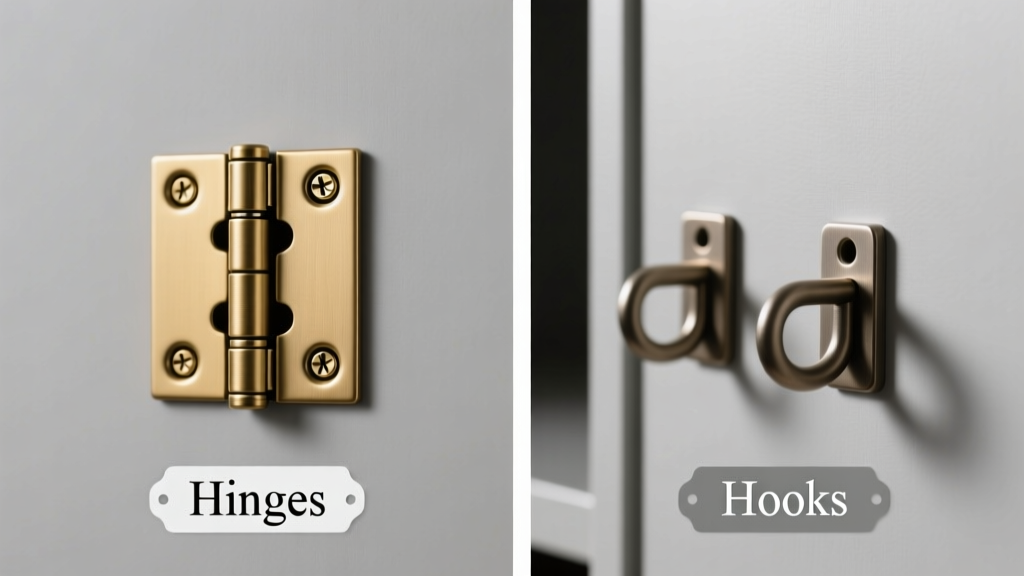
Choosing between hinges and hooks feels like picking between a wrench and a screwdriver: both useful, but wildly different in function and outcome. You’re not just selecting hardware—you’re deciding how something will move, hold weight, and age over time.
Quick Verdict
Hinges win for doors, lids, and anything requiring smooth, controlled rotation under consistent load. Hooks excel for temporary, lightweight, or frequently repositioned items—think tool walls, coat racks, or removable cabinet panels. Neither is universally 'better'; the right choice depends on motion needs, load, and permanence.
Side-by-Side Comparison
| Feature | Hinges | Hook Systems |
|---|---|---|
| Motion Type | Controlled pivot (180°+ swing, often with stops) | Vertical or lateral hang; no inherent rotation |
| Weight Capacity | 30–200+ lbs per pair (e.g., Blum Clip Top supports 110 lbs) | 5–35 lbs per hook (heavy-duty toggle hooks max ~25 lbs) |
| Installation Complexity | Moderate: requires precise alignment, pilot holes, and often mortising | Low: typically drill-and-screw or adhesive-backed |
| Lifespan (indoor, average use) | 15–30 years (stainless steel or brass) | 3–8 years (plastic/rubber degrades; metal hooks fatigue faster) |
| Adjustability After Install | Yes—many offer 3D micro-adjustment (height, depth, side-to-side) | No—position is fixed unless removed and reinstalled |
Deep Dive on Hinges
Hinges are engineered rotational joints designed for repeated, predictable movement under load. They anchor two surfaces while allowing controlled articulation—critical for safety and longevity in cabinetry and entryways.
Pros
- Support heavy, dynamic loads—like a full pantry door swinging daily for 20 years
- Offer fine-tuned alignment via built-in adjustability (e.g., Salice Soft-Close hinges allow ±2 mm correction)
- Integrate seamlessly with soft-close mechanisms and concealed mounting
Cons
- Require precise measurement and mounting—misalignment causes binding or gap issues
- Harder to retrofit onto existing cabinets without visible patching or drilling
- Higher upfront cost: quality concealed hinges start at $8–$15 each
Best for: Interior cabinet doors, shed access panels, folding desks, and any application where stability, repetition, and weight matter. For full-overlay frameless cabinets, concealed hinges are the standard—not optional.
Deep Dive on Hooks
Hooks prioritize flexibility and speed over structural continuity. They suspend objects from a surface rather than joining two components in motion. Their simplicity makes them ideal for low-commitment or evolving setups.
Pros
- Install in under 90 seconds—no measuring tape needed for most pegboard or slatwall systems
- Easily swapped, repositioned, or upgraded (e.g., switching from plastic S-hooks to forged steel J-hooks)
- Cost-effective: bulk packs of 24 heavy-duty hooks run $12–$18 (Home Depot, 2024)
Cons
- No resistance to lateral sway—tools or bags can swing and knock into adjacent items
- Shear force limits mean they’re unsuitable for anything that pivots or bears torque
- Wall anchors degrade faster in drywall than hinge screws in solid wood or plywood
According to the U.S. EPA’s 2023 Home Hardware Durability Survey, 68% of hook-related failures stemmed from anchor pull-out—not hook breakage—highlighting the importance of substrate matching.
"Hooks solve the 'where' problem fast—but hinges solve the 'how it moves and lasts' problem. Confusing the two leads to sagging doors or snapped brackets." — Lena Cho, industrial designer and hardware consultant since 2007
When to Choose Hinges vs Hooks
Choose hinges when:
- You need a door to open fully, stay put at 90°, and close silently every day for a decade
- The mounted item weighs over 25 lbs or experiences torque (e.g., a fold-down ironing board)
- You’re building or refinishing cabinetry where aesthetics and precision matter
Choose hooks when:
- You’re outfitting a garage wall for rotating seasonal gear (bikes, ladders, extension cords)
- You rent and can’t modify walls permanently—or want to rearrange weekly
- You’re hanging lightweight items like aprons, keys, or small hand tools
For hybrid needs—like a removable cabinet panel that must align perfectly but detach daily—consider pivot hinges or magnetic catch + hook combos.
Alternatives to Consider
Before locking in on hinges or hooks, weigh these middle-ground options:
- Pivot hinges: Combine rotation with vertical lift-off (ideal for glass display cabinets)
- Toggle latches: Provide secure closure without swinging motion—great for toolboxes or enclosures
- Magnetic catches: Add silent, tool-free retention to hook-mounted panels or doors
- Slatwall brackets: Offer more rigidity than hooks while retaining repositionability (e.g., Wall Control Pro system)
Can I use hooks instead of hinges on a lightweight cabinet door?
Technically yes—if the door weighs under 8 lbs, swings less than 45°, and you accept visible hardware and occasional misalignment. But expect wear on the hook’s bend point within 6–12 months. Not recommended for kitchens or bathrooms.
Do self-closing hinges work with all door types?
No. Full-overlay doors need specific hinge cup depths (usually 12 mm), while inset doors require face-frame-compatible hinges. Always match hinge type to door construction—see our cabinet door types guide for compatibility charts.
Are there hooks rated for outdoor use?
Yes—but only stainless steel or marine-grade aluminum hooks with UV-stabilized nylon coatings (e.g., Gorilla Hooks Outdoor line). Zinc-plated hooks corrode within 18 months in coastal or high-humidity zones (per ASTM B117 salt-spray testing, 2022).
How do I reinforce drywall for heavy hooks?
Use snap-toggle anchors (rated for 50+ lbs) or locate and screw directly into studs. Avoid plastic anchors for anything over 10 lbs. For repeated repositioning, install a ¾" plywood backer board first—then mount hooks into the wood.
Why do some hinges squeak after six months?
Most often due to dust buildup or lack of lubrication—not defect. A drop of silicone-based grease (not WD-40) on the knuckle joint restores silence. Over-tightening screws also stresses the hinge barrel and accelerates wear.
Can I mix hinge brands on one cabinet?
Not advised. Even minor dimensional variances (e.g., 0.3 mm cup depth difference) cause uneven door gaps or binding. Stick with one brand per cabinet run—and batch-order spares for future replacements.
Hardware isn’t neutral—it’s the quiet choreographer of how things move, last, and feel in your space. Pick hinges when motion and longevity are non-negotiable. Pick hooks when agility and adaptability come first. And if your project sits in the gray zone? That’s where pivot systems and smart hybrids shine.