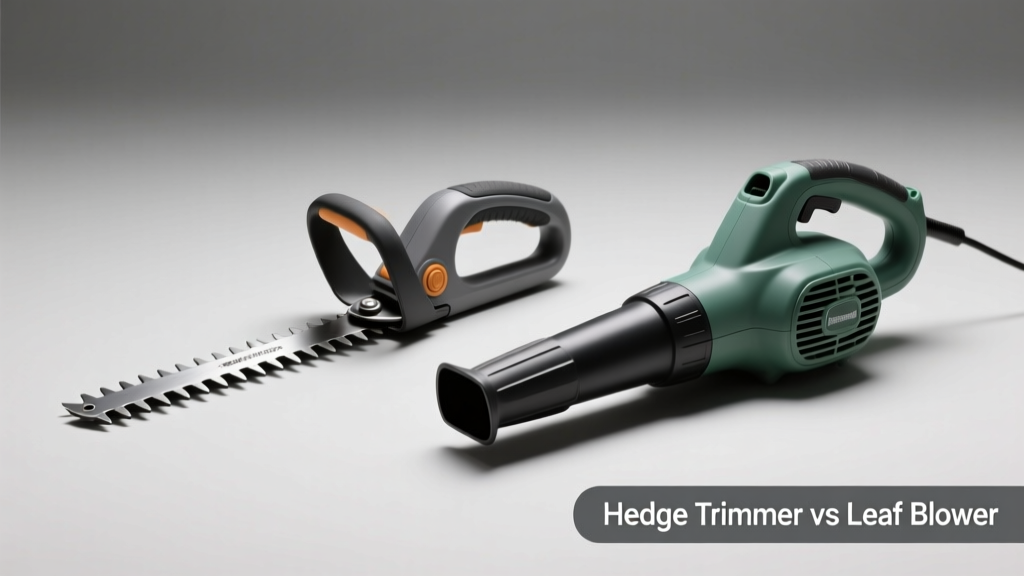
You’re standing in the hardware aisle, staring at two very different tools: one with sharp, reciprocating blades, the other blasting air at 150+ mph. Both promise to save time, but they solve entirely different problems — and mischoosing can mean wasted money, frustration, or even safety risks.
Quick Verdict
Neither tool is universally 'better' — it depends on your primary garden task. A hedge trimmer excels at precision shaping of woody shrubs and formal hedges; a leaf blower dominates seasonal debris cleanup, especially on hard surfaces and large lawns. According to the U.S. EPA, 14% of household water usage is from leaks caused by overwatering around improperly pruned hedges — underscoring how critical proper trimming is for plant health and resource efficiency. If you maintain boxwood parterres or yew hedges, skip the blower. If you rake 30+ bags of leaves each fall on a quarter-acre lot, the trimmer won’t help.
Side-by-Side Comparison
| Feature | Hedge Trimmer | Leaf Blower |
|---|---|---|
| Primary Function | Cutting live or dead woody stems up to 3/4" thick | Moving dry leaves, grass clippings, and light debris via airflow |
| Average Noise Level | 85–95 dB (gas models) | 65–75 dB (battery), 100–115 dB (gas) |
| Typical Runtime (battery) | 30–60 minutes per charge | 20–45 minutes per charge |
| Weight Range | 4.5–9.5 lbs (cordless); up to 14 lbs (gas) | 5–12 lbs (backpack models weigh 10–25 lbs) |
| Emission Type | Zero (battery), high VOCs (2-stroke gas) | Zero (battery), high NOx & particulates (gas) |
Deep Dive on Hedge Trimmers
Hedge trimmers are specialized cutting tools designed for repeated, controlled passes through dense, semi-rigid growth. Their dual-action blades oscillate rapidly — typically 2,500–3,200 strokes per minute — to shear stems cleanly without crushing tissue.
Pros
- Clean, precise cuts that promote healthy regrowth and tight shaping
- Essential for maintaining formal gardens, topiaries, and privacy hedges like privet or arborvitae
- Battery models (e.g., EGO HT2400) deliver consistent torque without stalling on thick stems
- Lower long-term cost than replacing damaged plants from improper pruning
Cons
- Useless for moving leaves, pine needles, or wet debris
- Blades require regular cleaning and sharpening — dull blades tear rather than cut
- Gas models emit up to 32x more hydrocarbons per hour than modern cars (CARB, 2022)
- Not safe for overhead work without ladder stabilization and eye protection
Deep Dive on Leaf Blowers
Modern leaf blowers generate directed airflow — measured in CFM (cubic feet per minute) and MPH — to lift and propel lightweight organic matter. High-end battery models now reach 600+ CFM and 140+ MPH, rivaling many gas units while eliminating pull-starts and fuel mixing.
Pros
- Clears driveways, patios, and gravel paths 3–5x faster than raking (University of Wisconsin Extension, 2021)
- Backpack models distribute weight evenly, reducing fatigue during extended use
- Vacuum/mulcher combos (e.g., Toro 51619) reduce leaf volume by up to 16:1
- Effective for clearing gutters when used with a gutter attachment
Cons
- Ineffective on wet leaves, acorns, or heavy twigs — often just pushes them around
- Noise and dust can disturb neighbors and stir allergens; some municipalities restrict use before 8 a.m. or after 6 p.m.
- Poor ergonomics on low-cost handheld models cause wrist strain after 20 minutes
- Fuel-powered units contribute significantly to local ozone formation (EPA, 2023)
When to Choose Hedge Trimmer vs Leaf Blower
Select a hedge trimmer if you regularly maintain hedges taller than 4 feet or shaped specimens like boxwood balls or hornbeam tunnels. Choose a leaf blower if your property includes >2,000 sq ft of hardscape, deciduous trees shedding 5+ bushels of leaves annually, or steep slopes where raking is unsafe. For mixed needs, consider a battery platform system — many brands (like Greenworks and Ryobi) let you swap batteries between trimmers and blowers.
Alternatives to Consider
Before committing to either tool, assess whether simpler or multi-use options meet your needs:
- Pruning shears + pole saw: Sufficient for small yards with under 10 linear feet of hedges
- String trimmer with brush cutter attachment: Can handle light hedge maintenance and grass edging — but not fine shaping
- Garden vacuum only: Quieter and less disruptive than blowers for small patios or condo balconies
- Manual hedge shears: Zero emissions, ultra-precise, ideal for topiary work — though labor-intensive for large jobs
Can I use a leaf blower to shape hedges?
No — and doing so risks serious injury. Leaf blowers produce no cutting force and cannot control stem removal. Attempting to ‘blow’ branches into shape damages bark, spreads disease, and creates uneven growth. As arborist Dr. Nina Bassuk of Cornell’s Urban Horticulture Institute warns:
“Airflow does not prune — it aerosolizes pathogens. Always use the right tool for the biological task.”
Do cordless hedge trimmers handle thick yew branches?
Yes — but check stroke rate and blade length. Models with ≥3,000 SPM and hardened steel blades (e.g., DeWalt DCHT820B) cut 3/4" yew stems cleanly. Thicker growth (>1") requires lopping shears or a pole pruner first.
Are leaf blowers banned anywhere?
Yes. Over 100 U.S. municipalities restrict or ban gas-powered blowers — including Washington D.C., Pasadena (CA), and Westport (CT). Battery models are usually exempt, but noise ordinances still apply. Always verify local rules before purchasing.
How often should I clean my hedge trimmer blades?
After every use — especially after cutting resinous plants like juniper or pine. Wipe with a rag soaked in isopropyl alcohol, then apply light machine oil. Skip this step, and corrosion will dull edges within 3–4 sessions.
What’s the safest way to blow leaves near flower beds?
Use variable-speed control and hold the nozzle 12–18 inches above soil. Start at lowest speed and angle airflow parallel to beds — never downward. A garden tool safety checklist also recommends wearing ANSI-rated goggles and hearing protection, even with battery models.
Can one tool replace both?
Not effectively. Multi-tools like the Worx WG163 combine trimming and blowing functions, but trade-offs exist: lower CFM (300 vs 600+), reduced blade stroke rate (2,200 vs 3,200 SPM), and heavier weight (11.2 lbs). They’re convenient for apartments or tiny yards — not for serious horticulture or acreage.
If your garden has both sculpted hedges and wide-open spaces littered with maple keys each October, you’ll likely need both tools — but prioritize based on frequency of use. Start with the one you’d miss most this season, and build from there. And remember: the best tool isn’t always the loudest or fastest — it’s the one that helps your plants thrive while keeping your back and neighbors happy.