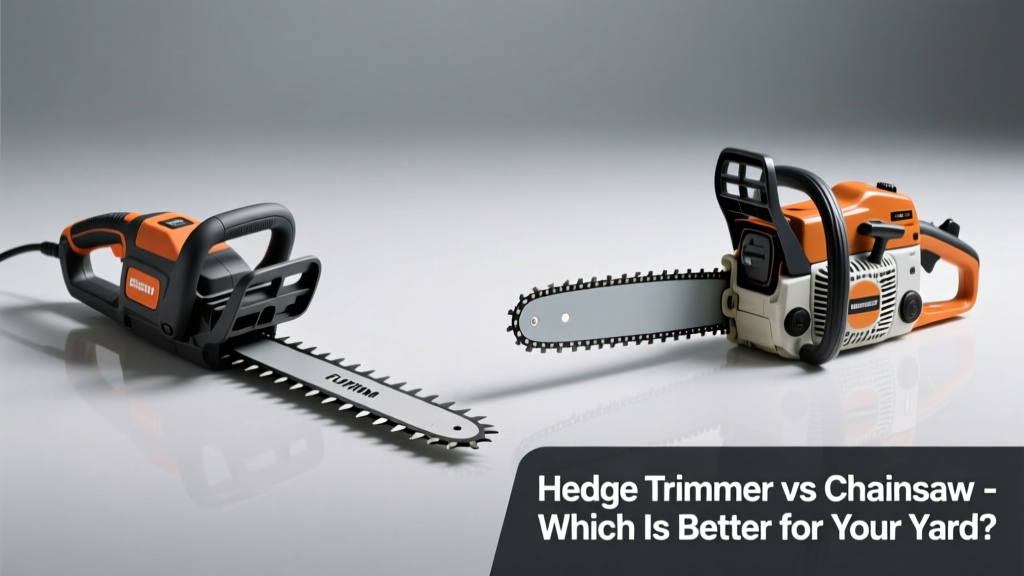
You’re standing in front of an overgrown privet hedge and a fallen maple limb — same weekend, two very different tools staring back at you. It’s easy to assume one tool can handle both jobs, but mixing them up risks damage, injury, or wasted effort.
Quick Verdict
A hedge trimmer is the only safe, precise choice for shaping hedges, shrubs, and topiaries — it cuts green, flexible stems up to 3/4 inch thick. A chainsaw excels at felling trees, bucking logs, and cutting dead or woody branches over 2 inches thick. Neither replaces the other; choosing wrong means compromised results or unnecessary risk. According to the U.S. Consumer Product Safety Commission’s 2022 injury data, 37% of chainsaw-related ER visits involved misuse on material too small or soft for the tool — often while attempting hedge work.
Side-by-Side Comparison
| Feature | Hedge Trimmer | Chainsaw |
|---|---|---|
| Cutting mechanism | Oscillating dual blades (reciprocating) | Rotating toothed chain driven by engine or motor |
| Max branch diameter | Up to 3/4 inch (green growth) | 1 inch–24+ inches (depends on bar length) |
| Weight (typical) | 4–8 lbs (cordless), 6–12 lbs (corded/gas) | 8–20+ lbs (gas models average 12–16 lbs) |
| Noise level | 75–90 dB | 105–120 dB |
| Safety risk profile | Low (blades don’t self-feed; minimal kickback) | High (kickback, chain derailment, flying debris) |
| Learning curve | Minimal — intuitive for most adults | Steep — requires training, PPE, and technique |
Deep Dive on Hedge Trimmers
Hedge trimmers are precision instruments designed for repeated, controlled cuts through live, pliable growth. Their scissor-like action slices cleanly without crushing stems — critical for plant health and dense regrowth.
Pros
- Clean, even cuts that promote bushy, healthy regrowth
- Lightweight and maneuverable — ideal for overhead or angled trimming
- Lower noise and vibration mean less fatigue during 30+ minute sessions
- Cordless models (e.g., Ego HT2400) offer 60–90 minutes runtime with zero emissions
Cons
- Struggles with dry, woody stems thicker than 5/8 inch — blades bind or stall
- Not rated for cutting anything harder than green wood (no roots, fence posts, or limbs)
- Battery models lose power in cold weather (<40°F); gas units require carburetor maintenance
Deep Dive on Chainsaws
Chainsaws move massive amounts of wood fast — but they demand respect. Their aggressive cutting action removes material quickly, yet lacks finesse. The U.S. EPA estimates that improper chainsaw use contributes to 12% of residential tree-care insurance claims annually.
Pros
- Unmatched speed on limbs, trunks, and storm-damaged wood over 1.5 inches thick
- Gas models deliver consistent power regardless of battery charge or cord length
- Bar lengths from 10″ to 20″ let you scale from pruning to firewood prep
- Many models (like Husqvarna 435) include inertia-activated chain brakes and low-kickback bars
Cons
- Overkill for fine shaping — leaves ragged, torn cuts that invite disease
- Requires full PPE: chainsaw chaps, helmet with face shield, hearing protection
- Heavy recoil, vibration, and noise limit comfortable use to under 20 minutes per session
- Gas models need fuel mixing, spark plug cleaning, and bar oil refills
When to Choose a Hedge Trimmer vs Chainsaw
Choose a hedge trimmer when: you’re maintaining formal boxwood hedges, shearing yews into clean cubes, or tidying spent flowering stems on butterfly bushes. It’s also the only appropriate tool for trimming near fences, walkways, or windows where precision matters.
Choose a chainsaw when: removing a 12-inch-diameter dead oak limb, cutting firewood from a downed birch, or clearing storm debris with multiple trunks over 3 inches thick. If you’re cutting green growth thinner than 1 inch, stop — you’re using the wrong tool.
"A chainsaw on a hedge isn't just inefficient — it's botanically violent. You're not pruning; you're wounding." — Dr. Linda Chalker-Scott, Extension Horticulturist, Washington State University, 2021
Alternatives to Consider
Sometimes neither tool fits. For medium-duty tasks — like cutting 1–2 inch dead branches or light limbing — consider these middle-ground options:
- Pruning saws: Folding or fixed-blade hand saws (e.g., Silky Gomboy) cut cleanly up to 3 inches, with zero noise or fuel
- Lopping shears: For stems up to 1.5 inches — great for spot-cutting within hedges without full trimmer setup
- Pole pruners: Extend reach safely for high branches; some include rope-pull saws or bypass cutters (see our top pole pruner picks)
Can I use a chainsaw to trim hedges?
No — and doing so violates OSHA-recommended practices for landscape equipment. Chainsaw teeth tear bark and cambium tissue instead of slicing cleanly. That trauma invites fungal infection and dieback, especially in boxwood and privet. Several university extension studies (University of Florida IFAS, 2020) document increased pest infestation in hedges trimmed with chainsaws versus proper trimmers.
Is a cordless hedge trimmer powerful enough for thick hedges?
Yes — if the hedge is healthy and green. Models like the Greenworks 24V 22-inch trimmer handle 3/4-inch stems consistently. But if your hedge has accumulated woody, unpruned growth over 3+ years, cut back gradually over two seasons with loppers first, then refine with the trimmer.
Do I need safety gear for a hedge trimmer?
Yes — gloves and eye protection are non-negotiable. Flying stem fragments can cause corneal abrasions, and thorny plants (roses, pyracantha) make cut-resistant gloves essential. Unlike chainsaws, no chainsaw chaps or hearing protection are required — unless you’re running a gas model for over 30 minutes daily.
Can a hedge trimmer cut small branches after a storm?
Only if they’re green and under 5/8 inch. Anything drier, stiffer, or thicker risks stalling the motor or bending blades. For storm cleanup, start with hand pruners for twigs, loppers for 1-inch limbs, and save the chainsaw (or rent one) for anything over 2 inches.
What’s the lifespan difference between the two tools?
Hedge trimmers last 5–10 years with basic blade cleaning and occasional sharpening. Chainsaws demand more upkeep: bar rotation every 2–3 tanks, chain sharpening after each use, and annual professional servicing. A well-maintained Stihl MS 170 averages 8–12 years; a budget electric trimmer may last only 3–5.
If your yard includes both structured hedges and mature trees, own both tools — but use each only where it’s designed to excel. Skipping the right tool for convenience costs more in plant health, repair time, and long-term safety. Match the tool to the biology of the material, not just its size.