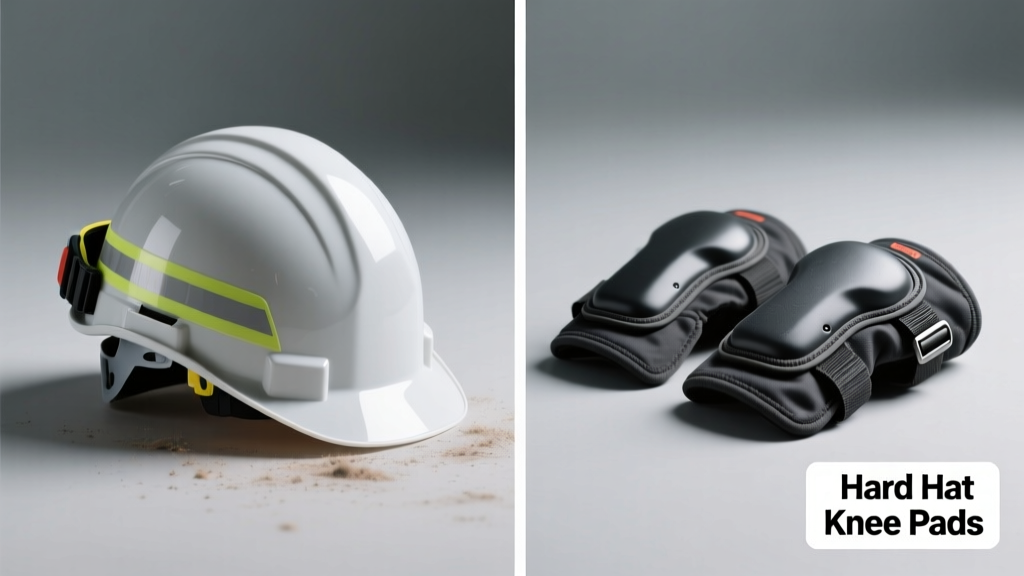
You’re standing on a concrete slab, laying tile in a new commercial build. Your knees ache after 90 minutes. A coworker taps his hard hat as a beam gets hoisted overhead. You wonder: Do I need both? Or is one enough — and which one matters more right now?
Quick Verdict
Neither is "better" — they protect entirely different body parts against unrelated hazards. A hard hat prevents skull fractures from falling objects or bumps; knee pads reduce joint wear, abrasions, and long-term osteoarthritis risk. According to the Bureau of Labor Statistics’ 2023 Census of Fatal Occupational Injuries, head injuries accounted for 9% of all workplace fatalities, while knee-related musculoskeletal disorders made up 17% of non-fatal lost-time injuries in construction. You don’t choose between them — you assess whether your task exposes your head, knees, or both.
Side-by-Side Comparison
| Feature | Hard Hat | Knee Pads |
|---|---|---|
| Primary Protection Target | Skull and scalp | Patella, tibial tuberosity, and surrounding soft tissue |
| OSHA Requirement (General Industry) | Yes, in areas with falling object or electrical hazard risk (29 CFR 1910.135) | No federal OSHA mandate — but required under ANSI/ISEA Z87.1-2022 for specific kneeling tasks |
| Average Lifespan (with normal use) | 5 years (or sooner if impacted, exposed to UV/solvents) | 6–12 months (depends on surface abrasion and foam compression) |
| Typical Cost Range | $15–$85 (basic polyethylene to vented, suspension-adjustable models) | $20–$120 (strap-on foam to gel-cushioned, tool-belt-integrated designs) |
| Key Failure Mode | Crack or deformation after impact; degradation from UV exposure | Loss of padding resilience; strap stretch or buckle failure |
Deep Dive on Hard Hats
Hard hats are engineered to absorb and disperse energy from impacts up to 400 joules — roughly equivalent to a 2.2-lb wrench dropped from 6 feet. They’re tested per ANSI/ISEA Z89.1-2023 standards for penetration resistance, electrical insulation (Class C, E, or G), and lateral deformation.
- Pros: Proven reduction in fatal head injuries; lightweight (most weigh under 14 oz); integrates with face shields, ear muffs, and headlamps
- Cons: Offers zero protection below the neck; ineffective against low-velocity rolling objects or sustained pressure; sweat buildup causes discomfort during extended wear
- Ideal for: Roofing, steel erection, electrical work, excavation zones, and any site where overhead hazards exist — even temporarily, like during material delivery or crane lifts
According to the Insurance Institute for Business & Home Safety’s 2023 report, workers wearing compliant hard hats reduced severe head injury risk by 65% in environments with moderate falling-object exposure.
Deep Dive on Knee Pads
Knee pads cushion repetitive contact — think tile setters averaging 1,200+ kneels per 8-hour shift, or HVAC techs crawling through tight mechanical rooms. Unlike hard hats, their value isn’t about preventing acute trauma but mitigating cumulative damage. The U.S. National Institute for Occupational Safety and Health (NIOSH) estimates that prolonged kneeling increases knee osteoarthritis risk by 3.5× compared to non-kneeling trades.
- Pros: Reduce peak pressure on patellofemoral joints by up to 70% (per University of Michigan Ergonomics Lab, 2022); improve stability on uneven surfaces; many models include tool loops or magnetic pockets
- Cons: Can slip or ride up during dynamic movement; poor fit causes chafing or nerve compression; not designed for high-impact falls
- Ideal for: Flooring installers, plumbers working under sinks, drywall finishers, and utility technicians accessing underground vaults or crawlspaces
When to Choose Hard Hat vs Knee Pads
Choose a hard hat when overhead hazards are present — even intermittently. Choose knee pads when you’ll spend >30 minutes/hour on your knees across hard, abrasive, or uneven surfaces. But here’s the reality: many jobs demand both. For example:
- A solar panel installer on a sloped roof needs a hard hat (falling tools, rafter edges) and knee pads (gravel ballast, metal flashing)
- A concrete finisher on a fresh pour requires a hard hat (crane-swing zone) but not knee pads — unless finishing edges on hands-and-knees
- A warehouse stocker navigating narrow aisles with overhead racks needs a hard hat — but knee pads only during pallet-floor repairs
Alternatives to Consider
Depending on your role, supplemental or hybrid solutions may outperform standalone options:
- Knee pads with rigid outer shells — better for sharp debris (e.g., rebar stubs), but less flexible than foam-only versions
- Full-body harnesses with integrated knee padding — used in roofing or telecom tower work where fall arrest and joint protection overlap
- Ergonomic kneeling mats — portable, non-PPE option for short-duration indoor tasks (e.g., carpet repair), though not OSHA-recognized as PPE
Can knee pads replace a hard hat in low-ceiling spaces?
No. Knee pads provide zero structural resistance to impact above the waist. In confined spaces like boiler rooms or ductwork, head clearance is still a hazard — and hard hats are rated for vertical impact absorption. Knee pads won’t deflect a dropped socket or bent conduit.
Do hard hats expire even if unused?
Yes. Most manufacturers recommend replacing hard hats after 5 years from date of manufacture — regardless of visible wear — because UV exposure and ambient heat degrade the shell’s polymer matrix. Check the date stamp inside the brim (usually laser-etched near the sweatband).
Are there knee pads approved for electrical work?
Not as standalone PPE — but some models (like the Klein Tools Kneepads with Class 0 rating) pair with electrically insulated boots and gloves to meet ASTM F1506 requirements for arc-flash zones. Always verify full ensemble compliance with your site safety officer.
Can I wear both without overheating?
Yes — but prioritize breathability. Look for hard hats with 6+ ventilation ports and knee pads with perforated neoprene or mesh backing. A 2021 NIOSH field study found workers wearing both pieces of PPE maintained core temps within safe limits when using moisture-wicking base layers and scheduled 10-minute shade breaks every 50 minutes.
What’s the biggest mistake people make with either item?
"The most common error isn’t skipping PPE — it’s misusing it. We see hard hats worn backward (disrupting suspension geometry) and knee pads strapped too loosely (causing lateral knee shear). Both defeat engineering intent." — Lena Cho, CSP, Senior Safety Engineer at Bechtel Construction (2024)
How often should I inspect each piece?
Inspect hard hats daily for cracks, dents, or fading; check suspension webbing for fraying. Knee pads need weekly checks: press foam firmly — if it doesn’t rebound within 2 seconds, replace. Also examine straps for elasticity loss and buckles for smooth engagement.
If your job involves overhead work, kneeling, or both, skip the false choice. Start with the hazard assessment — then equip accordingly. And remember: PPE is your last line of defense, not your first. Pair hard hats and knee pads with proper staging, material handling protocols, and task rotation to truly reduce risk.